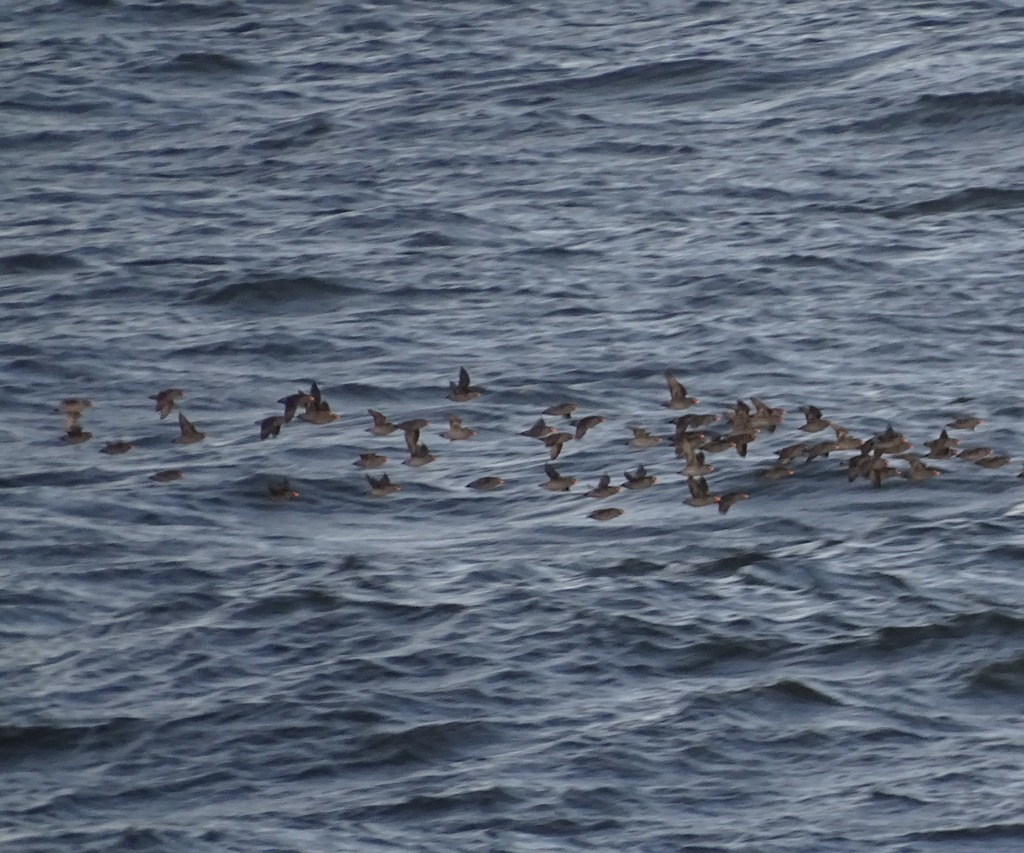
Crested Auklet
Photo © Sandra Keller
Photo © Sandra Keller — CC BY 4.0 — Source: iNaturalist #370797017The crested auklet (Aethia cristatella) is a small seabird of the family Alcidae, distributed throughout the northern Pacific and the Bering Sea. The species feeds by diving in deep waters, eating krill and a variety of small marine animals. It nests in dense colonies of up to 1 million individuals in the Bering Sea and the Sea of Okhotsk. It often breeds in mixed-species colonies with the least auklet, a smaller congener. The species is known for its sexual ornaments, found in both males and females. These include colorful plumage with a forehead crest, a striking scent recalling citrus fruit, and a loud trumpet call, all of which appear to have evolved through sexual selection. The total population is around 6 million, almost half in North America. It is in general considered to be of least concern, though the Alaskan population faces additional threats from predation and oil spills. == Taxonomy == The crested auklet was first described as Alca cristatella in 1769 by the German zoologist Peter Simon Pallas. The specific epithet cristatella is Neo-Latin for "little crested" from Latin cristatus "crested" or "plumed". It is now placed in the genus Aethia that was introduced by the German naturalist…
St. Paul Island
Saint Paul, United States
+255 birds+8 mammals
Windswept tundra rolls across this remote Pribilof island, where volcanic basalt cliffs plunge into the Bering Sea and fog rolls in thick enough to erase the…
VIEW PROTECTED LANDSCAPEKodiak National Wildlife Refuge
United States
+221 birds+22 mammals
Where temperate rainforest meets subarctic coast, Kodiak National Wildlife Refuge sprawls across Alaska's largest island, a sanctuary defined by steep valleys carved by tidewater glaciers and…
VIEW WILDLIFE SANCTUARYAlaska Maritime National Wildlife Refuge
Alaska, United States
+391 birds+58 mammals
Where the North Pacific collides with Alaska's rugged coastline, a sprawling archipelago of islands, rocky outcrops, and coastal headlands forms one of North America's most remote…
VIEW WILDLIFE SANCTUARYIzembek National Wildlife Refuge
Cold Bay, United States
+138 birds+9 mammals
Where the Aleutian archipelago reaches westward into the Bering Sea, subarctic tundra and shallow coastal waters converge to create one of Alaska's most ecologically vital wildlife…
VIEW WILDLIFE SANCTUARYNo community photos yet. Log in to add the first one.
No community observations of this species yet.