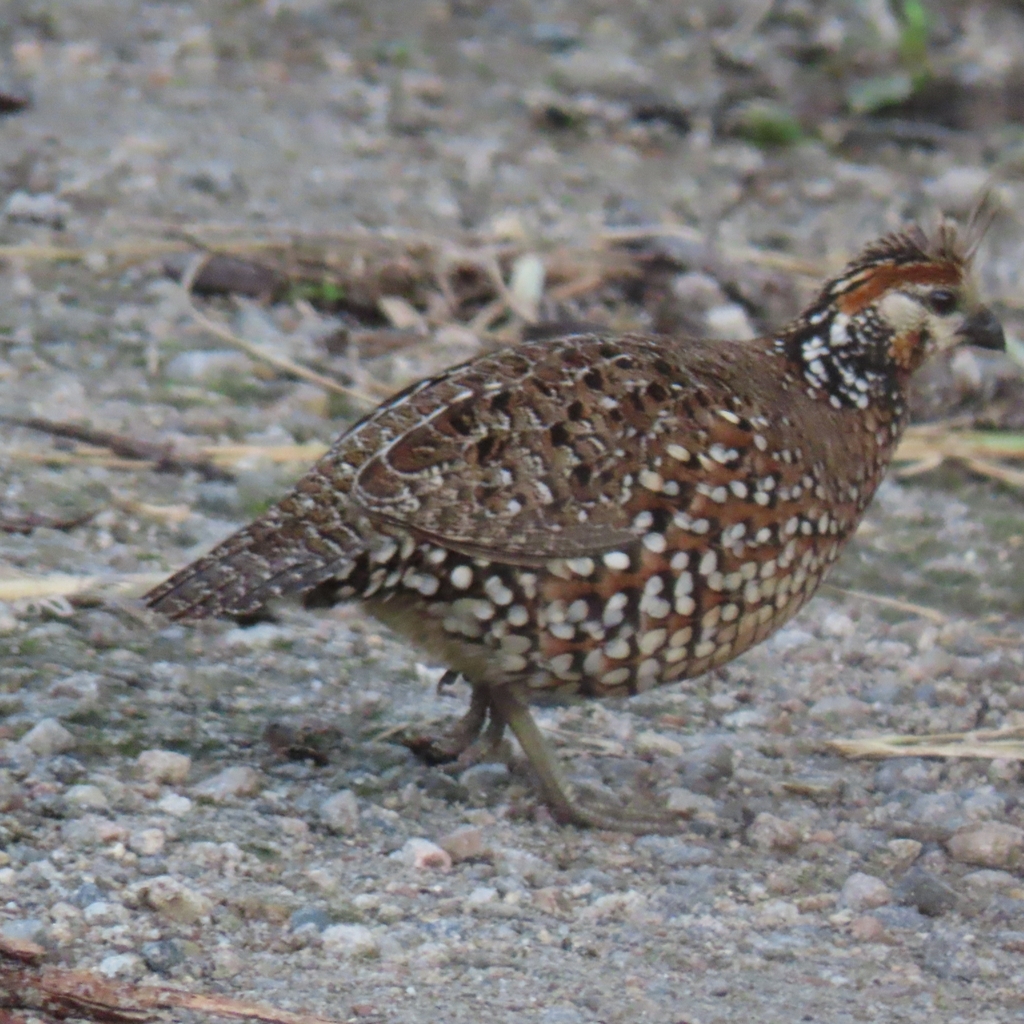
Crested Bobwhite
Photo © Maria Janeiro
Photo © Maria Janeiro — CC BY 4.0 — Source: iNaturalist #125019308Identification
The crested bobwhite is a small quail, measuring 7.0 to 8.5 inches (178 to 216 millimetres) in length. Both sexes are remarkably similar in appearance, though females tend to be slightly browner than males. The most distinctive feature is the pale buff or white long feathers on the forehead and crown, which form an erectile crest with darker feather tips. The back and sides of the neck display characteristic black and white marbling, while the throat is white or buff, sometimes spotted with black. The upper parts are mottled in black, brown and grey tones, and the underparts are pale with buff, cinnamon and black markings. Look for the brown eye, black beak, and bluish-grey legs to confirm identification.
Range & Habitat
The crested bobwhite is found throughout northern South America, extending northward through Panama to just reach Costa Rica. Its range also includes the Caribbean islands of Aruba and the Netherlands Antilles. The species is common across much of its range and shows an encouraging population trend. It inhabits subtropical and tropical dry shrubland, seasonally wet or flooded lowland grassland, and heavily degraded former forest areas, demonstrating considerable adaptability to disturbed landscapes.
Behaviour & Diet
The crested bobwhite is a ground-dwelling species that occurs in small groups, preferring to stay in or near thick cover. Its behaviour closely resembles that of its northern relative, the northern bobwhite. The diet consists of buds, shoots, leaves and small invertebrates, making these birds important seed dispersers and insect controllers within their habitats. During the breeding season, the distinctive male call is a memorable feature of the landscape—a fast, husky, three-syllable "quoit bob-white" or shortened two-syllable "oh, wheet" that echoes through suitable habitat.
Best Time & Places to See It
The crested bobwhite's status as common across much of its range makes it a realistic target for visiting naturalists and birders. The breeding season is the ideal time to encounter this species, when males are most vocal and easier to locate by their distinctive calls. Focus your search on dry shrublands and grassland habitats, particularly near areas of thick cover where small groups shelter. Early morning visits to suitable habitat offer the best chance of encountering these ground-dwelling birds before they retreat into dense vegetation during the heat of the day.
Photography Tips
Photographing the crested bobwhite presents both challenges and rewards. The species' preference for thick cover and ground-level behaviour demands patience and careful stalking. Use earth-tone camouflage clothing to blend with grassland and shrubland environments. Wide-angle lenses may be useful for capturing birds in their habitat context, though a telephoto lens (300mm or longer) will allow you to maintain distance and avoid flushing birds. The breeding season offers the best opportunities, as calling males are more active and predictable. Early morning light is ideal for capturing the subtle plumage details—the pale crest, marbled neck feathers, and buff underparts show well in soft, directional sunlight.
Natural Farallones de Cali National Park
Buenaventura, Colombia
+733 birds+27 mammals
Where the Pacific coastal plain meets the western slopes of the Andes, Farallones de Cali National Park sprawls across nearly 3,500 square kilometers of dramatic topography…
VIEW NATIONAL PARKNatural Chingaza National Park
Junín, Colombia
+285 birds+6 mammals
Where the Andes rise above three thousand metres in the Cundinamarca region, high-altitude grasslands and cloud forests converge in a landscape shaped by both geology and…
VIEW NATIONAL PARKNatural Pisba National Park
Socotá, Colombia
+95 birds
High-altitude grasslands and páramo ecosystems sweep across the Andean terrain of this national park, where thin soils and cool, windswept conditions define a landscape shaped by…
VIEW NATIONAL PARKNatural el Cocuy National Park
Güicán, Colombia
+313 birds+3 mammals
Where the Andes rise to their highest peaks in Colombia's eastern cordillera, El Cocuy National Park sprawls across more than 6,600 square kilometers of some of…
VIEW NATIONAL PARKGuácharos Cave National Natural Park
Acevedo, Colombia
+359 birds
High in the Andean foothills of southern Huila, where mist-laden slopes rise above 1,600 metres, lies a landscape carved by underground rivers and crowned by karst…
VIEW NATIONAL PARKNatural Sierra de la Macarena National Park
Vista Hermosa, Colombia
+566 birds+15 mammals
Across nearly 20,000 square kilometres of Colombia's Meta Department, the terrain rises from lowland savanna into Andean foothills through a mosaic of gallery forests, palm-fringed wetlands,…
VIEW NATIONAL PARKViruá National Park
Brazil
+389 birds+6 mammals
Across the northern frontier of Roraima, where the forest canopy rises from ancient Amazonian lowlands, Viruá National Park protects nearly 3,700 square kilometres of terra firme…
VIEW NATIONAL PARKNo community photos yet. Log in to add the first one.
No community observations of this species yet.