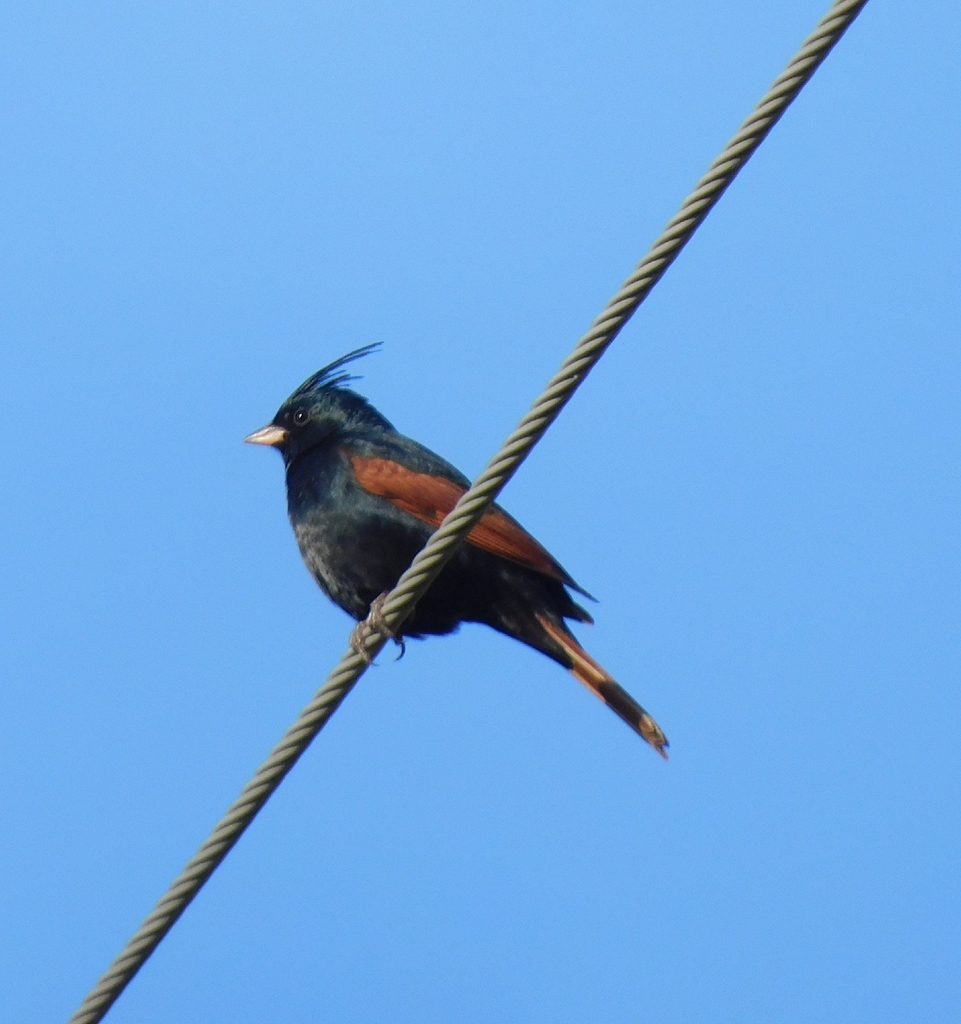
Crested Bunting
Photo © Jagdish Singh Negi
Photo © Jagdish Singh Negi — CC BY 4.0 — Source: iNaturalist #351602326Identification
The crested bunting is a sparrow-sized bunting with a distinctive prominent crest that distinguishes it from all other buntings. Males are strikingly marked with jet-black body plumage contrasted by rufous flight feathers in the wings and tail, a yellowish beak, and their characteristic crest. Females are considerably less striking, sporting shorter crests and overall dull olive-brown plumage with dark brown streaks; their wing and tail feathers are fringed in cinnamon, and they have grey beaks. Non-breeding males transition to buffish grey, while subadults display black tips to the rufous primary coverts. This sexual dimorphism is pronounced, making pair identification straightforward for field observers.
Range & Habitat
The crested bunting has a wide but scattered distribution across Asia, ranging from the Himalayas in India east through China, Laos, Thailand, Vietnam, and into Indonesia, with populations also present across the plains of India south of the Himalayas, extending west to Gujarat and Rajasthan, and through central and peninsular India. The species favours open, dry habitats including thorny scrub, rocky dry hillsides, grasslands, and savannah across a range of altitudes. Populations inhabiting higher elevations in the Himalayas undertake seasonal altitudinal movements, descending to lower elevations during winter months.
Behaviour & Diet
Crested buntings are notably more gregarious in winter, forming flocks that often forage alongside other finches, buntings, and larks, maintaining contact through short piping calls. During breeding season, males sing prominently from atop tall plants and perform elaborate courtship displays involving tail-fanning, wing-raising, and circling movements around females. The birds feed primarily on seeds from various plants but will opportunistically take termite alates. They visit small waterbodies regularly during morning and late afternoon hours. Breeding occurs in summer, with cup nests constructed of fine fibre and hair placed on the ground in stone walls or sheltered by rocks; clutches typically consist of three to four white eggs with greenish to reddish spots concentrated toward the broad end.
Best Time & Places to See It
Winter months offer the best opportunity to observe crested buntings, as birds become more social and concentrate in flocks, making them more conspicuous than during the breeding season. The species can be encountered throughout its wide Asian range, from Himalayan foothills to plains across India, extending into Southeast Asia. Look for them in open scrubland, grasslands, and rocky hillsides, particularly near small waterbodies where they regularly visit at dawn and dusk. Higher-altitude Himalayan populations are most reliably found during their winter descent to lower elevations.
Photography Tips
Males in breeding plumage offer striking photographic subjects with their bold black-and-rufous contrast and prominent crests, best captured when perched atop tall plants during their characteristic singing behaviour. Early morning and late afternoon visits to waterbodies provide excellent opportunities for photography when birds congregate to drink. Winter flocking behaviour allows photographers to capture group dynamics and interaction with other species. Use patient, distant positioning to avoid disturbing birds, and anticipate courtship displays during breeding season, which involve distinctive posturing and movement sequences that reward prepared photographers with memorable action shots.
Kanha Tiger Reserve
Bandhavgarh National Park
Banke National Park
Bardiya National Park
Chitwan National Park
Doi Inthanon National Park
Gaoligong Mountain National Nature Reserve
Gir National Park
Keoladeo National Park
Nothing matches these filters.
No community photos yet. Log in to add the first one.
No community observations of this species yet.