Skip to content
ATLAS
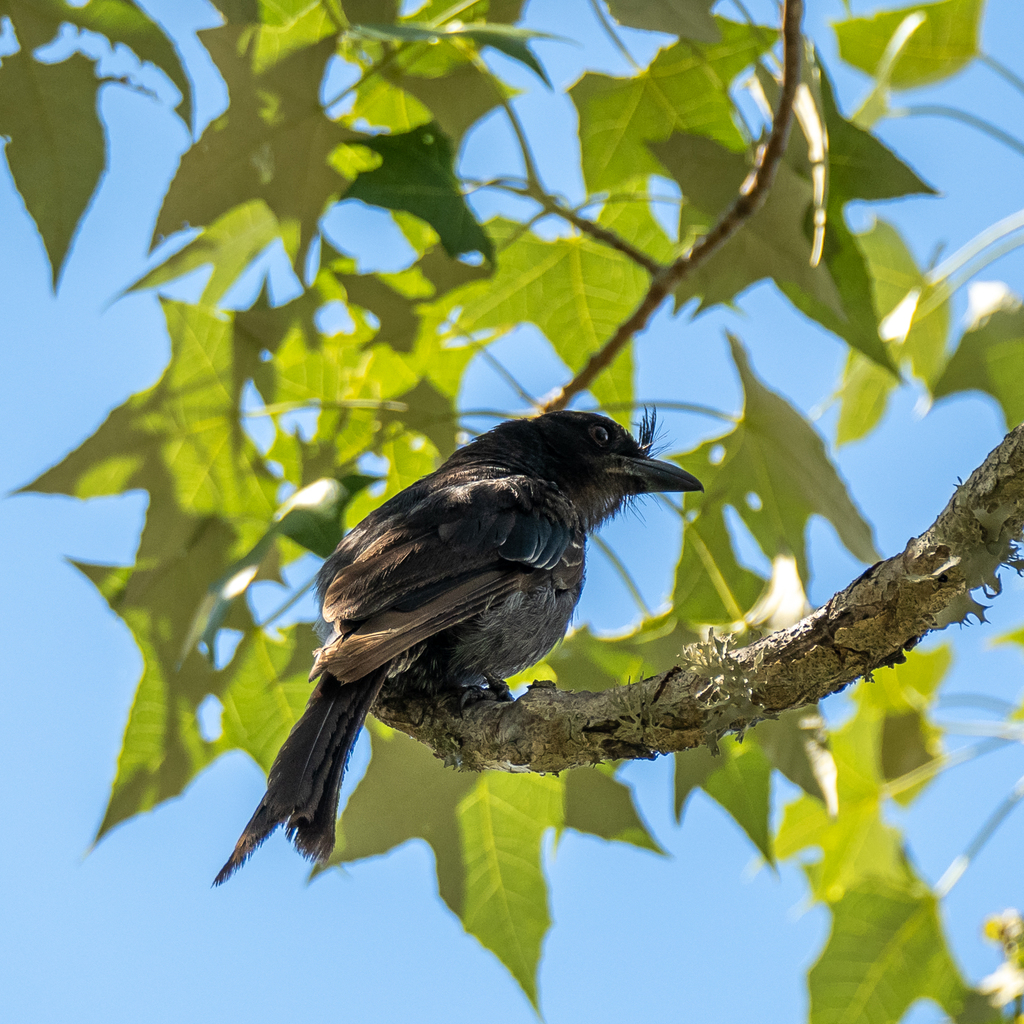
Crested Drongo

Crested Drongo

Dicrurus forficatus
Photo © Piotr LukasikPhoto © Piotr Lukasik — CC BY 4.0 — Source: iNaturalist #146332328
ABOUT
Subspecies of Crested Drongo
Dicrurus forficatus forficatusDicrurus forficatus potior

The crested drongo (Dicrurus forficatus) is a passerine bird in the family Dicruridae. It is black with a bluish-green sheen, a distinctive crest on the forehead and a forked tail. There are two subspecies; D. f. forficatus is endemic to Madagascar and D. f. potior, which is larger, is found on the Comoro Islands. Its habitat is lowland forests, both dry and humid, and open savannah country. It is a common bird and the IUCN has listed it as "least concern". == Taxonomy == In 1760 the French zoologist Mathurin Jacques Brisson included a description of the crested drongo in his Ornithologie based on a specimen collected in Madagascar. He used the French name Le grand gobe-mouche noir hupé de Madagascar and the Latin Muscicapa Madagascariensis nigra major cristata. Although Brisson coined Latin names, these do not conform to the binomial system and are not recognised by the International Commission on Zoological Nomenclature. When in 1766 the Swedish naturalist Carl Linnaeus updated his Systema Naturae for the twelfth edition, he added 240 species that had been previously described by Brisson. One of these was the crested drongo. Linnaeus included a brief description, coined the binomial name Lanius forficatus and cited…

HOTSPOTS
Sort by
National Park

Andasibe-Mantadia National Park

Falierana·Madagascar
+142 birds+16 mammals
National Park

Andringitra National Park

Madagascar
+50 birds+1 mammal
National Park

Ankarafantsika National Park

Madagascar
+137 birds+12 mammals
National Park

Marojejy National Park

Antsirabe·Madagascar
+74 birds+6 mammals
National Park

Montagne d’Ambre National Park

Joffreville·Madagascar
+77 birds+6 mammals
National Park

Ranomafana National Park

Madagascar
+129 birds+22 mammals
National Park

Tsingy de Bemaraha National Park

Begara·Madagascar
+81 birds+10 mammals

Nothing matches these filters.

Where to see & photograph the Crested Drongo →
COMMUNITY
Share your photos of Crested Drongo Inspire other photographers and contribute to the atlas.
Drag your photos here or select a file from your device JPG, PNG or WebP · Up to 10 photos of 25 MB

Your photo, your rights. Always credited to you.

Sort by

No community photos yet. Log in to add the first one.

0 Observed by
0 Hotspots reported
0 Countries

No community observations of this species yet.

Wild Atlas Guide

  • About
  • Contact
  • Privacy Policy
  • Terms of Use
  • Send Feedback

Community

  • Submit a Hotspot
  • Operators Directory
  • Add your business
  • Business Terms
© 2026 Wild Atlas Guide — Content & data compilation protected.
Privacy Policy · Cookie settings · Copyright & data use

Contact Us

We'd love to hear from you. We'll reply as soon as possible.

Send Feedback

Found an error? Have a suggestion? We read every message.

Submit a hotspot Add your business
Sign in
MENU
Sign in

or

Enter your username or email and we'll send you a link to reset your password.

or

Biological profile

Crested Drongo

A compact view of how this species lives, moves and responds to its environment.

The species at a glance

Select a card to explore the details.

Movement
Does it remain in the same area?
It generally remains in the same region
How does it move?
Local Ranging
Do its movements change with the seasons?
No, they are not tied to one season
Do all populations follow the same calendar?
Yes, broadly speaking
Activity
When is it active?
Mainly active by day
How to detect it
How can you detect it?
AcousticVisual
Does it tend to hide?
It hides in some situations
Which seasonal signs help?
Breeding Colony
Habitat
Which environment does it live in?
Terrestrial
Which places does it prefer?
Woodland
Can it adapt to different habitats?
It tolerates some variety of habitats
At what level of the habitat does it move?
CanopyUnderstory
Feeding
What kind of food does it eat?
InsectivoreInvertivore
How does it get its food?
Aerial HawkingGleaning
Social life
Does it usually live alone or in a group?
It usually lives in pairs
Reproduction
How does it breed?
Territorial
Where does it breed?
ShrubTree
Spatial ecology
Does it defend a territory?
Yes, it defends a territory
How far does it usually travel?
Across the surrounding landscape
In which major regions does it live?
Afrotropical
Sensitivity
When does it need the most space?
Nest
Global profile. Local behaviour and timing may vary.
Discover
Book
AllBirdsMammalsCountriesHotspotsHidesExperiencesOperators

Before you choose a photo

Please confirm the photo rights and credit terms first.

Read the photo rights and credit terms

I'm the author of this photo or hold the rights to it, and I keep full ownership. I grant Wild Atlas Guide a free, non-exclusive licence to display it on the site and in Wild Atlas Guide's own channels, including social media, always credited to me by my display name or the Instagram handle I choose to provide. I confirm it does not reveal a sensitive wildlife location or a recognisable person without their permission. I can withdraw future social use for this photo or ask for it to be removed at any time.

Please accept the photo rights and credit terms to continue.

Add your photo

    Uploading…

    We use cookies to measure traffic and improve Wild Atlas Guide. You decide. Privacy policy