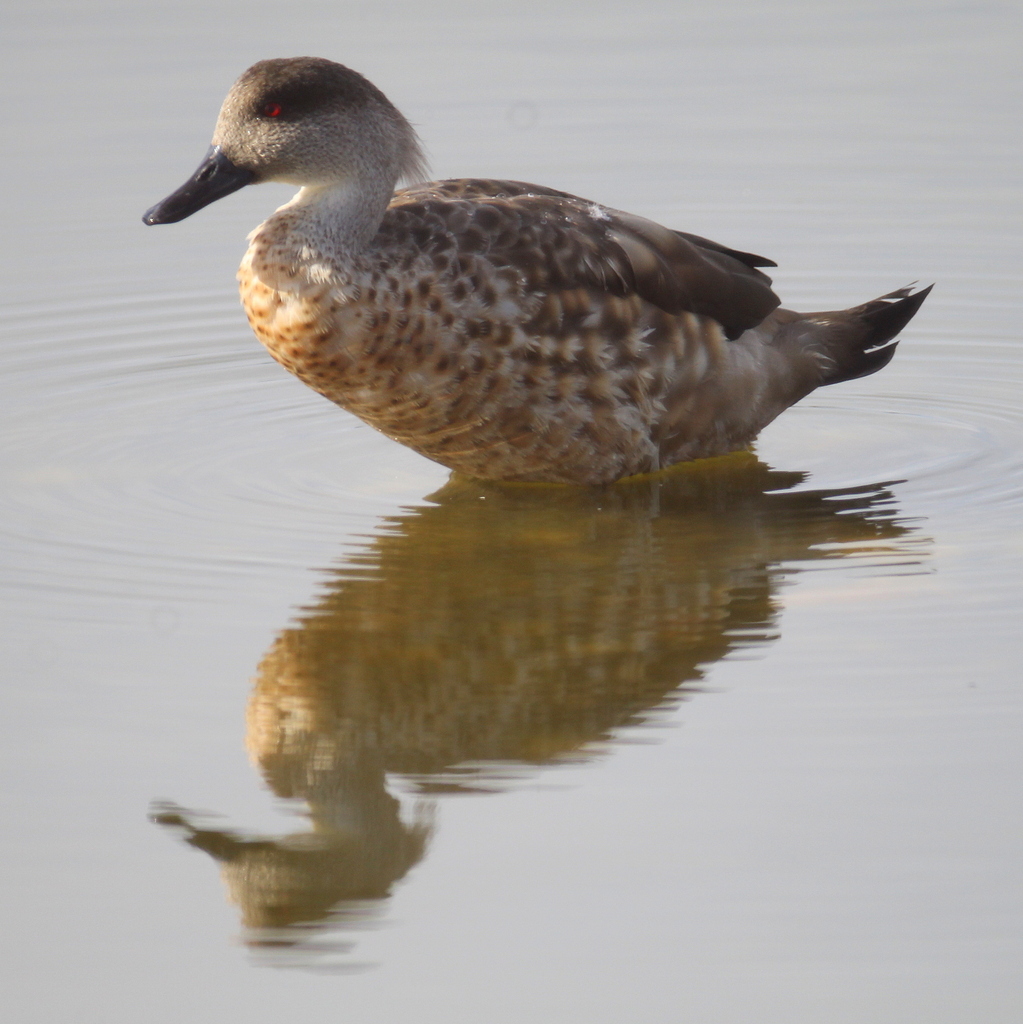
Crested Duck
Photo © Jan Ebr & Ivana Ebrová
Photo © Jan Ebr & Ivana Ebrová — CC BY 4.0 — Source: iNaturalist #70405177Identification
The crested duck is a medium-sized South American waterfowl, with adult males weighing just over a kilogram. Both sexes are similar in appearance, though males display a slightly more prominent crest—the distinctive feature that gives this species its name. The plumage is characterized by dark brown feathers on the mantle, back, and scapulars with pale centers, creating an attractive mottled appearance. The abdomen, flanks, and tail coverts are light gray, while the tail itself is notably elongated and black. Perhaps most striking are the iridescent secondaries, which display a coppery to greenish sheen with a broad dark band behind, narrowly edged in white. Juveniles lack the distinctive crest and have lighter brown faces with paler abdomens than adults.
Range & Habitat
Endemic to South America, the crested duck comprises two subspecies occupying distinct elevational zones. The Andean crested duck (L. s. alticola) inhabits high-altitude environments from 2,500 to 4,800 metres across Peru and central Chile, while the Patagonian crested duck (L. s. specularioides) occupies lower elevations below 1,500 metres in southern Patagonia and the Falkland Islands. These subspecies meet and overlap in intermediate elevational habitats around Mendoza, Argentina and Talca, Chile.
Crested ducks are highly adaptable to diverse aquatic environments, from shallow coastal bays to remote alpine lakes. In the Altiplano, they favor turbid, alkaline lakes rich in zooplankton. Coastal populations inhabit sheltered bays and beaches, foraging among rocks and kelp beds for clams and marine amphipods. They also utilize lakes, marshes, and grassy areas throughout their range.
Behaviour & Diet
Unlike many duck species, crested ducks are highly territorial and non-gregarious, typically remaining solitary or in pairs except where food is exceptionally abundant. Pairs actively defend their foraging areas against other crested ducks and competing species. They are dabbling ducks, feeding by sieving through mud, silt, and gravel to extract macroinvertebrates. Their diet varies considerably by habitat, including zooplankton, clams, kelp, and other aquatic invertebrates.
Crested ducks are monogamous, and breeding pairs exhibit remarkable cooperation that enables them to nest in close proximity to potentially predatory species such as gulls and skuas. Nesting occurs almost year-round depending on location: from October to April in high Andean elevations, and from September to January in Patagonia and the Falklands. Females typically lay clutches of five to eight cream-colored eggs in grass or fern-concealed ground nests near water. While only females incubate the approximately 30-day incubation period, males play important roles in early duckling development. Two broods annually are common, with three occasionally occurring.
Best Time & Places to See It
For Andean populations, visit high-altitude lakes in Peru and central Chile during the austral summer (October to April) when nesting activity peaks. Patagonian populations are most active from September to January. The crested duck is one of the most common duck species in Tierra del Fuego, making this region an excellent destination for reliable sightings. Look for them on alkaline Altiplano lakes, coastal bays, and marshes throughout their range.
Photography Tips
The crested duck's striking head crest, iridescent wing coloration, and elongated black tail offer excellent photographic subjects. Since they are territorial and non-gregarious, patient stalking of individual pairs or small groups will yield better results than searching for large flocks. Photograph them in their natural habitats—high alpine lakes, coastal bays, and marshes—to capture their environmental context. Early morning light will best highlight the coppery-green iridescence of their secondary feathers and the subtle mottling of their plumage.
Manu National Park
Manu, Peru
+892 birds+26 mammals
Across the eastern slopes of the Peruvian Andes, tropical rainforest descends into the Amazon basin with a complexity that few terrestrial ecosystems match. Manu National Park…
VIEW NATIONAL PARKHuascarán National Park
Independencia, Peru
+201 birds+5 mammals
Where granite peaks pierce the Andean sky above 6,000 metres, Huascarán National Park sprawls across more than 11,500 square kilometres of Peru's Cordillera Blanca, a landscape…
VIEW NATIONAL PARKKidney Island
Stanley, Falkland Islands
+47 birds
Wind-scoured tussock grassland sweeps across this remote South Atlantic outcrop, where peaty soils and exposed rock formations create a landscape as austere as it is vital.…
VIEW ISLAND & ARCHIPELAGOPort Stephens
Port Stephens, Falkland Islands
+29 birds
Windswept moorlands sweep down to pristine beaches where kelp forests fringe the turquoise shallows, their giant fronds swaying in the southern current. Port Stephens, cradled on…
VIEW NATURE RESERVEMurrell Farm
falskland islands, Falkland Islands
+54 birds
Rolling grasslands sweep across windswept plateaux where the South Atlantic exerts its relentless influence on the vegetation, sculpting tussock grassland into a tapestry of browns and…
VIEW NATURE RESERVECape Dolphin
falskland islands, Falkland Islands
+54 birds+1 mammals
Where windswept grasslands meet dramatic coastal cliffs, the Falkland Islands' northern reaches reveal one of the Southern Hemisphere's most compelling seabird sanctuaries. The terrain here is…
VIEW NATURE RESERVEVolunteer Point
Stanley, Falkland Islands
+70 birds+3 mammals
Windswept grasslands meet volcanic black sand beaches where three penguin species converge in the South Atlantic's most theatrical wildlife theatre. This remote peninsula on East Falkland…
VIEW NATURE RESERVEWest Point Island
West Point, Falkland Islands
+67 birds+3 mammals
Windswept cliffs plunge dramatically into the South Atlantic, their rust-coloured rock faces sculpted by millennia of gales and spray. This northwestern outpost of the Falkland Islands…
VIEW ISLAND & ARCHIPELAGOSalar del Huasco National Park
Pica, Chile
+75 birds+2 mammals
High above the Atacama's shimmering flats, where the Andes grip the sky, lies a landscape of stark geological drama and surprising biological richness. Salar del Huasco…
VIEW NATIONAL PARKCabo de Hornos National Park
Cape Horn, Chile
+88 birds+9 mammals
Where the Andes plunge into the Southern Ocean and the Drake Passage churns between two continents, Cabo de Hornos National Park sprawls across one of Earth's…
VIEW NATIONAL PARKTorres del Paine National Park
Torres del Paine, Chile
+143 birds+10 mammals
Where granite spires pierce the Patagonian sky, Torres del Paine commands one of South America's most dramatic landscapes. Across 4,106 square kilometres of southern Chile, jagged…
VIEW NATIONAL PARKLaja National Park Lagoon
Antuco, Chile
+123 birds+1 mammals
Where the Andes descend into the Biobío Region's temperate forests, a vast lagoon fills the caldera of the extinct Antuco volcano, cradled by steep native woodland…
VIEW NATIONAL PARKLauca National Park
Putre, Chile
+139 birds+17 mammals
Where the Andes rise toward the altiplano in Chile's far north, Lauca National Park sprawls across more than 3,000 square kilometres of some of South America's…
VIEW NATIONAL PARKCerro Castillo National Park
Coyhaique, Chile
+89 birds+3 mammals
Granite peaks and windswept steppe converge across this vast Patagonian landscape, where the Andes' eastern flank drops into terrain sculpted by ice age glaciers and relentless…
VIEW NATIONAL PARKPatagonia National Park
Cochrane, Chile
+133 birds+8 mammals
Where the Andes meet the Patagonian steppe, vast grasslands and shrublands sweep across rolling terrain carved by ancient glaciation, their contours softened by distance and dramatic…
VIEW NATIONAL PARKSalar de Surire Natural Monument
Putre, Chile
+61 birds
High across the Altiplano of northern Chile, where the Andes push toward 4,300 metres and the air thins to a crystalline clarity, lies a vast shallow…
VIEW NATURAL MONUMENTReserva Nacional Magallanes
Punta Arenas, Chile
+78 birds+2 mammals
Where windswept steppe meets sub-Antarctic forest near the southern tip of continental South America, Reserva Nacional Magallanes unfolds across roughly 352 square kilometres of profound ecological…
VIEW NATIONAL PARKParque Provincial Península de Magallanes
Argentina
+125 birds+4 mammals
Granite peaks and windswept steppe converge across this 415-square-kilometre peninsula jutting into the cold Atlantic waters of southern Patagonia, where the Magallanes landscape embodies the raw,…
VIEW NATIONAL PARKMonte León National Park
Argentina
+100 birds+4 mammals
Where the Patagonian steppe meets the Atlantic, Monte León National Park protects a landscape of windswept coastal cliffs, rocky outcrops, and semi-arid grassland spanning over 1,200…
VIEW NATIONAL PARKLos Glaciares National Park
Argentina
+121 birds+3 mammals
Where granite peaks and sprawling ice fields dominate the landscape, Los Glaciares National Park encompasses over ten thousand square kilometres of Patagonian wilderness in southern Argentina.…
VIEW NATIONAL PARKPerito Moreno National Park
Argentina
+78 birds
Where the Patagonian steppe descends into a landscape carved by ancient ice, Perito Moreno National Park sprawls across nearly 1,590 square kilometres of some of South…
VIEW NATIONAL PARKLos Cardones National Park
Argentina
+193 birds+6 mammals
Where the Andes descend into northwestern Argentina, Los Cardones National Park sprawls across nearly 1,200 square kilometres of one of South America's most distinctive high-altitude desert…
VIEW NATIONAL PARKNahuel Huapi National Park
Argentina
+124 birds+11 mammals
Where the Andes descend toward Patagonia, vast glacial lakes cut through a landscape of southern beech forest and granite peaks, creating one of South America's most…
VIEW NATIONAL PARKLanín National Park
Argentina
+128 birds+7 mammals
Where the volcanic spine of the Andes plunges into Patagonian steppe, Lanín National Park sprawls across nearly 4,700 square kilometers of one of Argentina's most visually…
VIEW NATIONAL PARKNo community photos yet. Log in to add the first one.
No community observations of this species yet.