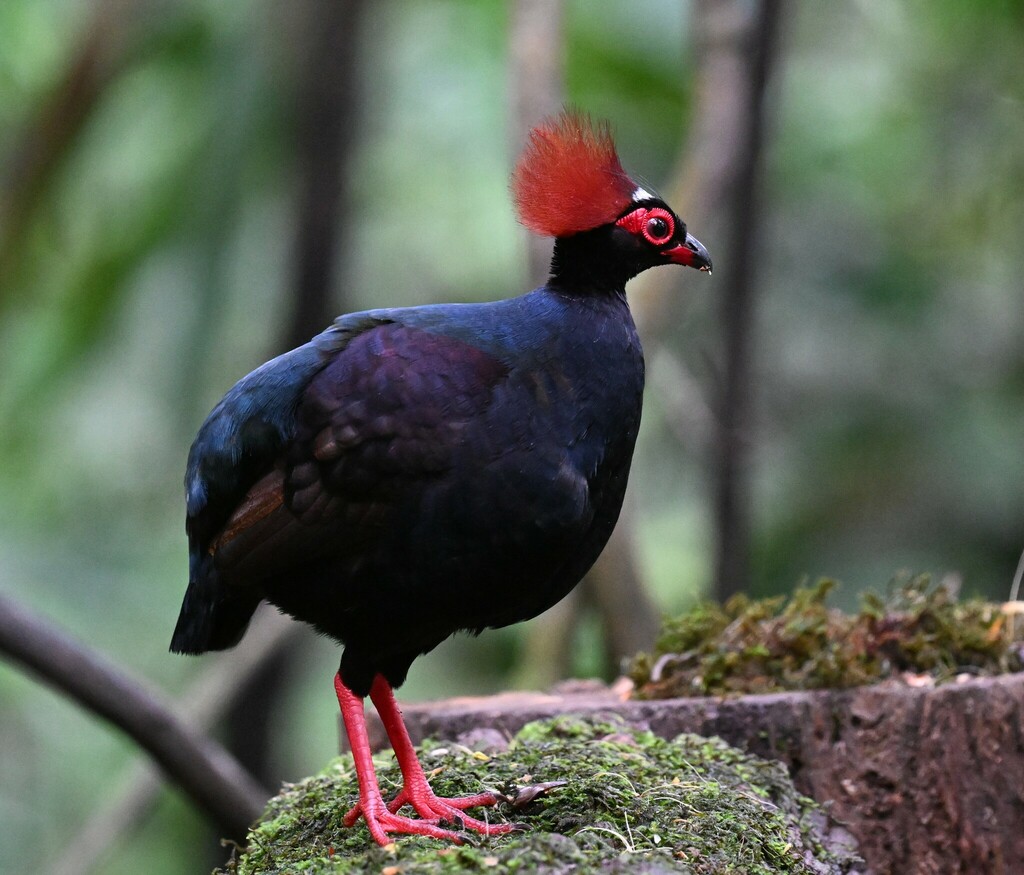
Crested Partridge
Photo © Chrissy McClarren and Andy Reago
Photo © Chrissy McClarren and Andy Reago — CC0 1.0 — Source: iNaturalist #252512942Identification
The crested partridge is a compact, short-tailed gamebird measuring just 25 cm in length, making it easy to overlook in the forest undergrowth despite its striking plumage. Males are unmistakable, displaying iridescent metallic green upperparts contrasted with glossy dark blue underparts and a distinctive tall red crest adorning the head. A white forehead spot and black frontal bristles complete the male's ornate appearance. Females are far more subdued, clad in pea-green body plumage with brown wing coverts and a slate-grey head; they retain the black bristles but lack both the crest and the white spot. Both sexes share several key field marks: a scarlet patch of bare skin encircling the eye, red legs, and an all-dark bill. Young birds are duller versions of their respective parents. When heard rather than seen, the crested partridge betrays its presence with a distinctive mournful whistled call of "si-ul."
Range & Habitat
This species is endemic to Southeast Asia, with a range restricted to lowland rainforests of southern Burma, southern Thailand, Malaysia, Sumatra, and Borneo. It is a resident breeder throughout this region, never undertaking long-distance migrations. The crested partridge shows a marked preference for the dense, humid environment of lowland rainforest, where it can forage undisturbed on the forest floor.
Behaviour & Diet
The crested partridge is a solitary or paired bird, spending most of its time on the ground using its feet to methodically probe the leaf litter and soil for food. Its diet consists of fruit, seeds, and invertebrates gleaned from the forest floor. When alarmed, it relies primarily on its strong legs to escape, preferring to run rather than fly; however, it is capable of short, whirring flights on its rounded wings when necessary. The species exhibits remarkable parental care unusual among galliforme birds: both parents feed their young bill-to-bill rather than allowing chicks to peck independently from the ground. Despite being precocial, the young roost communally in the nest for an extended period rather than immediately dispersing. Breeding birds construct a simple nest, merely a ground scrape lined with leaves and concealed beneath a substantial heap of leaf litter, where the female incubates five or six white eggs for approximately 18 days.
Best Time & Places to See It
The crested partridge is a year-round resident of its range, so timing is less critical than location. Visitors should focus on lowland rainforest habitats in Malaysia (particularly Peninsular Malaysia and Borneo), Thailand, Sumatra, and Burma where primary forest remains intact. Early morning hours are typically most productive for observation, when the birds are most active on the forest floor. Patience and a keen ear for the distinctive mournful whistle will aid in locating this retiring species.
Photography Tips
Photographing the crested partridge presents considerable challenges owing to its preference for dense forest undergrowth and elusive behaviour. Use a telephoto lens (at least 400–600 mm) to maintain distance and avoid flushing the bird. Shutter speed should be fast enough to freeze motion should the bird suddenly flee. Early morning light filtering through the canopy is ideal, though the forest setting typically demands higher ISO and wider apertures. Patience is essential; position yourself quietly near promising habitat and wait rather than actively pursuing the bird, which will invariably choose to run away.
Taman Negara National Park
Kampong Samas, Malaysia
+393 birds+48 mammals
Where ancient rainforest meets limestone peaks, one of Southeast Asia's oldest protected wilderness preserves sprawls across 4,343 square kilometers of primordial landscape. Dipterocarp giants tower overhead,…
VIEW NATIONAL PARKGunung Mulu National Park
Long Seridan, Malaysia
+280 birds+39 mammals
Where granite monoliths pierce the rainforest canopy of Sarawak, an ancient limestone karst landscape reveals one of Southeast Asia's most biodiverse strongholds. Soaring peaks cloaked in…
VIEW NATIONAL PARKGunung Palung National Park
Kayong Utara, Indonesia
+38 birds+1 mammals
Rainforest swells across the steep terrain of West Kalimantan, where ancient volcanic ridges rise abruptly from lowland swamps and weathered plateaus. Gunung Palung National Park encompasses…
VIEW NATIONAL PARKWay Kambas National Park
Lampung Timur, Indonesia
+237 birds+20 mammals
Across the low swamplands of eastern Lampung, where freshwater wetlands merge into tidal mangrove forests along the Sunda Strait, sprawls one of Sumatra's most vital sanctuaries.…
VIEW NATIONAL PARKNo community photos yet. Log in to add the first one.
No community observations of this species yet.