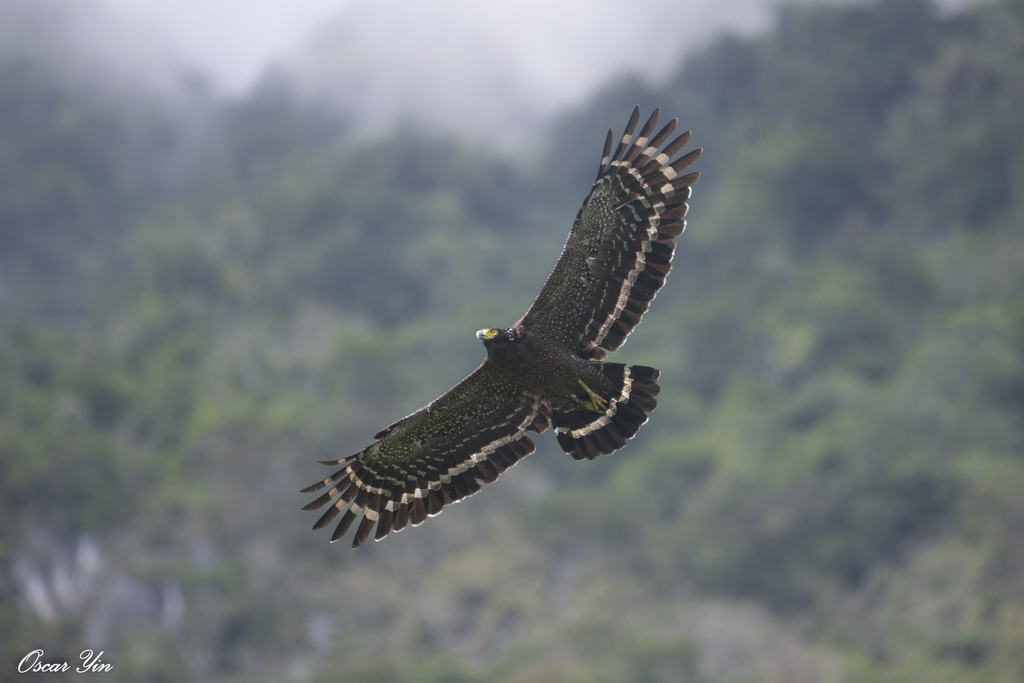
Crested Serpent Eagle
Photo © 尹若宇
Photo © 尹若宇 — CC BY-SA 4.0 — Source: iNaturalist photo #177394934Identification
The Crested Serpent Eagle is a medium-large, dark brown raptor with a stocky build, rounded wings, and short tail. Its most distinctive feature is a short black and white fan-shaped nuchal crest on the back of its head, creating a thick-necked, maned appearance. The bare facial skin and feet are bright yellow, contrasting sharply with its plumage. The underside is spotted with white and yellowish-brown. In flight, the broad, paddle-shaped wings are held in a shallow V, with the tail and underside of flight feathers displaying striking black and white bars. Young birds show considerably more white on the head than adults. The tarsus is unfeathered and covered in hexagonal scales.
Size varies dramatically across subspecies, with total length ranging from 41 to 75 cm and wingspan from 89 to 169 cm. Weights vary threefold between races, from as little as 420 g in small mainland subspecies to over 2,300 g in the largest populations. The nominate subspecies S. c. cheela is among the largest, while island populations typically show insular dwarfism, being noticeably smaller than their mainland counterparts.
Range & Habitat
The Crested Serpent Eagle is found across tropical Asia, with its range spanning the Indian subcontinent, Southeast Asia, and East Asia. Twenty-one subspecies have been proposed, distributed from peninsular India and Sri Lanka through Southeast Asia to Taiwan and Hainan, with populations inhabiting major landmasses and numerous smaller islands including Sumatra, Java, Borneo, the Andamans, Nicobars, and the Philippines. The species shows considerable geographical variation, with size decreasing southward in a clinal pattern, and island populations being distinctly smaller than mainland forms.
These eagles favour forested habitats, hunting mainly over areas with thick vegetation on both low hills and plains, often close to wet grassland. They are typically resident throughout their range, though in some regions they are found only in summer.
Behaviour & Diet
True to its name, the Crested Serpent Eagle is primarily a reptile eater, hunting snakes and lizards over the forest canopy. However, its diet is more varied than its common name suggests; it has been observed preying on birds, large insects such as grasshoppers and locusts, amphibians, mammals, fishes, termites, and large earthworms. It hunts by soaring on its broad, paddle-shaped wings held in a distinctive shallow V formation.
This species is highly vocal, calling frequently with a loud, piercing, and distinctive three or two-note call described as kluee-wip-wip, with the first note being high and rising. The eagle's constant calling makes it a familiar sound throughout its forest range despite being primarily canopy-dwelling.
Best Time & Places to See It
The Crested Serpent Eagle is widespread and fairly common across its range, making it a regular sighting for forest birders and wildlife travellers throughout tropical Asia. However, certain island subspecies have restricted distributions and smaller populations; some are believed to number only in the hundreds, with the Bawean serpent eagle being critically endangered with a declining population of only 26–37 pairs. The species' loud, familiar calls make it often easier to locate by ear than by sight, especially when perched in the forest canopy.
Photography Tips
Photographing the Crested Serpent Eagle presents both challenges and opportunities. The bird's preference for hunting over thick forest vegetation and the forest canopy means it is often seen in flight rather than perched, offering opportunities to capture its distinctive soaring silhouette with wings held in a shallow V. The striking black and white barring on the tail and flight feathers is best visible during soaring flight from below. The bird's bright yellow facial skin and feet provide excellent colour contrast when photographing perched individuals. The distinctive nuchal crest is a key identification feature to capture, particularly visible when the bird is alert or vocalising. The eagle's frequent calling habit means patient observers can sometimes predict its appearance, allowing preparation for flight photography. Early morning hours are typically best for raptor activity, and watching from forest edges adjacent to open grassland or clearings may increase encounter chances.
Kanha Tiger Reserve
Minneriya National Park
Bandhavgarh National Park
Bandipur National Park
Banke National Park
Bardiya National Park
Berbak National Park
Chitwan National Park
Doi Inthanon National Park
Nothing matches these filters.
No community photos yet. Log in to add the first one.
No community observations of this species yet.