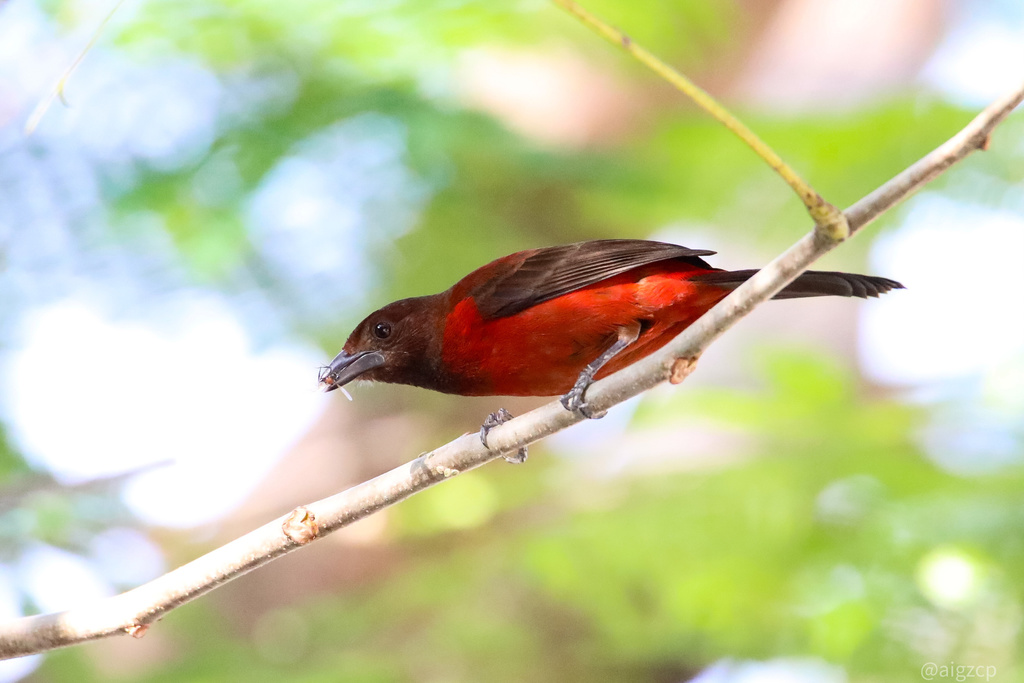
Crimson-backed Tanager
Photo © Aitor
Photo © Aitor — CC BY 4.0 — Source: iNaturalist photo #120053457Identification
The crimson-backed tanager is a compact bird, about 16 cm (6.3 in) long, with a distinctive heavy bill featuring a wide base to the mandible. Males are unmistakable: they display a deep blackish maroon-red head, mantle, throat, and breast, transitioning to brighter red on the back and brilliant red on the lower back, rump, and uppertail coverts. Their plush-textured head contrasts with a shiny back, while wings and tail remain black. The lower breast and belly are bright red with black thighs and a black belly stripe. Females are considerably duller, with dusky brown heads tinged reddish, nearly black throats, and much paler red underparts. All birds show a reddish-brown iris and gray to blackish legs.
Subspecific variation exists across the species' range. R. d. arestus is the darkest form with males showing less belly black and deeper red coloration; R. d. limatus males display more scarlet (less orange) red tones with reduced black on the belly; R. d. molochinus has slightly darker crown and throat coloration in males. Immature birds resemble adult females in their muted plumage.
Range & Habitat
This species is native to Colombia, Panama, and Venezuela, with four subspecies occupying distinct ranges: R. d. arestus on Coiba Island off western Panama; R. d. limatus in the Pearl Islands of the Gulf of Panama; R. d. dimidiatus across Panama (except the far northwest) and northern Colombia into western Venezuela; and R. d. molochinus in Colombia's upper Magdalena River valley. An introduced population exists in French Polynesia, established when birds escaped or were released from a private aviary in Tahiti in the early twentieth century.
The crimson-backed tanager favors somewhat open landscapes including forest edges, shrublands, farmland, parks, and gardens in moist to humid regions. It occurs less frequently in dry scrublands and rarely penetrates humid forest interior, except on Coiba Island. Elevation ranges from sea level to approximately 1,600 m in Panama, 2,200 m in Colombia, and 1,300 m in Venezuela.
Behaviour & Diet
A year-round resident, the crimson-backed tanager feeds on insects, fruit, and seeds, typically foraging in pairs or family groups during breeding season and in larger flocks at other times. It sometimes joins mixed-species feeding flocks and forages mostly in undergrowth and middle levels at forest edges, taking most food while hopping through foliage. The bird also visits feeding stations and often roosts in flocks exceeding 50 individuals.
Breeding apparently spans February to June in Panama, with evidence in Colombia extending through the year. Females construct cup nests from dead leaves and coarse fibers, concealing them well in bushes or small trees 1–3 m above ground. Clutches typically contain two pale blue or greenish-blue eggs sparsely marked with deep brown, black, or lilac. Females incubate alone; fledging occurs 10–11 days after hatching, with both parents provisioning nestlings. Previous broods sometimes assist with feeding the new brood.
Best Time & Places to See It
For the best chance of observing crimson-backed tanagers, visit their native range during the breeding season (February to June in Panama) when birds are most active and vocal. The species is readily found in accessible habitats: forest edges, gardens, parks, and farmland throughout its range. In Panama, explore areas near lowland forests and residential gardens. In Colombia and Venezuela, focus on the northern Caribbean lowlands and areas surrounding Lake Maracaibo. The introduced population in French Polynesia (Tahiti) offers an alternative viewing opportunity.
These tanagers are social and conspicuous, often visiting feeding stations and foraging in the open at forest edges, making them relatively straightforward to locate. Look for them in small groups or larger flocks, particularly in gardens and parks where fruiting trees attract multiple individuals. Their loud, distinctive song aids location during the breeding season.
Photography Tips
The striking sexual dimorphism and brilliant plumage of males make the crimson-backed tanager highly rewarding for photographers. Males' vivid reds and blacks are best captured in bright, natural light that emphasizes the contrast and sheen of their plumage. Early morning or late afternoon light will showcase the metallic quality of their backs and the depth of their crimson coloration.
Photograph birds at feeding stations where they visit regularly and predictably, or locate roosting flocks for group shots. The bird's size and habit of foraging at middle levels in undergrowth make it accessible for ground-level photography. Patience is essential—wait for birds to emerge from shadowed foliage into clearer light. Females and immatures require different exposure settings due to their duller coloration; bracket exposures to capture detail in their brown and dull-red plumage without losing highlight detail on males nearby.
Baru Volcano National Park
Chagres National Park
Coiba National Park
Darién National Park
General de División Omar Torrijos Herrera National Park
Guácharos Cave National Natural Park
Natural Catatumbo Barí National Park
Natural el Cocuy National Park
Natural Farallones de Cali National Park
Nothing matches these filters.
No community photos yet. Log in to add the first one.
No community observations of this species yet.