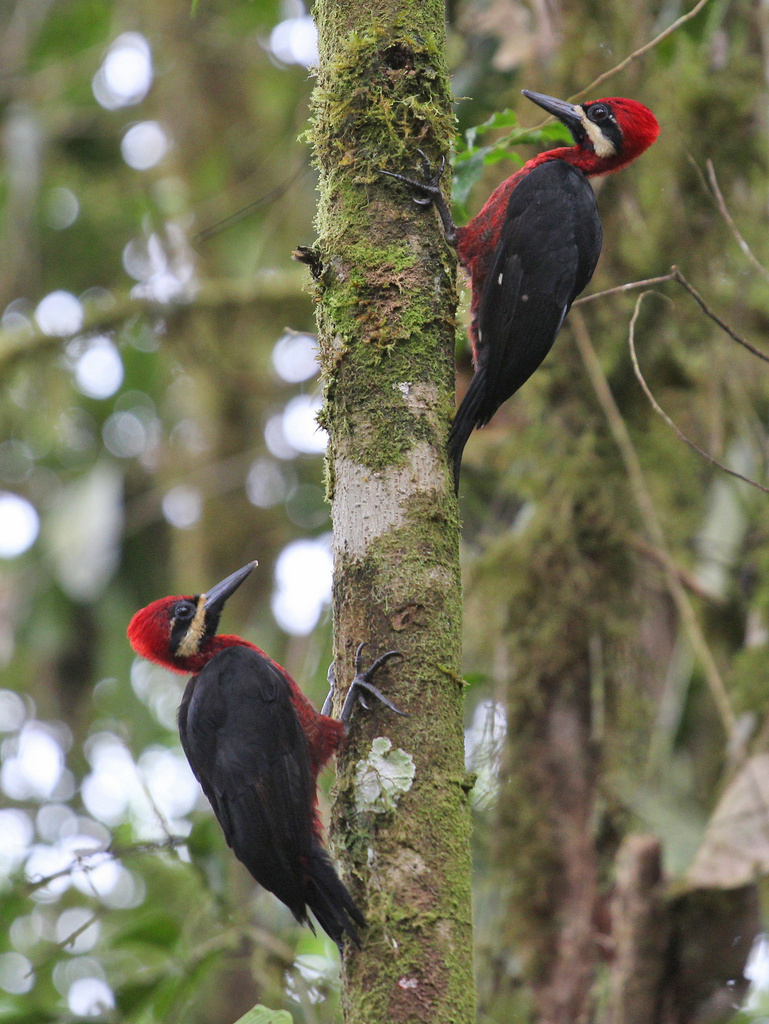
Crimson-bellied Woodpecker
Photo © Jan Ebr & Ivana Ebrová
Photo © Jan Ebr & Ivana Ebrová — CC BY 4.0 — Source: iNaturalist photo #115631729Identification
The Crimson-bellied Woodpecker is a striking large woodpecker measuring 33–34 cm in length. Both sexes display a brilliant red forehead, crown, nape, and hindneck that immediately catches the eye. The face is marked by a thin black line above the eye, a buff supercilium behind it, and a wider black band running from the nostrils through the eye to the nape. The chin and throat are black, while males sport a distinctive buff band between the eye band and chin; females show this buff marking extending down the side of the neck to the upper breast. The back is black to brownish-black, contrasting sharply with a deep red lower back and rump. The tail and upper tail coverts are black, and the wings are black above with white spots on most flight feathers. The entire underparts below the throat are deep red, making this species unmistakable in its range. Juveniles are duller and browner, with a sooty forehead and less extensive red below.
Range & Habitat
This species is restricted to the eastern slope of the Andes, occurring from Colombia south through Ecuador and Peru into northern Bolivia. It is a year-round resident throughout its range. The Crimson-bellied Woodpecker prefers the interior of humid and wet forests, montane forest, and várzea habitat, though it also frequents forest edges. Elevation varies by location: 500–1,500 m in Colombia, approximately 1,000–1,700 m in Ecuador, and 900–2,200 m in Peru.
Behaviour & Diet
This woodpecker forages primarily on the trunks of large trees, usually near the ground, either singly or in pairs. Its diet consists mainly of large beetle adults and larvae, supplemented by other insects. It locates prey by hammering and probing the bark. The breeding season appears to span September to April in Colombia and Ecuador, though little else is known about its reproductive biology. The species produces distinctive vocalizations: its song is a repetition of harsh, nasal, squeaky but loud 'eer' notes, and it utters a loud 'stk! st-kr-r-r-r-r-r-r' call. Its drumming consists of a fast roll of 3–4 loud raps.
Best Time & Places to See It
The Crimson-bellied Woodpecker can be found year-round throughout its Andean range in Colombia, Ecuador, Peru, and Bolivia. Look for it in humid montane forests and along forest edges, particularly on large tree trunks at lower to mid-story levels. Its loud vocalizations and distinctive drumming make it detectable even when not immediately visible. The species occurs within a large geographic range and is assessed as Least Concern by the IUCN.
Photography Tips
The brilliant red and black plumage of this species offers excellent photographic opportunities. Position yourself near large trees where the woodpecker forages, typically at close to mid-range distances. Early morning hours often provide the best light and activity levels. The bird's loud calls and drumming can help you locate individuals. Because it often forages low on tree trunks, you may achieve more dynamic angles than with canopy-dwelling species. The contrast between the deep red underparts, black back, and red rump makes for striking compositions. A moderate telephoto lens (400–600 mm) will allow you to capture detail while maintaining appropriate distance.
Chagres National Park
General de División Omar Torrijos Herrera National Park
Manu National Park
Natural Farallones de Cali National Park
Natural Sumapaz National Park
Natural Uramba Bahía Málaga National Park
Natural Utría National Park
Soberanía National Park
Sumaco Napo-Galeras National Park
Nothing matches these filters.
No community photos yet. Log in to add the first one.
No community observations of this species yet.