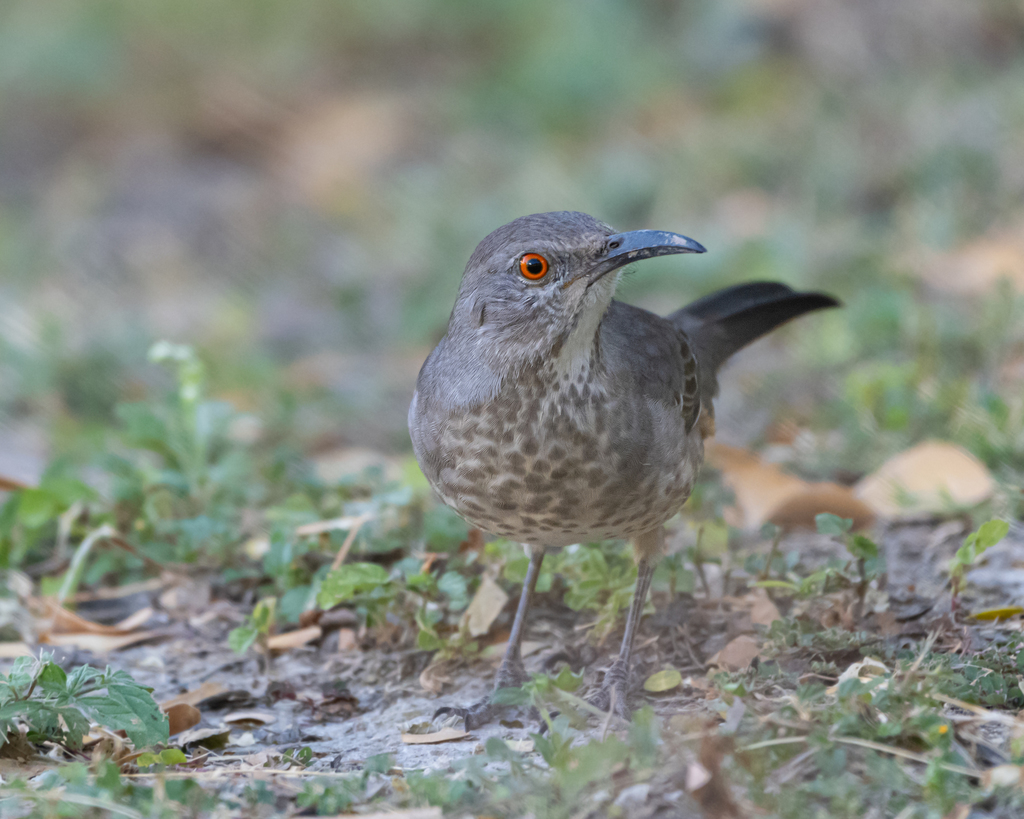
Curve-billed Thrasher
Photo © danygl
Photo © danygl — CC BY 4.0 — Source: iNaturalist #63038786Identification
The curve-billed thrasher is a medium-sized bird immediately recognized by its long tail, short wings, and distinctive sickle-shaped bill—almost as long as its head width and brownish black in color. The body is compact with a large head, and the plumage is grey-brown overall with a grayish-brown chest marked by circular brown-gray spots. The eyes are generally orange, shading to golden in adulthood. Adults measure 10.6–11.0 inches in length, weigh 2.1–3.3 ounces, and have a wingspan of 13.4–13.6 inches.
The curve-billed thrasher is easily confused with the related Bendire's thrasher, but several field marks distinguish them. The curve-billed's bill is entirely black and both mandibles are curved, whereas Bendire's has a paler bill with dark grey on the lower mandible and only the upper mandible is curved. The curve-billed also displays larger and rounder spots on its breast. Subspecific variations are markedly different across the species' range, with some displaying more distinct chest spotting and white on tail tips, while others show less spotting and less obvious wing bars.
Range & Habitat
The curve-billed thrasher is native to most of Mexico and the deserts of southwestern United States. It is a non-migratory species and is the most common desert thrasher throughout most of its range. Six recognized subspecies are divided into eastern and western populations, with ranges extending from southeastern Texas and northeastern Mexico in the east, to the islands of the Gulf of California in the west, and from southeastern Colorado southward into central Mexico.
This species generally resides in desert regions but demonstrates remarkable adaptability, inhabiting areas predominantly populated by humans. Its flexibility in habitat choice makes it a relatively accessible species for observers across its broad geographic range.
Behaviour & Diet
Despite being described as "shy and rather wild," the curve-billed thrasher allows humans to view it closely. The species is notably aggressive in defending territory, driving out potential threats—whether food competitors or predators of its chicks—with considerable vigor. As a member of the mimid family, it sometimes mimics several other species, though not to the extent of other mimics in its family. It is capable of imitating scissor-tailed flycatcher, northern cardinal, pyrrhuloxia, and occasionally even black-headed grosbeak.
The curve-billed thrasher is renowned for its extensive vocal repertoire. Its most distinctive call is an abrupt and brash whit-wheet, sounding like someone whistling to get attention, typically uttered from high perches. Its songs, similar to those of the northern mockingbird but with notes that do not end as abruptly, are regarded as more pleasant. The bird can utter consecutive songs lasting 2 to 15 seconds, with a large vocabulary that enables it to produce successive songs that usually differ from one another. Some phrases are nasal and buzzy, and this extensive melodic repertoire has earned it the Mexican name cuicacoche, meaning "songbird."
Best Time & Places to See It
The curve-billed thrasher is a year-round resident throughout its range, making it viewable in any season. As the most common desert thrasher across most of its range, it is relatively easy to locate in appropriate habitat. The species can be found in desert regions of southwestern United States and Mexico, including areas near human settlements where it has adapted successfully.
Observers should listen for the distinctive whit-wheet call, which is usually uttered from high perches where the bird is often visible. Its tendency to allow close human approach, despite its wild demeanor, makes it an accessible species for patient birders and photographers.
Photography Tips
The curve-billed thrasher's habit of calling from high, exposed perches provides excellent photography opportunities. Look for birds singing in early morning or late afternoon when light is optimal, positioning yourself to capture the bird's distinctive curved bill and spotted breast pattern clearly.
The orange to golden eyes are a striking feature worth highlighting, and the subtle variations in plumage across subspecies offer interesting compositional challenges. Since the species allows relatively close approach, a telephoto lens in the 300–500mm range should provide good framing without causing disturbance. Pay attention to subspecific differences in spotting patterns and wing markings, which can vary significantly across the bird's range and make for compelling comparative images.
Big Bend National Park
Brewster County, United States
+345 birds+34 mammals
Where the Chisos Mountains rise abruptly from the Sonoran Desert floor, Big Bend National Park spans over 7,300 square kilometers of one of North America's most…
VIEW NATIONAL PARKSaguaro National Park
Rincon Valley, United States
+354 birds+40 mammals
Where the Sonoran Desert meets sky-island mountains, two geographically separated districts of Saguaro National Park sprawl across nearly two thousand square kilometers of Arizona's most iconic…
VIEW NATIONAL PARKCarlsbad Caverns National Park
Eddy County, United States
+309 birds+18 mammals
Beneath the Chihuahuan Desert floor of southern New Mexico lies one of North America's most spectacular subterranean landscapes. Carlsbad Caverns National Park encompasses over 518 square…
VIEW NATIONAL PARKParque Nacional Cerro de la Estrella
Mexico
+126 birds+4 mammals
Where volcanic peaks rise sharply above Mexico City's sprawling metropolis, Parque Nacional Cerro de la Estrella offers a rare glimpse of high-altitude terrain within one of…
VIEW NATIONAL PARKParque Nacional Grutas de Cacahuamilpa
Pilcaya, Mexico
+97 birds+12 mammals
Where limestone ridges rise abruptly from the tropical deciduous forests of central Guerrero, the Grutas de Cacahuamilpa National Park shelters one of Mexico's most extensive cave…
VIEW NATIONAL PARKParque Nacional Isla Isabel
Santiago Ixcuintla, Mexico
+107 birds+2 mammals
A volcanic island sanctuary rises from the Pacific waters off Nayarit's coast, where three dormant cones define a landscape of sharp ridges, coastal cliffs, and sheltered…
VIEW NATIONAL PARKTutuaca
Tosanachi, Mexico
+147 birds+13 mammals
Where copper canyons plunge deeper than the Grand Canyon itself, Mexico's remote Sierra Madre Occidental unfolds in dramatic vertical relief. Tutuaca anchors this wilderness realm, a…
VIEW PROTECTED LANDSCAPEGuadalupe Mountains National Park
Culberson County, United States
+262 birds+14 mammals
Where fossil-laden limestone ridges thrust skyward above the Chihuahuan Desert floor, Guadalupe Mountains National Park reveals a landscape sculpted by ancient seas and relentless aridity. These…
VIEW NATIONAL PARKWhite Sands National Park
Otero County, United States
+178 birds+6 mammals
Across the Tularosa Basin in south-central New Mexico sprawls an otherworldly landscape of gypsum dunes—the largest gypsum field on Earth and a stark desert playground shaped…
VIEW NATIONAL PARKBosque del Apache National Wildlife Refuge
Socorro County, United States
+345 birds+17 mammals
Where the Rio Grande emerges from its desert canyon in central New Mexico, a narrow ribbon of riparian woodland defies the arid landscape that surrounds it.…
VIEW WILDLIFE SANCTUARYLaguna Atascosa National Wildlife Refuge
Cameron County, United States
+365 birds+19 mammals
Where coastal prairie meets shallow lagoon along the southernmost tip of Texas, Laguna Atascosa National Wildlife Sanctuary sprawls across a landscape sculpted by salt spray and…
VIEW WILDLIFE SANCTUARYSanta Ana National Wildlife Refuge
Hidalgo County, United States
+349 birds+12 mammals
Where the Rio Grande delta meets the semi-arid scrublands of South Texas, Santa Ana National Wildlife Sanctuary preserves a rare mosaic of wetland and thornforest habitat…
VIEW WILDLIFE SANCTUARYLower Rio Grande Valley National Wildlife Refuge
Starbase, United States
+311 birds+11 mammals
Where the Rio Grande delta spreads across the coastal plain of South Texas, a sanctuary of subtropical wetlands and riparian corridors creates a landscape that pulses…
VIEW WILDLIFE SANCTUARYCabeza Prieta National Wildlife Refuge
United States
+155 birds+6 mammals
Across southwestern Arizona's harshest terrain, where the Colorado River marks the border with Mexico, lies a sanctuary shaped entirely by heat and aridity. Cabeza Prieta National…
VIEW WILDLIFE SANCTUARYKofa National Wildlife Refuge
Yuma County, United States
+142 birds+10 mammals
Desert mountains rise in sculptured ridges across northwestern Arizona, where the Colorado River's distant influence fades into some of the most austere terrain in the American…
VIEW WILDLIFE SANCTUARYSalton Sea National Wildlife Refuge
Imperial County, United States
+289 birds+4 mammals
Across the floor of California's inland desert, where summer temperatures soar and rainfall is measured in tenths of inches, lies an improbable oasis of shallow water…
VIEW WILDLIFE SANCTUARYBitter Lake National Wildlife Refuge
Chaves County, United States
+284 birds+10 mammals
Across the high desert floor of southeastern New Mexico, where elevation and aridity shape every living thing, shallow alkaline lakes and marshes form an unexpected oasis…
VIEW WILDLIFE SANCTUARYNo community photos yet. Log in to add the first one.
No community observations of this species yet.