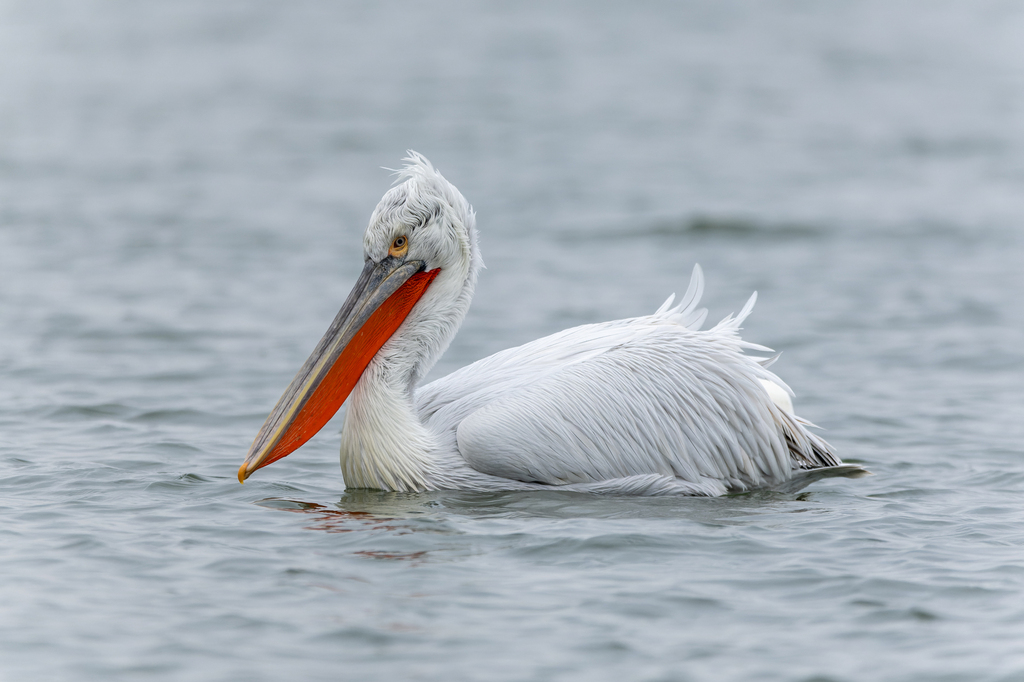
Dalmatian Pelican
Photo © David F. Belmonte
Photo © David F. Belmonte — CC BY 4.0 — Source: iNaturalist photo #466241273Identification
The Dalmatian pelican is the largest member of the pelican family and among the heaviest flying birds in the world. With a body length of 1.6–1.8 metres and a wingspan typically ranging between 2.7 and 3.2 metres, it ranks among the largest soaring birds. The species is most easily recognised by its enormous bill, which typically measures between 37 and 45 centimetres long and includes a large pouch used for catching fish, making it the bird species with the second longest bill.
The Dalmatian pelican has silvery-white plumage and is distinguished by its curly nape feathers, grey legs, and the grey appearance of its wings in flight. During the breeding season, the gular pouch becomes a vivid orange-red, contrasting with the more subdued yellow or grey tones observed during the rest of the year. In winter, adults acquire drabber plumage, making them appear more similar to the great white pelican. Males are noticeably larger than females.
Range & Habitat
The Dalmatian pelican spans much of Central Eurasia, from the eastern Mediterranean in the west to the Taiwan Strait in the east, and from the Persian Gulf in the south to Siberia in the north. It is a short-to-medium-distance migrant between breeding and overwintering areas, typically returning to traditional breeding sites. The species breeds across the Palearctic from southeastern Europe to Russia, India and China in swamps and shallow lakes.
The core population survives in Russia, though the species faced dramatic population declines during the 20th century due to land use, disturbance, and poaching activities. In its Mongolian range, the species is critically endangered. Conservation efforts including the removal of power lines to prevent bird strike or electrocution, and the construction of nesting platforms or rafts, have reversed declines locally.
Behaviour & Diet
As with other pelicans, the Dalmatian pelican's diet is mainly fish. The species is known for its graceful flight and often travels in synchronised flocks. Its harsh vocalizations become more pronounced during the mating season. The bird usually returns to traditional breeding sites, where it is less social than other pelican species.
Dalmatian pelicans breed in swamps and shallow lakes, constructing crude nests of vegetation placed on islands or dense mats of vegetation. During the breeding season, males develop the distinctive bright red gular pouch mentioned above, which plays a role in breeding displays and mate signalling.
Best Time & Places to See It
The core population of Dalmatian pelicans survives in Russia, making this region the most reliable destination for viewing the species. The breeding season, when harsh vocalizations become more pronounced and males display their vivid orange-red pouches, offers excellent opportunities for observation and photography. As a short-to-medium-distance migrant, the species follows predictable migration routes between breeding and overwintering areas, allowing for strategic planning of viewing trips.
Traditional breeding sites in swamps and shallow lakes throughout the Palearctic range offer the best chances of encountering these magnificent birds. However, travellers should note that the species is less social than other pelican species and typically less densely colonial, so patience and persistence may be required.
Photography Tips
The Dalmatian pelican's enormous wingspan of 2.7–3.2 metres and graceful flight make it an impressive subject when photographed in the air, particularly when traveling in synchronised flocks. The distinctive silvery-white plumage and grey wing coloration provide excellent contrast against varied skies and water backgrounds. Photographers should focus on capturing the species' characteristic curly nape feathers and grey legs, which are key identifying features.
For breeding season photography, the vivid orange-red gular pouch provides striking colour that contrasts dramatically with the bird's silvery-white plumage. Photograph subjects early in the day when lighting conditions are optimal for capturing the reflective quality of their white feathers. Winter plumage is drabber, so spring and summer offer superior opportunities for colourful, dynamic images of this remarkable bird.
Ranthambhore National Park
Sawai Madhopur, India
+294 birds+20 mammals
Granite ridges and ravines carved through the Aravalli Range frame this protected landscape in eastern Rajasthan, where deciduous forest mingles with open scrubland and seasonal water…
VIEW NATIONAL PARKDanube Delta Biosphere Reserve
Tulcea, Romania
+277 birds+27 mammals
Where the Danube surrenders to the Black Sea, a vast labyrinth of channels, reed beds, and freshwater lakes sprawls across nearly 13,400 square kilometers of eastern…
VIEW NATIONAL PARKHortobágy National Park
Hortobágy, Hungary
+260 birds+17 mammals
Across the North Great Plain of Hungary stretches one of Europe's most expansive semi-natural grassland systems, where horizon-wide vistas of steppe and wetland create a landscape…
VIEW NATIONAL PARKCamargue Regional Nature Park
Saintes-Maries-de-la-Mer, France
+378 birds+48 mammals
Where the Rhône Delta sprawls into the Mediterranean, a landscape of stark and haunting beauty emerges—vast salt marshes punctuated by shallow lagoons, reed beds, and scrubland…
VIEW NATURAL PARKJavakheti National Park
Bozali, Georgia
+138 birds
Dawn breaks over a high-altitude plateau where volcanic peaks pierce the Caucasian sky, their slopes cloaked in alpine meadows that stretch toward horizons of impossible clarity.…
VIEW NATIONAL PARKStrandzha Nature Park
Kondolovo, Bulgaria
+215 birds+19 mammals
Where the Rhodope Mountains descend toward the Black Sea coast, ancient forests rise above limestone plateaus in a tapestry of ecological richness rarely found elsewhere in…
VIEW NATURAL PARKKeoladeo National Park
Shreenagar Rural, India
+326 birds+14 mammals
Where shallow wetlands shimmer beneath vast Rajasthani skies, one of Asia's finest bird sanctuaries pulses with extraordinary life. This former maharaja's hunting reserve, now spanning 29…
VIEW NATIONAL PARKPindos National Park
Ioannina Regional Unit, Greece
+163 birds+12 mammals
Where limestone peaks rise abruptly from the Pindus range in northwestern Greece, a landscape of dramatic gorges, alpine meadows, and dense beech forests creates one of…
VIEW NATIONAL PARKButrint National Park
Vagalat, Albania
+140 birds+3 mammals
Where the Ionian coast meets ancient alluvial plains, Butrint National Park spans a landscape of extraordinary ecological complexity that has shaped human settlement for three millennia.…
VIEW NATIONAL PARKOlympos National Park
Pieria Regional Unit, Greece
+137 birds+3 mammals
Where the Thessalian plains give way to soaring limestone massifs, Olympos National Park rises as one of the Aegean's most dramatic mountain wilderness areas. This IUCN…
VIEW NATIONAL PARKKerkini Lake National Park
Serres, Greece
+291 birds+18 mammals
Where the Strymon River widens into a sprawling freshwater lake hemmed by the Rhodope Mountains, Kerkini National Park unfolds across northern Greece as one of southeastern…
VIEW NATIONAL PARKGir National Park
Asundrali, India
+258 birds+13 mammals
Dry deciduous forests cloak the rolling hills of western Gujarat where the Gir landscape rises as a final sanctuary for one of the world's rarest felids:…
VIEW NATIONAL PARKYancheng National Nature Reserve
Yancheng, China
+208 birds+4 mammals
Where the East China Sea's tidal rhythms sculpt the Jiangsu coast, Yancheng National Nature Reserve sprawls across one of Asia's most dynamic wetland complexes. This vast…
VIEW NATURE RESERVEPoyang Lake National Nature Reserve
Shangrao, China
+270 birds+7 mammals
Where the Yangtze River's massive floodplain spreads across central China, Poyang Lake National Nature Reserve encompasses one of the continent's most dynamic and water-rich wetland systems.…
VIEW NATURE RESERVENo community photos yet. Log in to add the first one.
No community observations of this species yet.