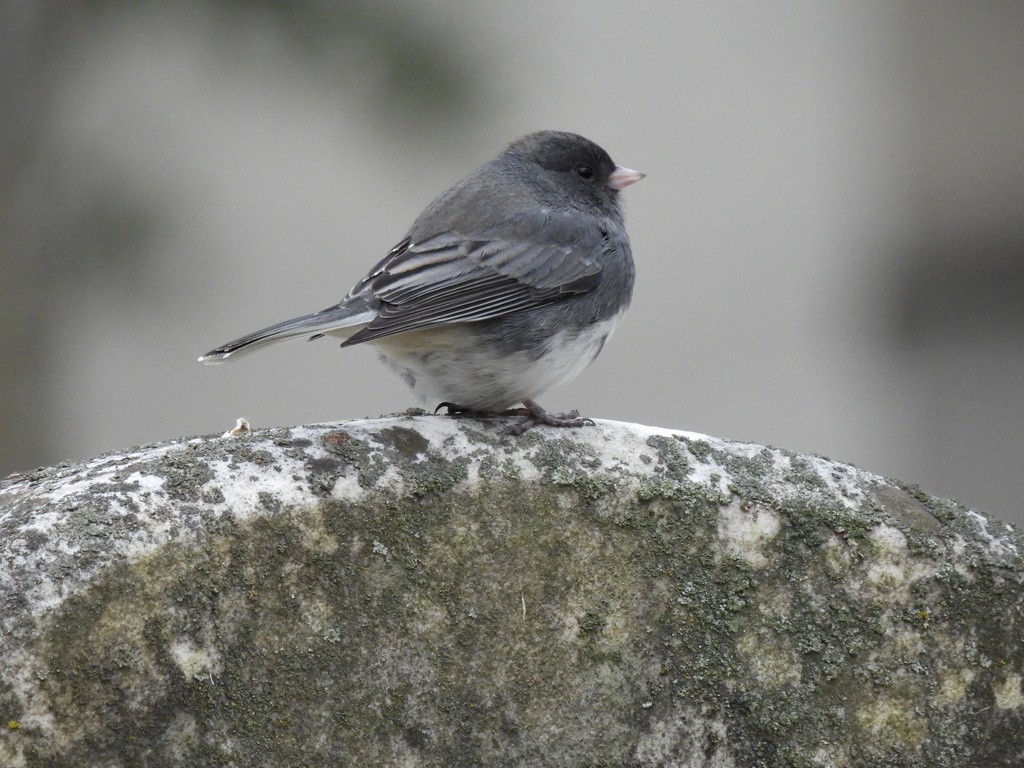
Dark-eyed Junco
Photo © Caroline Quinn
Photo © Caroline Quinn — CC BY 4.0 — Source: iNaturalist photo #251245132Identification
The dark-eyed junco is a small, grayish New World sparrow with considerable plumage variation across its range. All birds share white outer tail feathers and a white belly, but subspecies groups differ markedly. The slate-colored group features dark slate-gray heads, breasts, and upperparts, with females brownish-gray and sometimes showing reddish-brown flanks. The white-winged subspecies displays a medium-gray head and breast with distinctive white wing bars and notably more white in the tail than other subspecies. The Oregon or brown-backed group—the most common in the West—shows blackish-gray heads and breasts contrasting with brown backs, wings, and reddish flanks. The pink-sided subspecies has a lighter gray head and breast with rich pinkish-cinnamon coloring on the flanks. The gray-headed group presents light gray plumage with a rusty back. Females are generally duller than males across all groups.
Range & Habitat
The dark-eyed junco is common across much of temperate North America, ranging far into the Arctic during summer. The slate-colored group breeds in North American boreal forests from Alaska to Newfoundland and south to the Appalachian Mountains, wintering throughout most of the United States. The white-winged subspecies is endemic to the Black Hills region of South Dakota, Wyoming, Nebraska, and Montana, wintering south to northeastern New Mexico. The Oregon/brown-backed group, comprising eight subspecies, is the most common in the West, breeding in Pacific Coast Ranges from southeastern Alaska to extreme northern Baja California and wintering to the Great Plains and northern Sonora. The pink-sided subspecies breeds in the northern Rocky Mountains from southern Alberta to eastern Idaho and western Wyoming, wintering in central Idaho and nearby regions. The gray-headed group breeds in the southern Rocky Mountains from Colorado to central Arizona.
Behaviour & Diet
Dark-eyed juncos are small sparrows adapted to various temperate and boreal environments. While specific behavioral details and dietary preferences are not extensively detailed in available sources, their common name reflects their historical association with winter in North America, where they were traditionally noted as seasonal visitors to lowland areas before returning north to breed. The species exhibits considerable geographic variation, with different subspecies groups showing distinct plumage patterns that reflect their respective ranges and environments.
Best Time & Places to See It
The best time and location to observe dark-eyed juncos depends on the subspecies group. In eastern North America, slate-colored juncos are visible throughout winter across most of the United States, with breeding populations in boreal forests during summer. The white-winged subspecies is reliably found year-round in the Black Hills region. In the West, Oregon/brown-backed subspecies are present across Pacific ranges and inland western regions, particularly during breeding season. Pink-sided juncos are best found in the northern Rocky Mountains during breeding season. Gray-headed juncos are present in the southern Rocky Mountain region. Winter offers excellent opportunities to observe multiple subspecies at lower elevations and in more accessible locations.
Photography Tips
Photograph dark-eyed juncos in good lighting to capture the subtle plumage differences that distinguish subspecies groups. The white outer tail feathers are a key identifying feature—try to capture images showing the bird in flight or with tail spread. In slate-colored birds, focus on the contrast between the dark upperparts and white belly. For western subspecies, pay particular attention to flank coloration and back patterns. Early morning light often reveals the nuances of gray and brown tones that characterize different groups. Juncos are relatively approachable, making them excellent subjects for field photography, particularly at feeders during winter or in breeding territories during summer.
Tombstone Territorial Park
Acadia National Park
Alaska Maritime National Wildlife Refuge
Algonquin Provincial Park
Arches National Park
Arctic National Wildlife Refuge
Badlands National Park
Banff National Park
Bear River Migratory Bird Refuge
Nothing matches these filters.
No community photos yet. Log in to add the first one.
No community observations of this species yet.