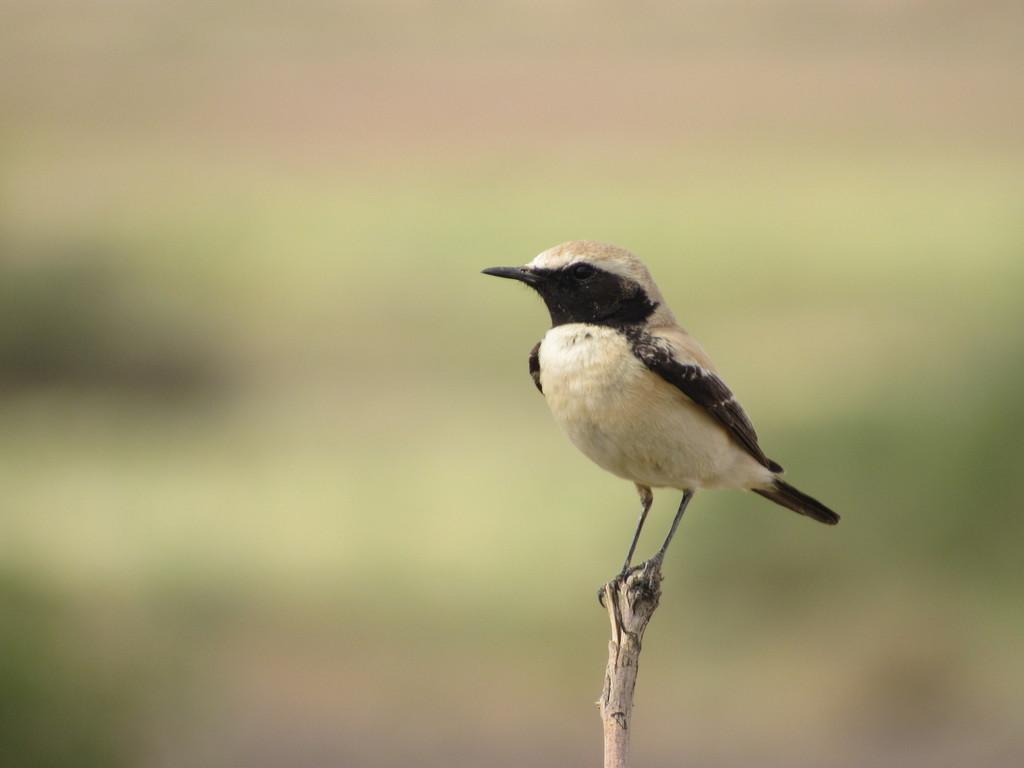
Desert Wheatear
Photo © Santiago Martín-Bravo
Photo © Santiago Martín-Bravo — CC BY 4.0 — Source: iNaturalist photo #182567602Identification
The desert wheatear is a small passerine, measuring 14.5 to 15 cm in length, with a distinctive appearance that varies between males, females, and seasons. Adult males in summer plumage display buff upper parts with white underparts tinged buff on the breast. The most striking feature is the black on the face and throat that extends to the shoulders, contrasted by a distinct white superciliary stripe. Females are greyer above and buffer below, with no black on the throat. In winter, males' throat black is partially obscured by white-tipped feathers.
A key identifying characteristic across all ages and sexes is the entirely black tail from the feather tips to the upper tail-coverts—a feature that distinguishes this species from many relatives. The bill, legs, and feet are black, with dark brown eyes. Winter plumage becomes noticeably richer in color as white feather tips wear away through spring, making seasonal identification important for field observers.
Range & Habitat
The desert wheatear has two distinct populations. The western race breeds across North Africa from Morocco to Egypt west of the River Nile, with some populations largely resident while others migrate seasonally. The eastern race ranges across a vast swathe of Asia from the Middle East through Iran, Afghanistan, the Caucasus, Turkestan, and into Mongolia, migrating south to winter in northeastern Africa, the Arabian Peninsula, Iraq, and Pakistan. Both western and eastern forms are rare vagrants to western Europe.
This species favors barren, open landscapes including steppes, deserts, semi-arid plains, saltpans, dried riverbeds, and sandy or rocky wasteland. It occurs at altitudes up to 3,500 meters. During winter, desert wheatears may visit cultivated land interspersed with bare ground. The species is an occasional vagrant to the United Kingdom.
Behaviour & Diet
The desert wheatear is an insectivorous species that typically perches on bushes, tussocks, or elevated ground before darting down to snatch insects from the ground. It feeds primarily on ants, beetles, caterpillars, flies, and various insect larvae including ant-lions, supplemented occasionally with seeds. The bird can also catch insects in flight and is capable of brief hovering. When encountering large prey it cannot manage, it displays by fluttering its wings in front of the insect.
Breeding occurs in late April or May across most of its range. Nests are often concealed behind gorse bushes or other vegetation in rocky hillsides, steppes, sandy plains, rock crevices, or hollows beneath rocks. The tidily-constructed cup nest is built from grasses, mosses, and stems. A clutch typically consists of four pale blue, slightly speckled eggs.
Best Time & Places to See It
For travelers seeking the western race, North African desert and semi-arid regions from Morocco through Egypt west of the Nile offer the best opportunities, particularly during the breeding season of late April and May. Eastern race populations can be encountered across Central Asian steppes and semi-deserts during breeding season, with wintering birds found in Pakistan and northeastern Africa. Birders in Europe should watch migration periods, particularly autumn, when vagrant individuals occasionally appear.
The species' preference for open, barren landscapes means it is often conspicuous when present, as it relies on exposed perches to hunt. Early morning observation in suitable habitat during breeding season will yield the best sightings, particularly when males are most active and vocal.
Photography Tips
The desert wheatear's contrasting plumage—particularly the males' striking black and white face pattern and buff upper parts—photographs well in bright desert light. The species' habit of perching prominently on bushes and rocks before diving to the ground provides predictable opportunities for action shots. Photograph males in spring and early summer to capture the crisp black throat and face markings before feather wear dulls the plumage.
The entirely black tail is a key diagnostic feature to capture in photographs, particularly the contrast between the black tail and pale rump. Wide-open desert or steppe landscapes provide suitable backgrounds that complement the bird's coloration. Patient observation of a perched individual will reward you with opportunities to photograph both the hunting stoop and the characteristic wing-fluttering display behavior.
Schleswig-Holsteinisches Wattenmeer National Park
Germany
+378 birds+49 mammals
Where the North Sea ebbs and flows across a vast expanse of exposed mud and sand, the Schleswig-Holsteinisches Wattenmeer National Park reveals one of Europe's most…
VIEW NATIONAL PARKSouth Downs National Park
Chichester, United Kingdom
+298 birds+45 mammals
Chalk downland ridges rise and fall across the South Downs, their open grasslands and beech hangers creating a mosaic of habitats that has shaped human settlement…
VIEW NATIONAL PARKRanthambhore National Park
Sawai Madhopur, India
+294 birds+20 mammals
Granite ridges and ravines carved through the Aravalli Range frame this protected landscape in eastern Rajasthan, where deciduous forest mingles with open scrubland and seasonal water…
VIEW NATIONAL PARKDelta de l’Ebre Natural Park
Eucaliptus, Spain
+341 birds+18 mammals
Where the Ebro River spreads into a vast labyrinth of shallow lagoons, reed beds, and brackish marshes before surrendering to the Mediterranean, one of southern Europe's…
VIEW NATURAL PARKCamargue Regional Nature Park
Saintes-Maries-de-la-Mer, France
+378 birds+48 mammals
Where the Rhône Delta sprawls into the Mediterranean, a landscape of stark and haunting beauty emerges—vast salt marshes punctuated by shallow lagoons, reed beds, and scrubland…
VIEW NATURAL PARKPanna National Park
Badgadi Kalan, India
+271 birds+17 mammals
Where granite gorges slice through central India's Vindhyan plateau, a landscape of stark beauty unfolds across nearly six hundred square kilometers. The Ken River carves through…
VIEW NATIONAL PARKHemis National Park
Raigahar Dhar, India
+131 birds+13 mammals
Where granite gorges cleave through the Himalayas at dizzying altitudes, a vast wilderness of alpine desert unfolds across the rain shadow of Ladakh. Hemis sprawls across…
VIEW NATIONAL PARKKeoladeo National Park
Shreenagar Rural, India
+326 birds+14 mammals
Where shallow wetlands shimmer beneath vast Rajasthani skies, one of Asia's finest bird sanctuaries pulses with extraordinary life. This former maharaja's hunting reserve, now spanning 29…
VIEW NATIONAL PARKAwash National Park
Didiga, Ethiopia
+473 birds+23 mammals
Where the Ethiopian Rift Valley carves through volcanic plateaus, a ribbon of riverine forest winds through acacia scrubland and grassland, creating a mosaic of habitats that…
VIEW NATURAL PARKAltai Tavan Bogd National Park
Tsengel, Mongolia
+146 birds+3 mammals
Where the Altai Mountains rise in jagged defiance along Mongolia's western frontier, the terrain transforms into a realm of alpine tundra, rocky plateaus, and glacier-carved valleys…
VIEW NATIONAL PARKGobi Gurvan Saikhan National Park
Tsagaan Subarga Hural, Mongolia
+183 birds+23 mammals
Where rust-coloured badlands rise from the southern Gobi steppe, the terrain transforms into a landscape of geological drama that few visitors expect to find in Mongolia's…
VIEW NATIONAL PARKGir National Park
Asundrali, India
+258 birds+13 mammals
Dry deciduous forests cloak the rolling hills of western Gujarat where the Gir landscape rises as a final sanctuary for one of the world's rarest felids:…
VIEW NATIONAL PARKCalanques National Park
Bouches-du-Rhône, France
+233 birds+42 mammals
Where limestone cliffs plunge dramatically into crystalline Mediterranean waters, Calanques National Park preserves one of Europe's most striking coastal landscapes. These steep-sided inlets, carved by erosion…
VIEW NATIONAL PARKQiangtang National Nature Reserve
Ngari Prefecture, China
+34 birds+5 mammals
Across the high Tibetan plateau north of Nagqu sprawls one of Earth's most extreme alpine tundra ecosystems, where vast expanses of sparse grassland and barren terrain…
VIEW NATURE RESERVEAltun Mountain National Nature Reserve
Jiuquan, China
+32 birds
Where the Altun Mountains rise across the high desert basin of northwestern China, one encounters a landscape shaped by extremes—cold, aridity, and relentless altitude. Spanning over…
VIEW NATURE RESERVEQinghai Lake National Nature Reserve
Hainan Tibetan Autonomous Prefecture, China
+243 birds+11 mammals
At 3,200 metres above sea level on the Tibetan plateau, where winter temperatures plunge far below freezing and snow blankets the landscape for half the year,…
VIEW NATURE RESERVEHolkham National Nature Reserve
North Norfolk, United Kingdom
+235 birds+11 mammals
Where Norfolk's coastal flatlands meet the North Sea, Holkham National Nature Reserve unfolds across nearly 4,000 hectares of some of England's most dynamic and least predictable…
VIEW NATURE RESERVESeven Sisters National Nature Reserve
Eastbourne, United Kingdom
+190 birds+15 mammals
Where the South Downs meet the English Channel, the chalk cliffs of Seven Sisters rise in a dramatic sequence of white promontories that have shaped both…
VIEW NATURE RESERVENo community photos yet. Log in to add the first one.
No community observations of this species yet.