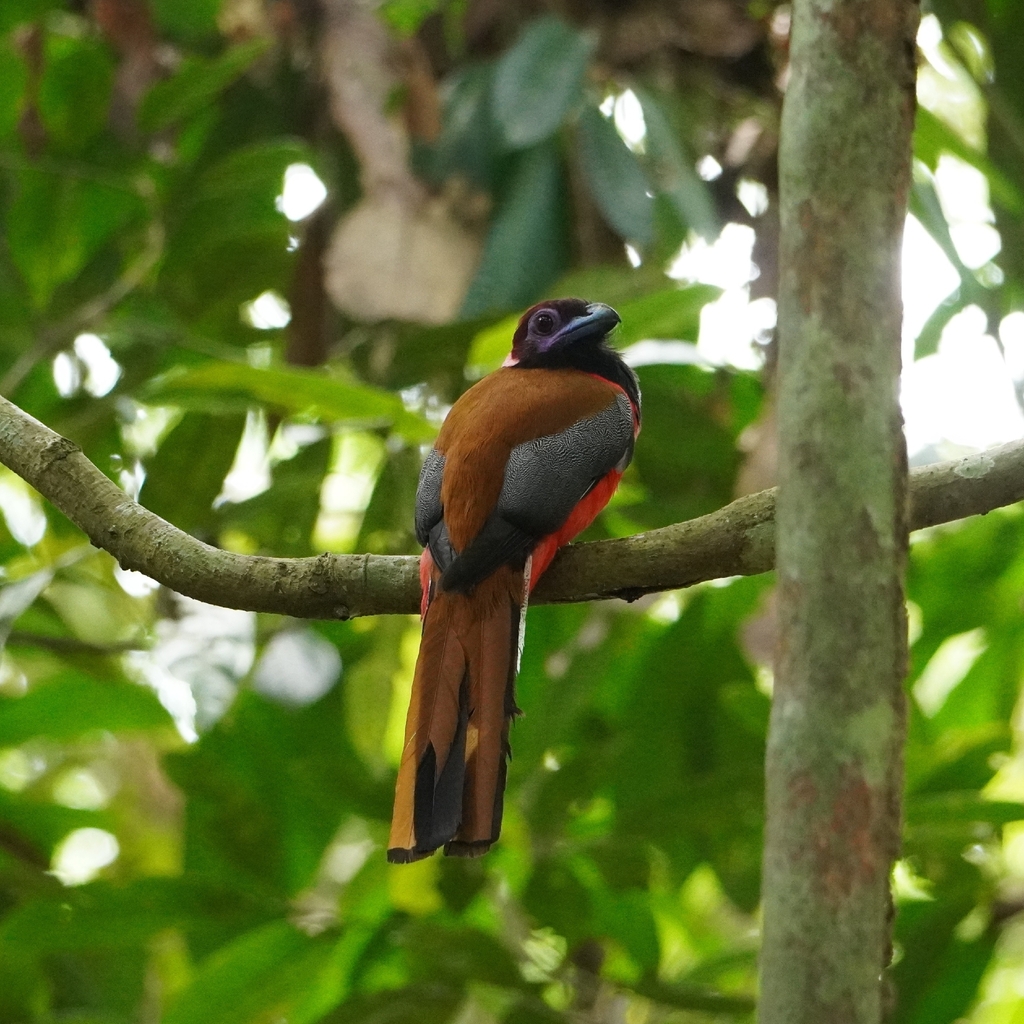
Diard’s Trogon
Photo © Ben Costamagna
Photo © Ben Costamagna — CC BY 4.0 — Source: iNaturalist #373420213Diard's trogon (Harpactes diardii) is a species of bird in the family Trogonidae. It is found in Brunei, Indonesia, Malaysia, Singapore, and Thailand. Its natural habitat is subtropical or tropical moist lowland forests. It is threatened by habitat loss. Apalodermatinae is the African subfamily consisting of one genus, Apaloderma. The Asian subfamily is Harpactinae and contains two genera, Harpactes and Apalharpactes. Males are black headed and breasted with a pink breast line. Females are brown headed and breasted with pink under parts. Diard's trogon eats caterpillars, beetles, stick-insects, locustids and other Orthoptera, and fruits. The breeding times of Diard's trogon range from February to August: February to mid-May in Malaysia, Mid-May to August in Borneo. The Dayak Iban community believes that hearing the Diard's trogon's call is a bad omen. == Taxonomy == The trogons are birds with colorful plumage that belong to the order Trogoniformes which only comprises one family, the Trogonidae. The genus Harpactes, which is one of the seven genera contained in this family, are all residents of South and Southeast Asia. Two biogeographical hypotheses propose different origins of trogons, one being they originated from Gondwana, and the other Laurasia. Although a paper from 1998 originally supported…
Taman Negara National Park
Kampong Samas, Malaysia
+393 birds+48 mammals
Where ancient rainforest meets limestone peaks, one of Southeast Asia's oldest protected wilderness preserves sprawls across 4,343 square kilometers of primordial landscape. Dipterocarp giants tower overhead,…
VIEW NATIONAL PARKGunung Mulu National Park
Long Seridan, Malaysia
+280 birds+39 mammals
Where granite monoliths pierce the rainforest canopy of Sarawak, an ancient limestone karst landscape reveals one of Southeast Asia's most biodiverse strongholds. Soaring peaks cloaked in…
VIEW NATIONAL PARKGunung Palung National Park
Kayong Utara, Indonesia
+38 birds+1 mammals
Rainforest swells across the steep terrain of West Kalimantan, where ancient volcanic ridges rise abruptly from lowland swamps and weathered plateaus. Gunung Palung National Park encompasses…
VIEW NATIONAL PARKWay Kambas National Park
Lampung Timur, Indonesia
+237 birds+20 mammals
Across the low swamplands of eastern Lampung, where freshwater wetlands merge into tidal mangrove forests along the Sunda Strait, sprawls one of Sumatra's most vital sanctuaries.…
VIEW NATIONAL PARKNo community photos yet. Log in to add the first one.
No community observations of this species yet.