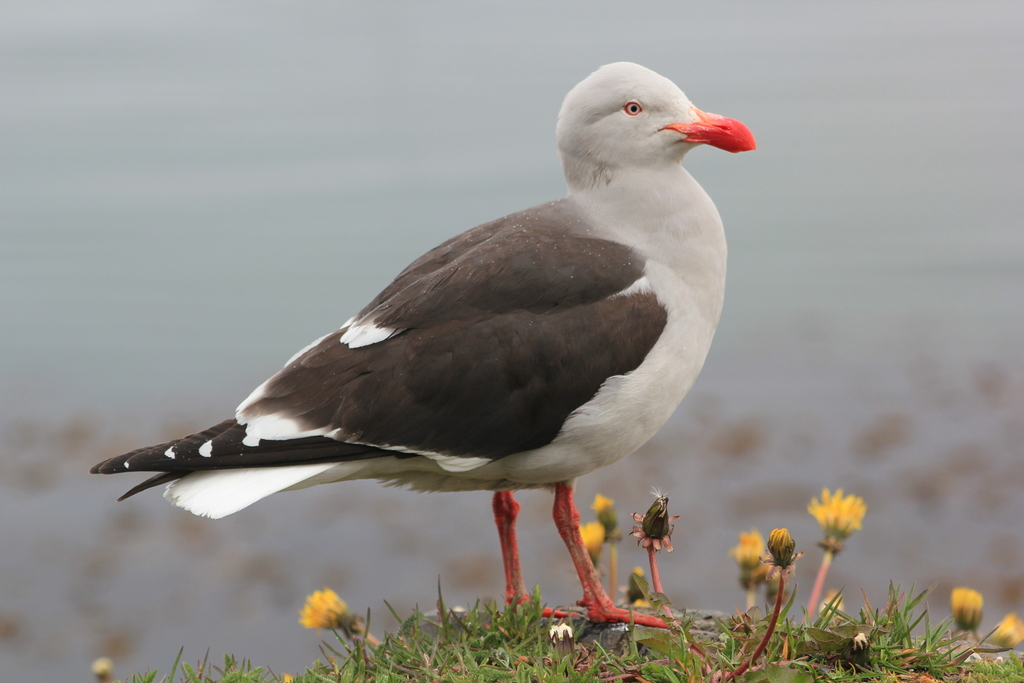
Dolphin Gull
Photo © Romi Galeota Lencina
Photo © Romi Galeota Lencina — CC BY 4.0 — Source: iNaturalist photo #57016970Identification
The dolphin gull is a distinctive coastal gull native to southern South America. It is characterized by greyish plumage on its body, with darker grey feathers on its wings, creating a subtle but noticeable contrast. Despite occasional confusion with New Zealand's red-billed gull—an unrelated species—the dolphin gull is readily identifiable once you know what to look for. The species is named after the English explorer William Scoresby (1789–1857), whose name is preserved in both its scientific designation, Leucophaeus scoresbii, and its now-obsolete common name, Scoresby's gull.
Range & Habitat
The dolphin gull is found around the coasts of Chile, Argentina, and the Falkland Islands, making it a characteristic bird of southern South American shores. The species occasionally wanders as a vagrant to South Georgia and the South Sandwich Islands. True to its name as a coastal specialist, it inhabits rocky, muddy, and sandy shores, showing a particular affinity for areas near seabird colonies. Dolphin gulls are also commonly spotted around human settlements including slaughterhouses, sewage outflows, and farmyards, where food opportunities abound.
Behaviour & Diet
The dolphin gull is an aggressive scavenger and opportunistic predator with an impressively varied diet. It feeds on carrion, offal, bird eggs, nestlings, marine invertebrates, and whatever natural food becomes available. The species has evolved a cunning strategy for nest raiding: when human disturbance causes adult seabirds to abandon their nests temporarily, dolphin gulls swiftly move in to exploit the undefended eggs and chicks. Research has shown that excluding humans from cormorant nesting areas significantly improves the cormorants' reproductive success—a testament to the dolphin gull's predatory impact. These gulls also take advantage of marine mammal activities, scavenging dead fish, placentae, and faeces, which serve as major attractants.
Dolphin gulls breed in small colonies of up to 200 pairs, typically nesting on low cliffs, sand or shingle beaches, headlands, or marshy depressions. They lay two to three eggs in December, with chicks fledging by March. Interestingly, older chicks gather together in creches, a communal arrangement that may provide protection and social benefits during the critical fledging period.
Best Time & Places to See It
The dolphin gull's breeding season peaks in December through March in the Southern Hemisphere, making this an ideal window for observing nesting birds and family groups. Year-round residents are found throughout coastal Chile and Argentina, with particularly reliable sightings in the Falkland Islands. Look for them along rocky and sandy shorelines, near active seabird colonies, and in human-modified landscapes such as coastal farmyards or waste areas where food is plentiful.
Photography Tips
Photographing dolphin gulls rewards patience and attention to their scavenging behaviour. Position yourself near seabird colonies during breeding season to capture interactions and predation attempts, or wait near food sources such as marine mammal haul-outs where they congregate. The contrast between their pale grey body plumage and darker wing feathers provides good compositional opportunities. Early morning and late afternoon light will best reveal the subtle tonal gradations that distinguish this species. Remember that the IUCN lists this species as "Least Concern" with a stable population, so ethical wildlife photography practices remain important for responsible wildlife tourism.
Chile: Fuegian Snipe & Juan Fernandez
Sea Lion Island
Sealion Island Settlement, Falkland Islands
+74 birds+3 mammals
Windswept tussock grasslands roll across volcanic terrain where Southern Ocean swells crash against rocky shores, creating one of the Falkland Islands' most dramatic wildlife theatres. This…
VIEW ISLAND & ARCHIPELAGOKidney Island
Stanley, Falkland Islands
+47 birds
Wind-scoured tussock grassland sweeps across this remote South Atlantic outcrop, where peaty soils and exposed rock formations create a landscape as austere as it is vital.…
VIEW ISLAND & ARCHIPELAGOPort Stephens
Port Stephens, Falkland Islands
+29 birds
Windswept moorlands sweep down to pristine beaches where kelp forests fringe the turquoise shallows, their giant fronds swaying in the southern current. Port Stephens, cradled on…
VIEW NATURE RESERVEMurrell Farm
falskland islands, Falkland Islands
+54 birds
Rolling grasslands sweep across windswept plateaux where the South Atlantic exerts its relentless influence on the vegetation, sculpting tussock grassland into a tapestry of browns and…
VIEW NATURE RESERVECape Dolphin
falskland islands, Falkland Islands
+54 birds+1 mammals
Where windswept grasslands meet dramatic coastal cliffs, the Falkland Islands' northern reaches reveal one of the Southern Hemisphere's most compelling seabird sanctuaries. The terrain here is…
VIEW NATURE RESERVEVolunteer Point
Stanley, Falkland Islands
+70 birds+3 mammals
Windswept grasslands meet volcanic black sand beaches where three penguin species converge in the South Atlantic's most theatrical wildlife theatre. This remote peninsula on East Falkland…
VIEW NATURE RESERVEWest Point Island
West Point, Falkland Islands
+67 birds+3 mammals
Windswept cliffs plunge dramatically into the South Atlantic, their rust-coloured rock faces sculpted by millennia of gales and spray. This northwestern outpost of the Falkland Islands…
VIEW ISLAND & ARCHIPELAGOChiloé National Park
Dalcahue, Chile
+122 birds+6 mammals
Temperate rainforest cloaks the Chiloé archipelago's northwestern reaches, where granite ridges thrust through dense, moisture-laden canopy and freshwater streams carve ravines toward the Pacific. Across approximately…
VIEW NATIONAL PARKCabo de Hornos National Park
Cape Horn, Chile
+88 birds+9 mammals
Where the Andes plunge into the Southern Ocean and the Drake Passage churns between two continents, Cabo de Hornos National Park sprawls across one of Earth's…
VIEW NATIONAL PARKTorres del Paine National Park
Torres del Paine, Chile
+143 birds+10 mammals
Where granite spires pierce the Patagonian sky, Torres del Paine commands one of South America's most dramatic landscapes. Across 4,106 square kilometres of southern Chile, jagged…
VIEW NATIONAL PARKReserva Nacional Magallanes
Punta Arenas, Chile
+78 birds+2 mammals
Where windswept steppe meets sub-Antarctic forest near the southern tip of continental South America, Reserva Nacional Magallanes unfolds across roughly 352 square kilometres of profound ecological…
VIEW NATIONAL PARKMonte León National Park
Argentina
+100 birds+4 mammals
Where the Patagonian steppe meets the Atlantic, Monte León National Park protects a landscape of windswept coastal cliffs, rocky outcrops, and semi-arid grassland spanning over 1,200…
VIEW NATIONAL PARKNo community photos yet. Log in to add the first one.
No community observations of this species yet.