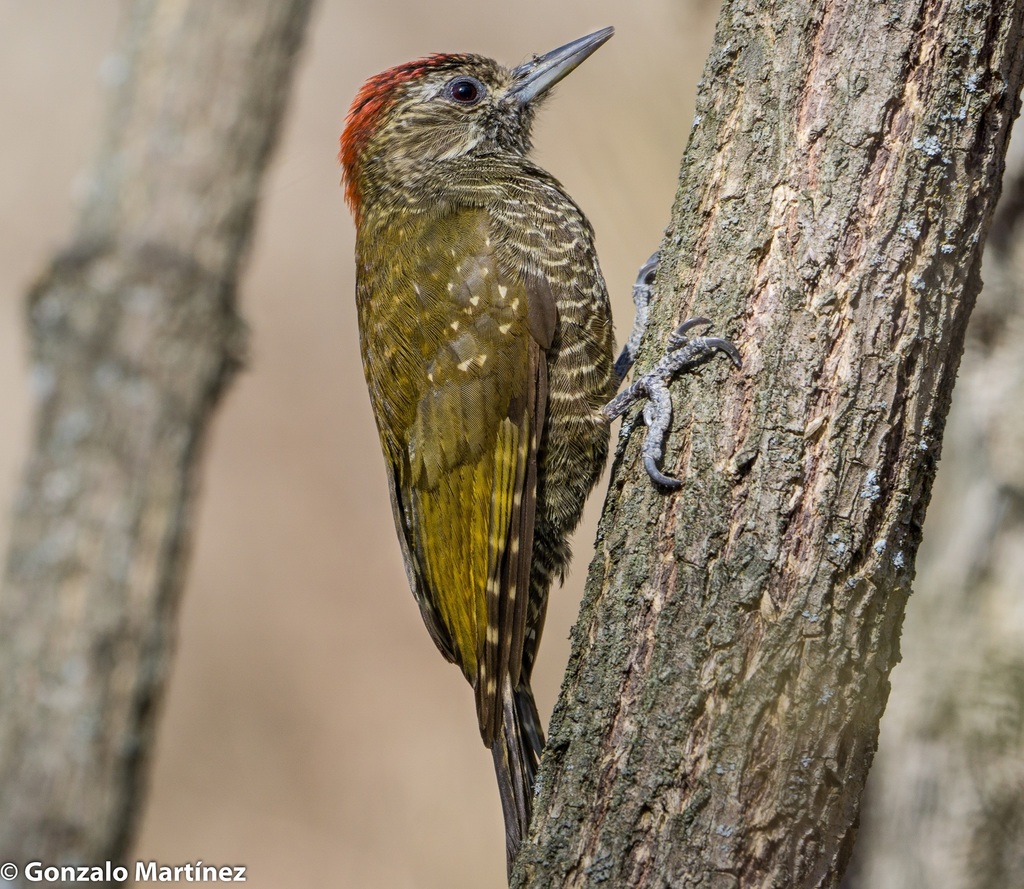
Dot-fronted Woodpecker
Photo © Gonzalo Martinez
Photo © Gonzalo Martinez — CC BY 4.0 — Source: iNaturalist #92008325The dot-fronted woodpecker (Veniliornis frontalis) is a species of bird in subfamily Picinae of the woodpecker family Picidae. It is found in Argentina and Bolivia. == Taxonomy and systematics == The International Ornithological Committee and BirdLife International's Handbook of the Birds of the World place the dot-fronted woodpecker in genus Veniliornis. However, starting in 2018, the American Ornithological Society and the Clements taxonomy moved all species of genus Veniliornis into genus Dryobates. The dot-fronted woodpecker and little woodpecker (V. (or D.) passerinus) sometimes hybridize, and some authors have treated them as conspecific. The taxonomic systems agree that the dot-fronted woodpecker is monotypic. == Description == The dot-fronted woodpecker is about 16 cm (6.3 in) long and weighs 30 to 40 g (1.1 to 1.4 oz). Males and females have the same plumage except on their heads. Males have an olive to gray-brown forehead ("front") with many white spots and are red from the crown to the nape with dark gray feather bases showing through. The female is olive-brown from forehead to nape with white spots throughout. Adults of both sexes have a mostly olive-brown face with a thin white supercilium and a thin white "moustache". Their upperparts are mostly yellowish…
El Rey National Park
Municipio de Las Lajitas, Argentina
+317 birds+4 mammals
Where the eastern slopes of the Andes descend into northwestern Argentina's subtropical transition zone, El Rey National Park unfolds across 841 square kilometers of dramatically varied…
VIEW NATIONAL PARKCalilegua National Park
Municipio de Calilegua, Argentina
+288 birds+8 mammals
Where the eastern Andean slopes plunge into northwestern Argentina's humid subtropics, nearly 2,645 square kilometers of steep terrain and luxuriant forest compose one of South America's…
VIEW NATIONAL PARKNo community photos yet. Log in to add the first one.
No community observations of this species yet.