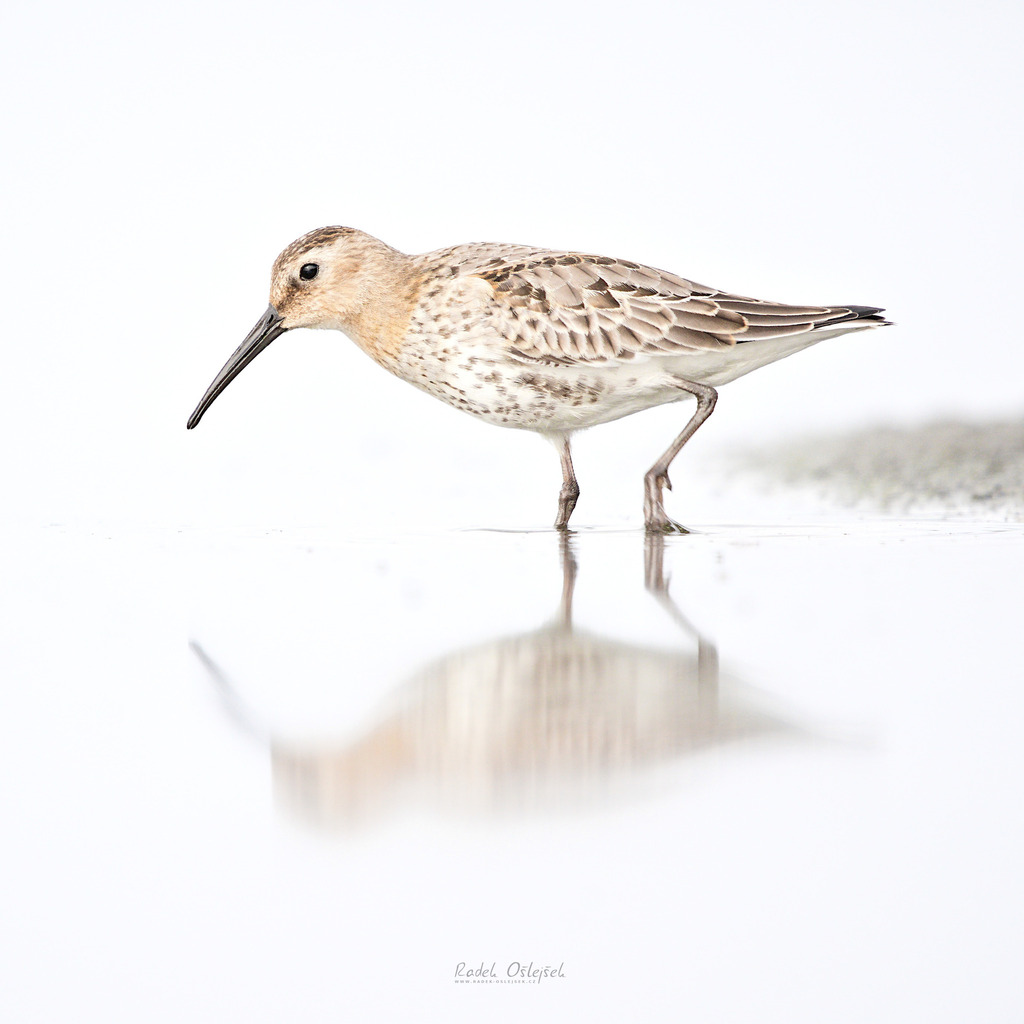
Dunlin
Photo © Radek Ošlejšek
Photo © Radek Ošlejšek — CC BY 4.0 — Source: iNaturalist #137296198Identification
The dunlin is a small wader measuring 16–20 cm in length with a wingspan of 38–43 cm, similar in size to a common starling but stouter and with a longer, thicker bill. In breeding plumage, adults display a distinctive black belly patch—a feature unique among similarly-sized waders. Winter birds are greyish-brown above and white below, while juveniles are brown with two weak whitish "V" shapes on the back and black marks on the flanks or belly. All ages show a narrow white wingbar in flight. The legs and black bill are particularly notable; the bill tip features a soft, sensitive probe filled with blood and nerve endings, used to detect prey in mud and sand, though it appears blunt in life despite looking sharp in dead specimens. Ten subspecies are recognised, differing mainly in the extent of rufous plumage and black belly patch size during breeding season, and in bill length.
Range & habitat
The dunlin is a circumpolar breeder found across Arctic and subarctic regions. Western European breeding populations are short-distance migrants, largely remaining on western and southern European coasts and northwest African shores. Birds breeding in far northern Europe and Asia are long-distance migrants, wintering as far south as Africa, southeast Asia, and west Asia. North American populations breeding in Alaska and the Canadian Arctic migrate to Pacific and Atlantic coasts, though those nesting in northern Alaska overwinter in Asia. These are highly migratory birds showing strong philopatry, with individuals returning to or near their natal breeding patches.
Behaviour & diet
The dunlin is one of the most common and highly gregarious waders throughout its range, particularly in winter when large flocks gather on coastal mudflats and sandy beaches. Flocks often engage in spectacular synchronized swirling flights during migration stopovers. The bird feeds with a characteristic "sewing machine" action, methodically picking small food items along coastal mudflat beaches. On breeding grounds, insects—particularly Diptera—form the main diet, while in coastal areas they consume molluscs, worms, and crustaceans.
Best time & places to see it
Dunlins are easiest to observe during winter months on coastal mudflats and sandy beaches, where large flocks congregate. They are particularly visible during migration periods on stop-overs. Western European coasts, northwest African shores, and North American Pacific and Atlantic coasts offer reliable viewing opportunities. The species is one of the most common waders throughout its breeding and wintering ranges, making encounters likely in suitable coastal habitats during appropriate seasons.
Photography tips
Photograph dunlins in winter plumage on open mudflats or beaches where their greyish-brown and white coloration contrasts with the habitat. Breeding birds offer more dramatic subjects with their distinctive black belly patches visible. Capture the characteristic feeding action by positioning yourself low and still near feeding flocks. Large synchronized flocks in flight provide spectacular opportunities for action photography. The narrow white wingbar is visible in flight photos. Early morning light on coastal habitats often yields the best results, and patience is rewarded as flocks wheel and turn in coordinated movements.
Abijata-Shalla Lakes National Park
Acadia National Park
Alaska Maritime National Wildlife Refuge
Algonquin Provincial Park
Alligator River National Wildlife Refuge
Alta Murgia National Park
Altai Tavan Bogd National Park
Arctic National Wildlife Refuge
Avesnois Regional Nature Park
Nothing matches these filters.
No community photos yet. Log in to add the first one.
No community observations of this species yet.