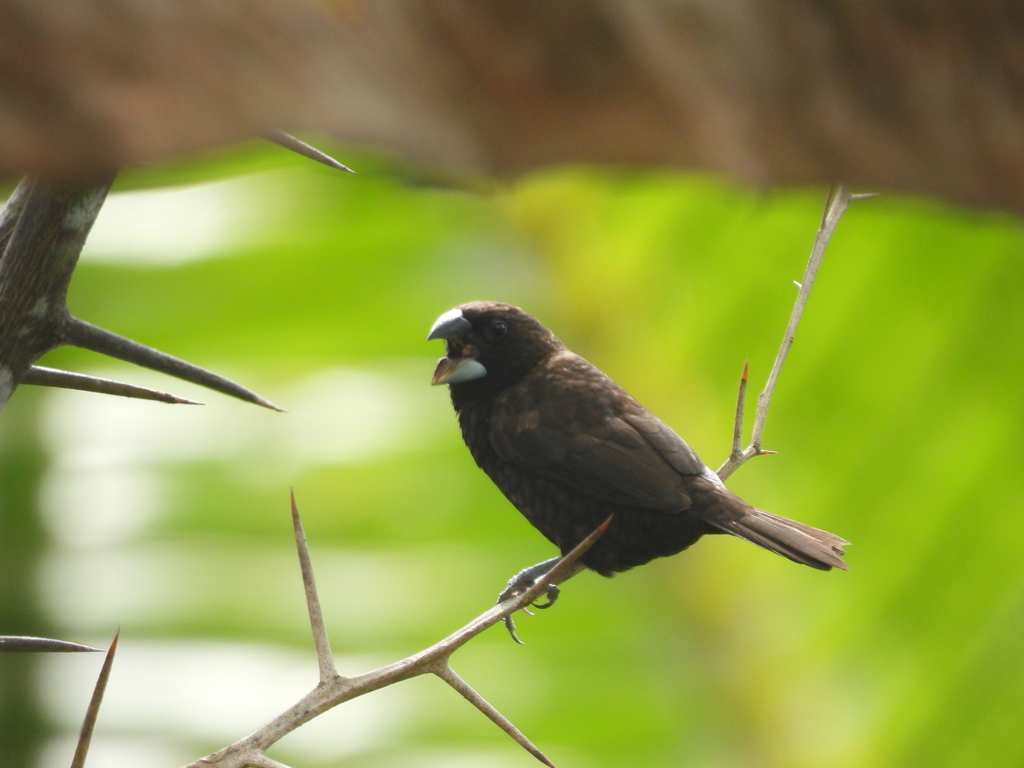
Dusky Munia
Photo © Seno Nur Rohman
Photo © Seno Nur Rohman — CC BY-SA 4.0 — Source: iNaturalist #183168634Identification
The Dusky Munia is a small perching bird, measuring just 10–11 cm in length and weighing around 9.5 grams. Its most distinctive feature is its rich dark brown plumage, with pale brown streaking on the crown. Look for the characteristic gray eye-ring and dark facial markings. The bill is notably bicolored: black on the upper mandible and blue-gray on the lower, matching the bird's blue-gray legs. There is no visible difference in plumage between males and females, making this a challenging species for sexing in the field.
Range & Habitat
Endemic to Borneo, the Dusky Munia is also found in Brunei, Indonesia, Malaysia, and the Philippines, with introduced populations in the Natuna, Banggi, Cagayan, and Sulu Islands. This non-migratory species inhabits subtropical and tropical lowland shrubland, forest, and grassland from sea-level to 500 meters elevation. It favors disturbed and cultivated habitats including rice paddies, secondary scrub, riverbanks, and reed-beds, making it relatively accessible to travelers.
Behaviour & Diet
Dusky Munias are highly social birds, typically encountered in flocks that communicate with gentle whistles and various calls. In flight, they produce low-toned "teck teck" calls, while perched birds emit shrill "pee pee" notes, high-pitched "peeps," or thin "chirrup" sounds. Their diet consists primarily of grass seeds and weed seeds, supplemented with rice grains and insects. They forage methodically through vegetation and on the ground, carefully gleaning seeds from seed heads, overturned earth, buffalo dung, and deep in the soil. These birds often roost and even sleep alongside other munia species, reinforcing their gregarious nature.
Best Time & Places to See It
The Dusky Munia's stable population and non-migratory habits mean it can be found year-round throughout its range. The best locations are Borneo's lowland agricultural areas, particularly rice paddies and grasslands in the foothills. Look along riverbanks and reed-beds where the species naturally congregates. Flocking behavior makes them more conspicuous than many small passerines, so patience and listening for their distinctive calls will improve your chances of locating groups.
Photography Tips
The bird's small size and preference for vegetation can make photography challenging. Position yourself near rice paddies or open grasslands at dawn when flocks are most active and vocal. Use a telephoto lens of at least 400 mm to capture detail from a distance. The dark plumage and pale crown provide good contrast; expose for the face to retain detail in the eye-ring. Since these birds forage on the ground and in low vegetation, a lower shooting angle often produces more engaging images. The gregarious nature of flocks offers opportunities for behavioral shots of multiple birds interacting.
Bako National Park
Kuching, Malaysia
+210 birds+17 mammals
Weathered sandstone cliffs rise dramatically from the South China Sea, their ochre faces sculpted by millennia of wind and tide into a landscape of extraordinary geological…
VIEW NATIONAL PARKKuching Wetlands National Park
Kuching, Malaysia
+103 birds+4 mammals
Where brackish waters meet mangrove stilts and freshwater swamps blend into coastal mudflats, one of Southeast Asia's most dynamic wetland ecosystems unfolds across Sarawak's northwestern coast.…
VIEW NATIONAL PARKTaman Negara Bukit Lambir National Park
Miri, Malaysia
+153 birds+7 mammals
Rainforest cascades down sandstone ridges where crystal streams carve through ancient geology, creating a landscape of profound biological richness in Sarawak's interior. This 68-square-kilometre sanctuary protects…
VIEW NATIONAL PARKGunung Mulu National Park
Long Seridan, Malaysia
+280 birds+39 mammals
Where granite monoliths pierce the rainforest canopy of Sarawak, an ancient limestone karst landscape reveals one of Southeast Asia's most biodiverse strongholds. Soaring peaks cloaked in…
VIEW NATIONAL PARKGunung Palung National Park
Kayong Utara, Indonesia
+38 birds+1 mammals
Rainforest swells across the steep terrain of West Kalimantan, where ancient volcanic ridges rise abruptly from lowland swamps and weathered plateaus. Gunung Palung National Park encompasses…
VIEW NATIONAL PARKNo community photos yet. Log in to add the first one.
No community observations of this species yet.