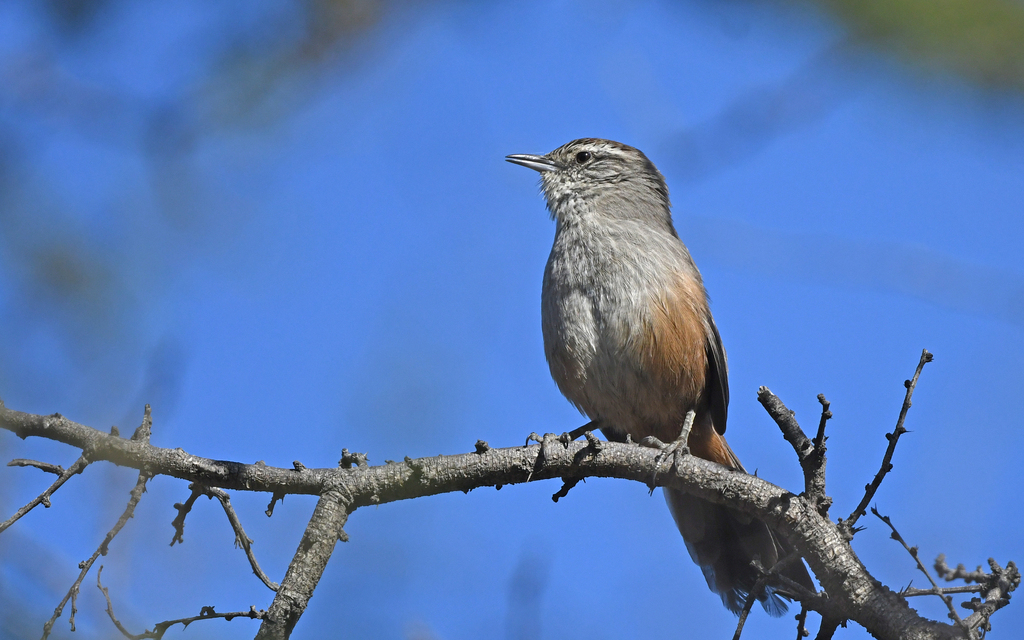
Dusky-tailed Canastero
Photo © Christoph Moning
Photo © Christoph Moning — CC BY 4.0 — Source: iNaturalist photo #378496549Identification
The dusky-tailed canastero is a small ovenbird, measuring 14 to 16 cm in length and weighing just 18 to 24 grams. Both sexes share identical plumage. The nominate subspecies features a dark gray-brown face with a narrow whitish supercilium and faint paler streaks, a dark brown crown, and a slightly paler brown back. The rump is paler brown with a rufescent tinge, while the tail's central feathers are brown with dark fuscous tips; the remaining tail feathers are blackish-fuscous. The underparts are distinctive: a whitish throat with black flecks, a whitish upper breast with black streaks, and a brownish-gray lower breast with faint pale streaks. The belly is paler and unstreaked, with rufescent-brown flanks and darker rufous-brown undertail coverts. The iris is dark brown, the maxilla dull black, and the mandible bluish gray with a black tip.
Two additional subspecies occur within the range. Subspecies goodalli displays more facial streaks, a darker crown, brighter cinnamon on the shoulder and flanks, and less visible breast streaks. Subspecies polysticta resembles the nominate but with duller flanks and undertail coverts and more spotting on the underparts. Juveniles are more rufous on the rump with less streaking on the underparts and more rufescence on the tail.
Range & Habitat
The dusky-tailed canastero is endemic to Chile, with its range divided among three subspecies. Subspecies goodalli inhabits the southwestern Antofagasta Region in the north, while the nominate subspecies ranges from the Atacama Region south into the northern Maule Region. Subspecies polysticta occurs from southern Maule south to the Araucanía Region. The species is a year-round resident throughout its range.
Habitat preferences vary geographically across its distribution. In the north, the species favors desert with scattered shrubs and the edges of dry forest near the coast, with very localized populations in inland valleys. Central and southern populations extend from near the coast up to approximately 1,800 meters in the piedmont foothills, inhabiting semi-arid steppe landscapes with dense bushes and forest edges. Throughout its range, the species consistently avoids populated areas, showing a strong preference for undisturbed habitat.
Behaviour & Diet
The dusky-tailed canastero is primarily an arthropod forager, supplementing its diet with smaller amounts of berries and seeds. It typically forages alone or in pairs, moving deliberately among branches of shrubs and trees as it searches for prey. The species is vocal, particularly during breeding season, producing two distinct songs: one composed of squeaky disyllabic "chi-wee" notes that gradually increase in volume and pitch before fading, and another a long, somewhat variable dry rattling trill that descends in pitch. A sharp "tsik" call is heard year-round.
Breeding occurs between August and December, peaking in mid-September. Both members of a breeding pair construct an elaborate covered basket nest of thorny twigs suspended from a forked branch or cactus. The egg chamber is lined with softer plant materials, horsehair, and feathers. Clutches contain two to four eggs, with an incubation period of 20 to 22 days and fledging occurring 15 to 16 days after hatching. Both parents share incubation and nestling provisioning duties.
Best Time & Places to See It
The breeding season from August through December, with peak activity in mid-September, offers the best opportunity to locate this species through its characteristic vocalizations. Year-round residency means the dusky-tailed canastero can potentially be found in suitable habitat in any season, though detecting this unobtrusive species requires patience and careful observation. The bird's strong avoidance of human-disturbed areas means protected reserves and remote semi-arid steppe landscapes offer the most promising locations for observation.
Photography Tips
The dusky-tailed canastero's small size and preference for dense shrubby habitat present significant photographic challenges. Success depends on locating birds through their calls during breeding season and positioning yourself patiently near suitable vegetation. The species' cryptic coloration—dominated by browns and grays with subtle rufescent tones—requires careful exposure metering to preserve detail in both highlights and shadows. Early morning light will best reveal the plumage patterns, particularly the facial supercilium and breast streaking. Since the bird forages among branches and typically moves as a single bird or pair, fast shutter speeds are essential to freeze motion as it hops through shrubs.
Chile: Fuegian Snipe & Juan Fernandez
Pan de Azúcar National Park
Chañaral, Chile
+74 birds+4 mammals
Where the Atacama Desert plunges toward the Pacific, Pan de Azúcar National Park sprawls across 727 square kilometres of one of Earth's most extreme transitions—a landscape…
VIEW NATIONAL PARKLaja National Park Lagoon
Antuco, Chile
+123 birds+1 mammals
Where the Andes descend into the Biobío Region's temperate forests, a vast lagoon fills the caldera of the extinct Antuco volcano, cradled by steep native woodland…
VIEW NATIONAL PARKNo community photos yet. Log in to add the first one.
No community observations of this species yet.