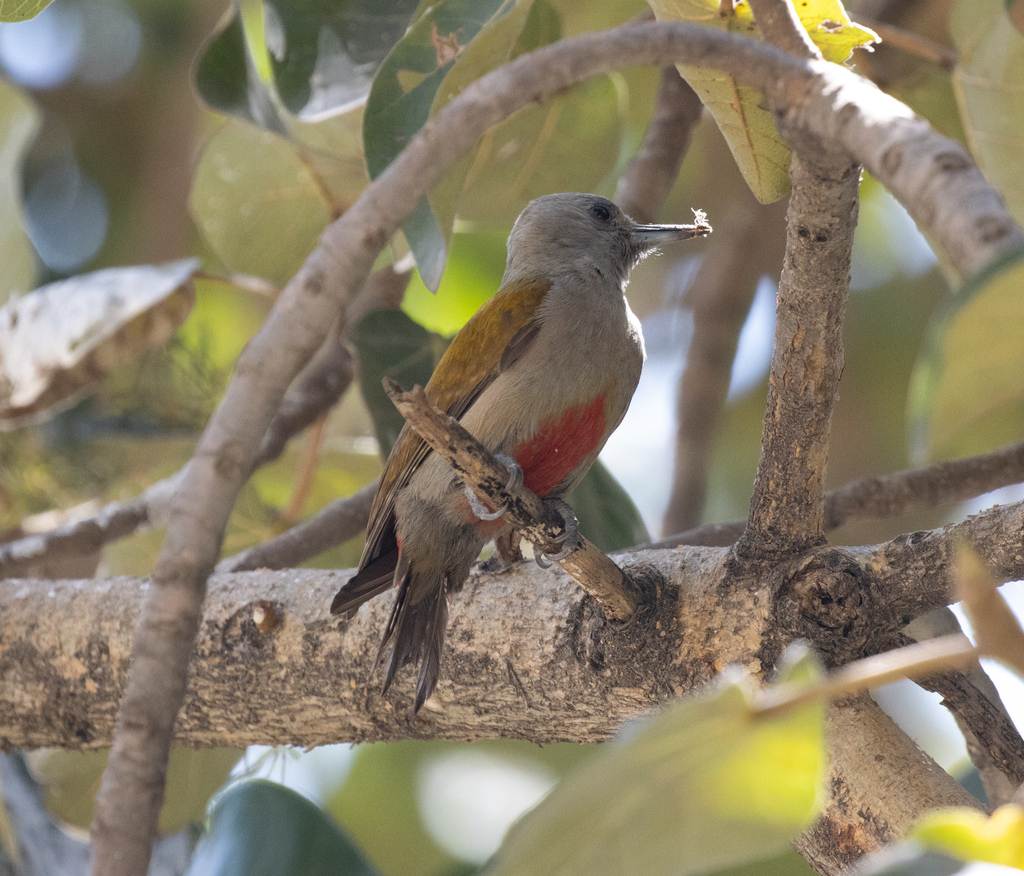
Eastern Grey Woodpecker
CC BY 4.0
CC BY 4.0 — Source: iNaturalist photo #607087404Identification
The eastern grey woodpecker is a striking species with distinctive sexual dimorphism. Males display a bold red crown and nape, while females sport a plain grey head entirely lacking red markings. Both sexes share yellowish-green upper parts, a red rump, and dark brown wings and tail. The head and underparts are pale grey, with a characteristic reddish patch on the lower belly. The bird has the typical woodpecker anatomy: a straight pointed bill, stiff tail feathers for trunk support, and zygodactyl feet with two toes pointing forward and two backward. The beak is dark grey or black, legs greenish-grey, and eyes range from red to brown. Young birds resemble females but display paler reds and may show subtle barring on the flanks and some red spotting on the crown.
Range & Habitat
This species is endemic to tropical eastern Africa, with its range spanning Ethiopia, Kenya, South Sudan, Sudan, and Tanzania. The eastern grey woodpecker favours humid forests, forest verges, and gallery forests, demonstrating remarkable altitudinal range from lowland areas up to 3,300 metres. As a resident breeder throughout its range, it is a fairly common species with a large overall distribution and no recognised special conservation threats.
Behaviour & Diet
Like all woodpeckers, the eastern grey woodpecker is a dedicated insectivore, employing its characteristic foraging style both on trees and on the ground. It actively hunts for moths, centipedes, larvae, and pupae, using its long extendable tongue to capture prey with precision. The species is frequently observed and regularly produces the distinctive tapping and drumming sounds characteristic of woodpeckers, which serve both territorial and feeding functions.
Best Time & Places to See It
Travellers seeking the eastern grey woodpecker should focus on forested regions throughout Ethiopia, Kenya, South Sudan, Sudan, and Tanzania. The species' preference for humid forests and gallery forests makes these riparian corridors particularly rewarding locations. Its status as a fairly common resident breeder means sightings are relatively reliable year-round, though the species can be located by listening for its distinctive drumming and tapping sounds through forested areas at any elevation from lowlands to mountains above 3,000 metres.
Photography Tips
Photographers should seek out humid forest habitats and gallery forests where light conditions can be challenging; a fast shutter speed and high ISO may be necessary in the dappled forest understory. The male's vibrant red crown and nape provide striking colour contrast against the pale grey head and yellowish-green back, making males particularly photogenic subjects. The bird's regular drumming behaviour offers opportunities for action shots, while patient positioning near fruiting or insect-rich trees may yield feeding sequences. The red rump and belly patch are distinctive field marks worth capturing from multiple angles.
Serengeti National Park
Tanzania
+558 birds+57 mammals
Across Tanzania's northern plateau, where volcanic soils meet acacia woodland and open grassland, unfolds one of Earth's most dynamic ecosystems. The Serengeti National Park sprawls across…
VIEW NATIONAL PARKArusha National Park
Tanzania
+555 birds+16 mammals
Where the slopes of Mount Mawenzi rise above the Arusha region, a compact yet ecologically rich national park unfolds across montane forest, moorland, and alpine zones.…
VIEW NATIONAL PARKAmboseli National Park
Etonet/Lenkism ward, Kenya
+501 birds+43 mammals
Where the Amboseli basin opens toward the Tanzanian frontier, a shallow alkaline lake mirrors vast skies across one of East Africa's most iconic savanna landscapes. The…
VIEW NATIONAL PARKMount-Kenya National Park
Abothuguchi west ward, Kenya
+334 birds+11 mammals
Where the slopes of Kenya's second-highest mountain rise steeply from the Meru County foothills, a landscape of profound ecological richness unfolds across Mount Kenya National Park.…
VIEW NATIONAL PARKTarangire National Park
Tanzania
+527 birds+50 mammals
Acacia woodland and grassland sweep across the Manyara Region where the Tarangire River carves through low hills and volcanic soils, creating one of East Africa's most…
VIEW NATIONAL PARKNgorongoro Conservation Area
Tanzania
+626 birds+55 mammals
Volcanic calderas and open grassland dominate this high plateau in northern Tanzania, where the landscape rises above 2,000 metres and ancient geological forces have shaped both…
VIEW WILDLIFE MANAGEMENT AREAAbijata-Shalla Lakes National Park
Ethiopia
+438 birds+7 mammals
Two crater lakes of contrasting chemistry define this remote corner of Ethiopia's Rift Valley, where soda lakes and freshwater basins create a mosaic of distinct aquatic…
VIEW NATIONAL PARKAwash National Park
Didiga, Ethiopia
+473 birds+23 mammals
Where the Ethiopian Rift Valley carves through volcanic plateaus, a ribbon of riverine forest winds through acacia scrubland and grassland, creating a mosaic of habitats that…
VIEW NATURAL PARKYabelo Wildlife Sanctuary
Bedewera, Ethiopia
+359 birds+5 mammals
Where acacia woodlands meet volcanic plateaus in southern Ethiopia, a landscape of austere beauty unfolds across nearly 2,500 square kilometers. Yabelo Wildlife Sanctuary sprawls across semi-arid…
VIEW WILDLIFE SANCTUARYNairobi National Park
Nairobi, Kenya
+515 birds+35 mammals
Just minutes from Kenya's capital, where the Nairobi River winds through acacia woodland and open grassland, lies one of Africa's most paradoxical wildlife sanctuaries. The park's…
VIEW NATIONAL PARKLake Nakuru National Park
Nakuru West, Kenya
+494 birds+32 mammals
Alkaline waters ringed by acacia woodland and grassland create one of East Africa's most distinctive wetland ecosystems, where the interplay of geology and climate sustains a…
VIEW NATIONAL PARKAberdare National Park
Mweiga ward, Kenya
+394 birds+30 mammals
Where the central highlands of Kenya rise to their elemental grandeur, the Aberdare range unfolds across Nyeri County as a montane stronghold of cool, misty forest…
VIEW NATIONAL PARKSamburu National Reserve
Samburu, Kenya
+430 birds+42 mammals
Across the arid plains of northern Kenya, where scattered acacia woodland gives way to rocky outcrops and dry riverbeds, Samburu National Park unfolds as one of…
VIEW NATURE RESERVEHell’s Gate National Park
Olkaria ward, Kenya
+388 birds+18 mammals
Volcanic scarps and geothermal vents dominate the floor of Hell's Gate, where the East African Rift has carved a dramatic gorge through crystalline rock formations. The…
VIEW NATIONAL PARKSaiwa Swamp National Park
Sinyerere ward, Kenya
+255 birds+4 mammals
Where papyrus and sedge marshes stretch across a highland plateau in western Kenya, Saiwa Swamp National Park shelters one of East Africa's most productive freshwater wetland…
VIEW NATIONAL PARKNo community photos yet. Log in to add the first one.
No community observations of this species yet.