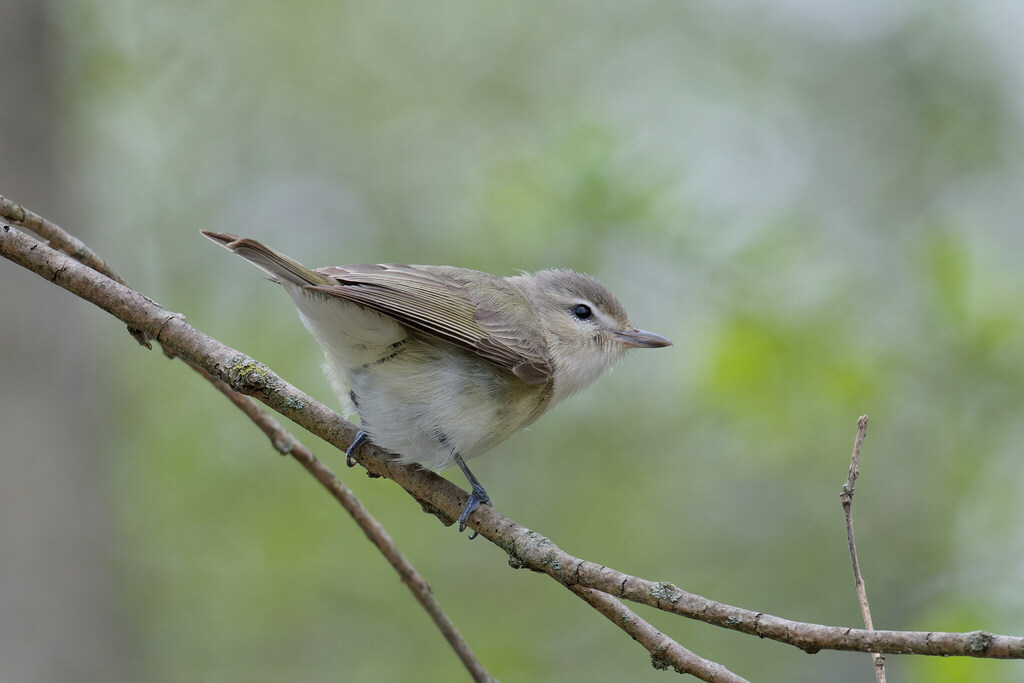
Eastern Warbling Vireo
Photo © Donald Davesne
Photo © Donald Davesne — CC BY 4.0 — Source: iNaturalist photo #504619112Identification
The Eastern Warbling Vireo is a small, delicate songbird measuring 12–13 cm in length with a wingspan of 22 cm and weighing just 10–16 grams. Its plumage is understated but elegant: mainly olive-grey on the head and upperparts, with clean white underparts and a distinctive white supercilium (eyebrow stripe). The front of the face is noticeably lighter, and the bird has brown eyes paired with thick blue-grey legs and a stout, sturdy bill. Compared to its western cousins, the Eastern Warbling Vireo tends to be slightly larger with a lighter crown, though subtle differences in appearance between eastern and western populations can make field identification challenging where ranges overlap.
Range & Habitat
The Eastern Warbling Vireo breeds across a broad range extending from central Alberta and northern Montana eastward and southward through most of the United States and parts of southern Canada. Its preferred breeding habitat consists of open deciduous and mixed woodlands, where it often nests in widely spaced trees—particularly cottonwoods and aspens—along streams and rivers. This species is a long-distance migrant, traveling south after breeding to winter grounds ranging from south-central Chiapas in Mexico through Nicaragua. Notably, Eastern birds complete their autumn molt on the breeding grounds before departing, unlike their western counterparts.
Behaviour & Diet
The Eastern Warbling Vireo is an active forager, gleaning insects from trees by hopping methodically along branches and occasionally hovering to snatch prey from foliage. Beyond insects, the species supplements its diet with berries, becoming particularly reliant on fruit before migration and throughout the winter season. Gumbo-limbo seeds are a favored winter food, though the birds show a notable preference for natural sources and avoid human-modified habitats in search of them.
During breeding season, pairs construct deep cup nests suspended carefully from tree branches or shrubs. Males are notably attentive partners, assisting with incubation duties and sometimes singing from the nest itself. The species is known for its cheerful warbling song, which bears similarity to the painted bunting and purple finch, with subtle regional variations between eastern and western populations.
Best Time & Places to See It
The Eastern Warbling Vireo is best sought during the breeding season when birds are territorial and vocal, actively nesting in open deciduous and mixed woodlands across the eastern and central portions of North America. Riparian corridors with cottonwoods and aspens along streams and rivers are prime habitat. Spring and early summer offer the best opportunities, when males are singing from nesting territories. The species departs for Central and South America by late summer, making winter sightings in northern regions impossible.
Photography Tips
Photographing the Eastern Warbling Vireo requires patience and careful positioning, as this small bird spends much of its time high in trees foraging among foliage. Early morning is ideal, when birds are most active and light is favorable. Position yourself quietly near riparian woodlands with scattered tall trees, and listen for the cheerful warbling song to locate individuals. The bird's habit of hopping along branches and occasionally hovering provides fleeting photographic opportunities; a fast shutter speed and high ISO may be necessary to capture sharp images in dappled light. The white supercilium and light facial markings are key identification features worth highlighting in your images.
Acadia National Park
Alaska Maritime National Wildlife Refuge
Algonquin Provincial Park
Alligator River National Wildlife Refuge
Arches National Park
Badlands National Park
Banff National Park
Bic National Park
Big Bend National Park
Nothing matches these filters.
No community photos yet. Log in to add the first one.
No community observations of this species yet.