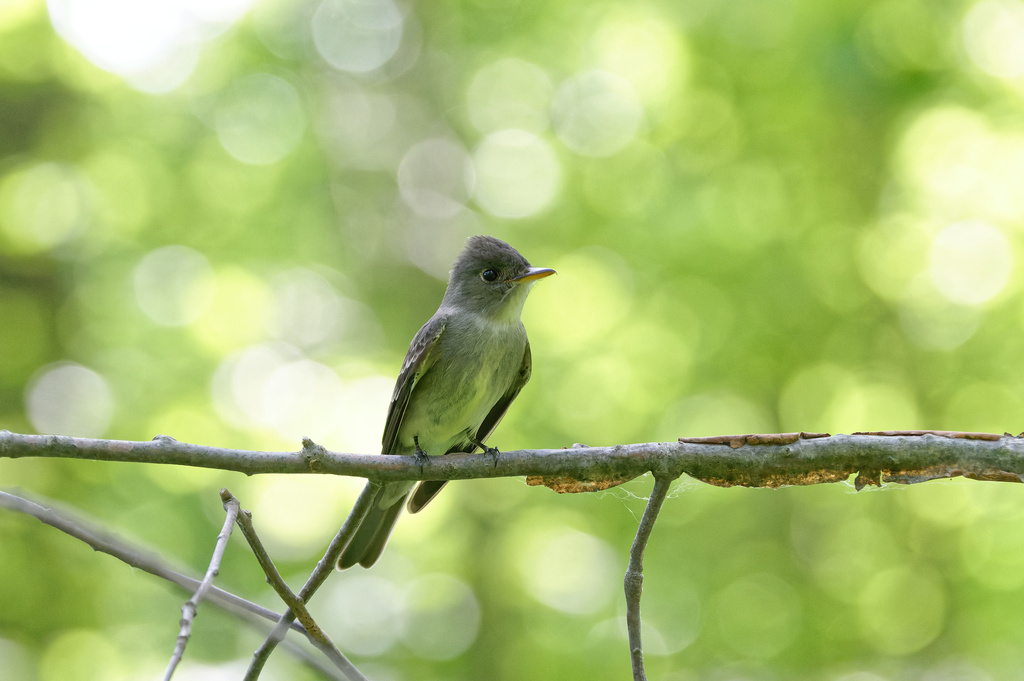
Eastern Wood Pewee
Photo © Donald Davesne
Photo © Donald Davesne — CC BY 4.0 — Source: iNaturalist photo #412695451Identification
The eastern wood pewee is a small tyrant flycatcher measuring 5.3–5.9 inches in length with a wingspan of 9.1–10.2 inches, weighing around 0.49 ounces. The sexes are identical. Adults display gray-olive upperparts with pale, olive-washed underparts on the breast. Two pale wing bars are visible on each wing, and notably long primary remiges create a slim, pointed wingtip silhouette. The upper mandible is dark while the lower mandible is yellowish.
The eastern wood pewee is most reliably distinguished from the nearly identical western wood pewee by voice: its mournful whistled song is a series of "pee-a'wee" notes, which inspired its common name, along with a rising "pe-wee" call. From the similar eastern phoebe, it differs by possessing clearly defined wing bars, lacking tail-bobbing behavior, and having longer primary projection. The least flycatcher is smaller, blunt-winged, and lacks the wood pewee's pointed primary projection.
Range & Habitat
Eastern wood pewees breed throughout deciduous, mixed, and pine forests of eastern North America, arriving late on breeding grounds—typically not before late April in southern regions, though not reaching southern Ontario until mid-May through early June. They winter in Central America, the Caribbean, and the Andes region of northern South America, departing breeding grounds from late August through September. Migration patterns have remained consistent over the past century, with birds dispersing and moving slowly as they approach breeding or wintering grounds.
Behaviour & Diet
These flycatchers are sit-and-wait hunters, perching at middle height in trees and flying out to catch insects and arthropods in flight, sometimes hovering to pluck prey from vegetation. Breeding males are aggressively territorial, defending nesting areas and frequently fighting with neighboring males and even attacking other species. They construct open cup nests from grasses, bark, and lichen, binding them to horizontal branches with spider silk at heights averaging 30 feet, typically in oaks, pines, birches, and maples. Females usually lay three translucent-white eggs with brown markings concentrated at the larger end; eggs hatch in 12–14 days, and nestlings fledge 15–17 days later, often landing on the ground during their initial flight.
Best Time & Places to See It
Eastern wood pewees are common and widespread across their breeding range in eastern North America during late spring and summer months. The best viewing period begins in late April and extends through August, before their southward migration. Listen for their distinctive mournful "pee-a'wee" song, which aids in locating birds in deciduous and mixed forests. While they migrate through the Caribbean (rarely encountered in the Cayman Islands except briefly in late February through early March during northbound migration), observers in eastern North America have the best chance of encountering them during the breeding season.
Photography Tips
Photograph perched birds to capture their characteristic pointed wingtip and pale wing bars against their gray-olive back. The pale lower mandible contrasts nicely with the darker upper mandible and provides good detail in close-ups. Early morning light suits their habit of perching at mid-canopy height. Their sit-and-wait hunting style makes them relatively cooperative subjects compared to more active flycatchers. Capturing birds in flight requires fast shutter speeds but rewards patient photographers with images showing their characteristic slim profile and long primary projection.
Acadia National Park
Alaska Maritime National Wildlife Refuge
Algonquin Provincial Park
Alligator River National Wildlife Refuge
Amacayacu National Park
Arenal Volcano National Park
Arrecifes de Cozumel National Park
Bahuaja Sonene National Park
Barbilla National Park
Nothing matches these filters.
No community photos yet. Log in to add the first one.
No community observations of this species yet.