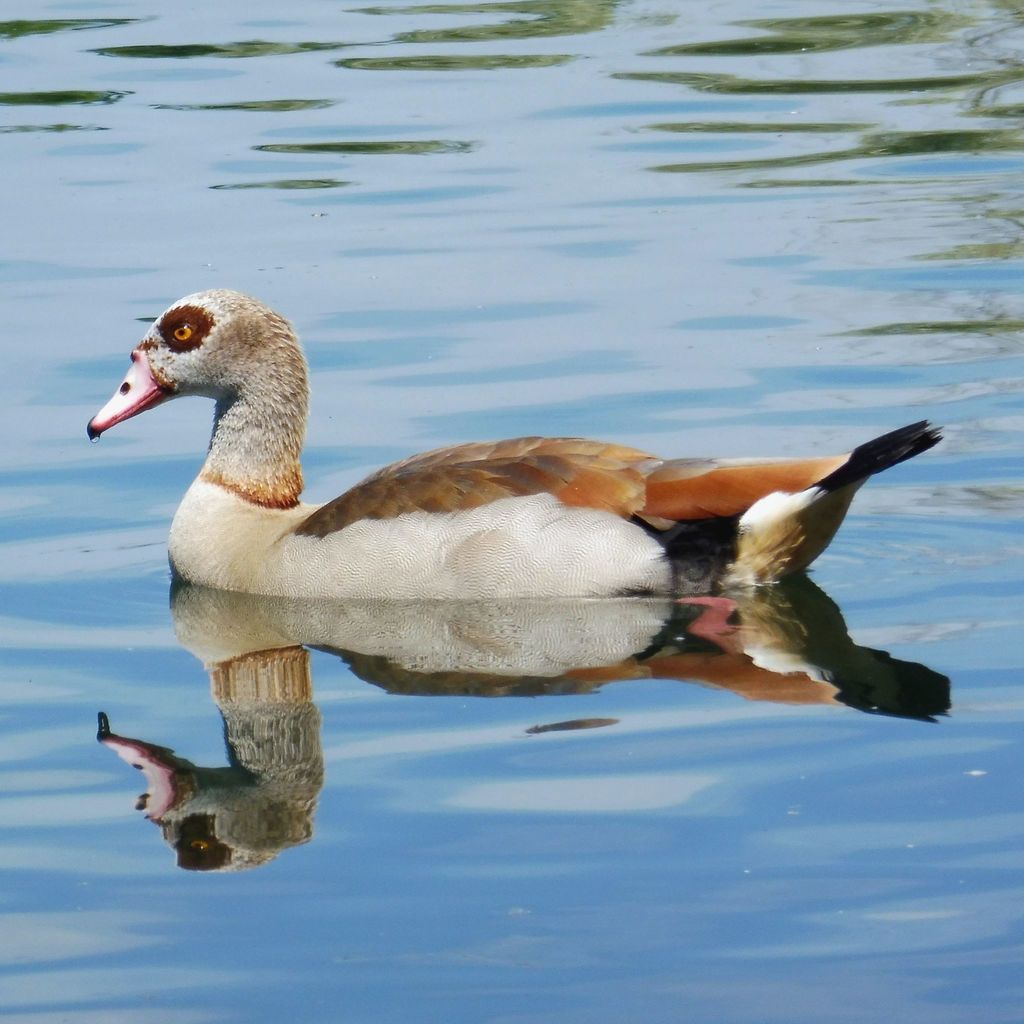
Egyptian Goose
Photo © Barry Walter
Photo © Barry Walter — CC BY 4.0 — Source: iNaturalist #20184479Identification
The Egyptian goose is a medium-sized waterfowl, measuring 63–73 cm in length and weighing 1,500–2,348 g. Males are typically somewhat larger than females, though the sexes are identical in plumage. The species exhibits considerable variation in coloring, with some individuals appearing greyer and others browner, a variation unrelated to sex or age. A distinctive feature is the large expanse of white on the wings of mature birds, which remains hidden by wing coverts when the bird is at rest but becomes prominently displayed when the goose is alarmed or aggressive. The Egyptian goose swims well and appears heavy in flight, moving more like a goose than a duck, which accounts for its common name.
The vocalizations of males and females differ markedly. Males produce a hoarse, subdued duck-like quack that rarely sounds unless the bird is aroused, as well as a louder, breathy call performed in rapid sequence, resembling a steam engine. Females have a far noisier, raucous quack, frequently heard when they are tending young or displaying aggression. During courtship, males perform an elaborate, noisy display that includes honking, neck stretching, and feather displays to attract mates.
Range & Habitat
The Egyptian goose is native to Sub-Saharan Africa and the Nile Valley, where it remains widespread and common to abundant, though it has become scarce in the northern Nile Valley. The species inhabits open or semi-open habitats typically near fresh water, ranging from lowlands to 4,000 m above sea level in the Ethiopian Highlands. It is largely absent from dense forests and deserts. While not breeding, Egyptian geese disperse more widely, sometimes undertaking longer migrations northwards into the arid Sahel regions, and occasionally reaching the North African nations of Algeria and Tunisia.
Beyond its native African range, the Egyptian goose has been introduced to Europe, the United States, and elsewhere, primarily through its popularity as an ornamental bird. The species was historically present in southeastern Europe until the early 1700s and in parts of Turkey and the western Middle East until the early 1900s. In Great Britain, Egyptian geese date back to 17th-century introductions to estates and parks, and the species is now found mainly in East Anglia and along the River Thames. From introductions in the Netherlands in 1967 and Belgium in 1982, the species has experienced relatively fast range expansion across mainland Europe, spreading into Germany, France, and subsequently into the Czech Republic, Denmark, Luxembourg, Switzerland, and other countries.
Behaviour & Diet
Egyptian geese in the wild can live for up to 15 years, while captive individuals have been recorded reaching an age of 35 years. In their introduced British habitat, the species breeds at sites offering open water, short grass, and suitable nesting locations such as islands, holes in old trees, or amongst epicormic shoots on aged trees. During winter months, they disperse widely in river valleys, where they feed on short grass and cereals, making them adaptable foragers in agricultural landscapes.
Best Time & Places to See It
For those wishing to observe Egyptian geese in their native range, Sub-Saharan Africa and the Nile Valley offer the best opportunities, where the species remains widespread and common to abundant. In Europe, introduced populations can be reliably encountered in Great Britain, particularly in East Anglia and along the River Thames, where they breed and winter. During winter months, dispersed populations are more widely visible in river valleys across their European range.
Photography Tips
The Egyptian goose's dramatic white wing patches provide excellent photographic opportunities, particularly when the bird is alarmed or displaying aggression and extends its wings. Photographers should position themselves near open water, short grass, and suitable nesting habitats such as tree-lined rivers or islands to capture the species in its preferred environment. The species' heavy, goose-like flight style offers distinctive in-flight photography opportunities. Early morning or late afternoon light along river valleys during winter dispersal periods will best illuminate the bird's variable plumage tones and distinctive features.
Bwindi Impenetrable National Park
Lake Mburo National Park
Mabamba Swamp
Murchison Falls National Park
Queen Elizabeth National Park
Aberdare National Park
Abijata-Shalla Lakes National Park
Addo Elephant National Park
Agulhas National Park
Nothing matches these filters.
No community photos yet. Log in to add the first one.
No community observations of this species yet.