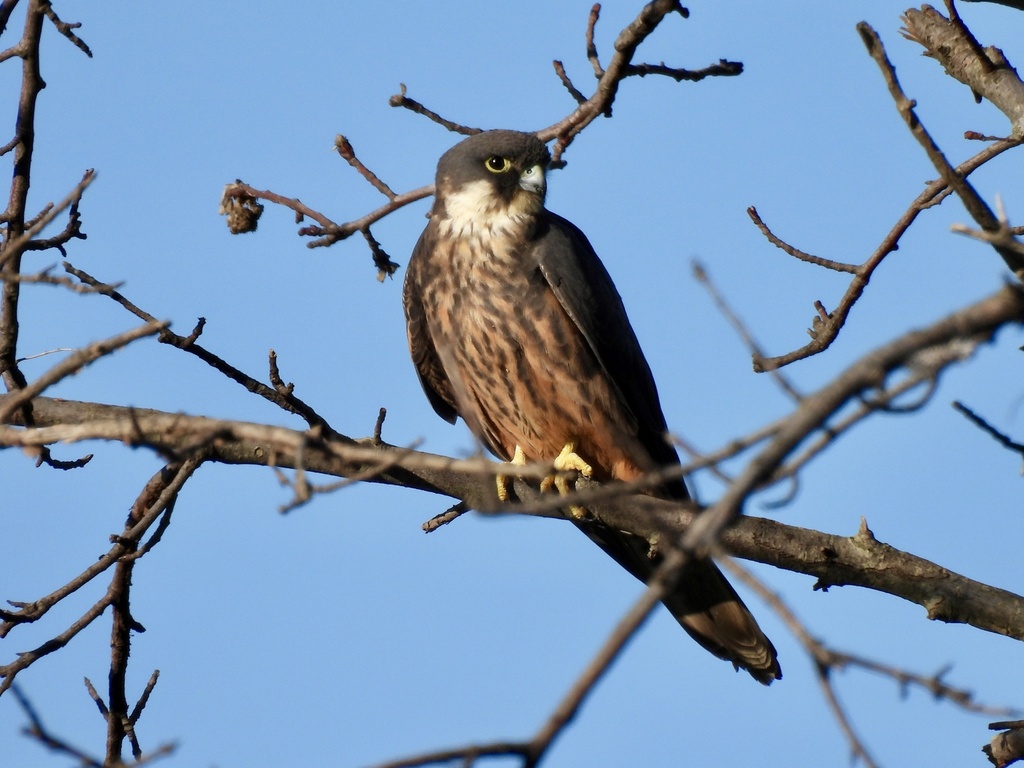
Eleonora’s Falcon
Photo © Caroline Quinn
Photo © Caroline Quinn — CC BY 4.0 — Source: iNaturalist photo #402515284Identification
Eleonora's falcon is a medium-sized bird of prey measuring 36–42 cm long with a wingspan of 87–104 cm. It is shaped like a large Eurasian hobby or a small slender peregrine falcon, characterized by long pointed wings, a long tail, and a slim body. The species exhibits two colour morphs. The dark morph is entirely sooty brown with black underwing coverts, while the light morph resembles a juvenile Eurasian hobby but features buff underparts and striking contrast between black underwing coverts and paler flight feather bases. Young birds display pale underparts that contrast with darker wingtips and wing coverts. The bird's call is a typical falcon kek-kek-kek.
Range & Habitat
Eleonora's falcon breeds primarily on Mediterranean islands, with approximately two-thirds of the world's population nesting in Greece. Other breeding populations occur in Cyprus, the Canary Islands, Ibiza, and off the coasts of Spain, Italy, Croatia, Morocco, and Algeria. The island of Tilos in the Dodecanese supports roughly 10 per cent of the global population, with around 650 breeding pairs. The species is rare as a vagrant north of its breeding range.
This is a long-distance migrant, wintering in Madagascar and also inhabiting the coasts of Mozambique. Recent satellite telemetry has revealed that the migration route runs inland through the African continent, covering up to 9,000 km for a single one-way journey. The route passes through the Sahara Desert and equatorial rainforests before reaching Kenya and Mozambique, contradicting earlier theories of a coastal route via the Red Sea and Horn of Africa.
Behaviour & Diet
Eleonora's falcon is a specialist hunter of migrating birds, exhibiting a delayed breeding season in late summer to capitalize on the abundance of migrants passing through Mediterranean islands. It captures small birds in flight using remarkable speed and aerobatic skills, cruising along coastal cliffs with steady wingbeats while searching for exhausted incoming migrants. The species also feeds on large insects such as dragonflies, transferring prey from talons to beak and consuming it in flight. Occasionally, it has been observed feeding on bats.
Uniquely, this falcon imprisons live prey in rock crevices, removing flight feathers from small birds and feeding them to chicks sometimes days later—a behaviour unmatched among bird species. It is also one of the few falcon species that breeds in colonies, nesting on coastal cliffs and laying up to four eggs.
Best Time & Places to See It
The breeding season in late summer and early autumn offers the best opportunity to observe Eleonora's falcon, when birds are actively hunting migrants and feeding colonies. Greek islands, particularly Tilos in the Dodecanese, are prime locations where substantial populations can be observed. The Canary Islands, Cyprus, and islands off Spain, Italy, and Morocco also provide reliable viewing opportunities during the breeding season.
Photography Tips
Photograph this falcon along coastal cliffs where it hunts migrants, focusing on capturing its characteristic long pointed wings and slim silhouette in flight. The contrast between dark and light morphs offers interesting compositional opportunities. Early morning and late afternoon light along cliff faces provides optimal conditions for capturing both hunting behaviour and the striking underwing patterns that distinguish this species. Patient observation of cliff-side hunting perches will reward photographers with dynamic in-flight images.
Serra D’Irta Natural Park
Alcossebre, Spain
+122 birds+13 mammals
Where Mediterranean limestone cliffs meet the Balearic Sea, Serra d'Irta unfolds as a tapestry of dramatic coastal terrain and diverse terrestrial habitats. This Category 5 protected…
VIEW NATURAL PARKS’Albufera Natural Park
Platja de Muro, Spain
+253 birds+6 mammals
Where Mediterranean lagoons meet the Balearic coast, S'Albufera stretches across nearly 1,600 hectares of wetland and dune systems that rank among Europe's most ecologically vital shallow-water…
VIEW NATURAL PARKMarjal Pego-Oliva Natural Park
Molinell, Spain
+219 birds+2 mammals
Where the Valencian littoral flattens into wetland and reed-bed, Marjal Pego-Oliva straddles the boundary between the Mediterranean and its inland margins, a mosaic of shallow lagoons,…
VIEW NATURAL PARKL’Albufera Natural Park
València, Spain
+321 birds+18 mammals
Where shallow lagoons meet Mediterranean coastal marshland, L'Albufera Nature Park unfolds as one of Spain's most vital wetland complexes. This protected landscape, designated under IUCN Category…
VIEW NATURAL PARKTablas de Daimiel National Park
Daimiel, Spain
+246 birds+6 mammals
Where the Guadiana River spreads into a labyrinth of shallow lagoons and reed beds across the sun-baked plains of central Spain, Tablas de Daimiel National Park…
VIEW NATIONAL PARKTeide National Park
La Orotava, Spain
+83 birds+7 mammals
At nearly 3,900 metres, Spain's highest peak rises from the Canary Islands as a singular volcanic monument, its slopes sweeping through five distinct climate zones in…
VIEW NATIONAL PARKGarajonay National Park
Hermigua, Spain
+68 birds+1 mammals
Laurel forests cloak the volcanic ridges of this Canarian national park, their evergreen canopy so dense that mist clings to the moss-draped branches even on cloudless…
VIEW NATIONAL PARKTsavo West National Park
Mwatate, Kenya
+513 birds+49 mammals
Where volcanic ridges and weathered lava flows meet the semi-arid lowlands of south-central Kenya, Tsavo West National Park unfolds across a landscape sculpted by fire and…
VIEW NATIONAL PARKMount-Kenya National Park
Abothuguchi west ward, Kenya
+334 birds+11 mammals
Where the slopes of Kenya's second-highest mountain rise steeply from the Meru County foothills, a landscape of profound ecological richness unfolds across Mount Kenya National Park.…
VIEW NATIONAL PARKCabo de Gata-Níjar Natural Park
San José, Spain
+274 birds+11 mammals
Where volcanic ridges plunge toward the Mediterranean, Cabo de Gata-Níjar Nature Park unfolds across one of Europe's most arid coastlines, a landscape sculpted by tectonic violence…
VIEW NATURAL PARKDelta de l’Ebre Natural Park
Eucaliptus, Spain
+341 birds+18 mammals
Where the Ebro River spreads into a vast labyrinth of shallow lagoons, reed beds, and brackish marshes before surrendering to the Mediterranean, one of southern Europe's…
VIEW NATURAL PARKCap de Creus Natural Park
Roses, Spain
+245 birds+23 mammals
Where the Pyrenees tumble into the Mediterranean, Cap de Creus Nature Park unfolds across 300 square kilometres of one of northeastern Spain's most dramatic coastal wilderness…
VIEW NATURAL PARKCévennes National Park
Vebron, France
+187 birds+63 mammals
Where granite gorges slice through the limestone plateaux of southern France, the Cévennes Cœur National Park unfolds across nearly 3,500 square kilometres of one of Europe's…
VIEW NATIONAL PARKSierra de las Nieves National Park
Tolox, Spain
+159 birds+7 mammals
Where limestone summits pierce the Mediterranean sky above Andalusia's coastal ranges, Sierra de las Nieves National Park unfolds across nearly 500 square kilometres of dramatically folded…
VIEW NATIONAL PARKSierra de Guadarrama National Park
Rascafría, Spain
+179 birds+13 mammals
Where granite peaks rise abruptly from the central Spanish plateau, the Sierra de Guadarrama National Park unfolds across more than eleven hundred square kilometres of montane…
VIEW NATIONAL PARKSierra de Cazorla, Segura y las Villas Nature Park
Las Canalejas, Spain
+176 birds+21 mammals
Where granite gorges slice through mountainous terrain in eastern Andalusia, the Sierra de Cazorla, Segura y las Villas Nature Park sprawls across more than 5,200 square…
VIEW NATURAL PARKParc del Foix
Castellet i la Gornal, Spain
+180 birds+4 mammals
Where the Foix River carves through limestone ridges southwest of Barcelona, a natural park of modest area but outsized ecological richness unfolds across roughly 37 square…
VIEW NATURAL PARKParc del Garraf
Rat-Penat, Spain
+190 birds+15 mammals
Where limestone ridges rise abruptly from the Mediterranean coastal plain, Parc Natural del Garraf unfolds across 319 square kilometers of one of Catalonia's most dramatic protected…
VIEW NATURAL PARKCollserola Natural Park
Barcelona, Spain
+194 birds+20 mammals
Where Mediterranean scrubland rises steeply from Barcelona's urban edge, Collserola unfolds across 173 square kilometres of low mountains that form a crucial ecological buffer between city…
VIEW NATURAL PARKParc del Montnegre i el Corredor
Font-Montnegre, Spain
+148 birds+16 mammals
Where Mediterranean scrubland gives way to deciduous and coniferous woodland, the Parc Natural del Montnegre i el Corredor unfolds across nearly 478 square kilometres of northeastern…
VIEW NATURAL PARKCadí Moixeró Natural Park
Bor, Spain
+172 birds+21 mammals
Cadí-Moixeró Natural Park is one of the largest and most spectacular protected areas in Catalonia, located in the heart of the eastern Pyrenees. Covering more than…
VIEW NATURAL PARKEspacio Natural Remolar-Filipinas
El Prat del Llobregat, Spain
+297 birds+7 mammals
Where the Llobregat River delta meets the Mediterranean, a patchwork of salt marshes, reed beds, and shallow lagoons creates one of Catalonia's most dynamic wetland ecosystems.…
VIEW NATURE RESERVEMontaña de Montserrat Natural Park
Marganell, Spain
+149 birds+10 mammals
Where granite monoliths erupt from the Mediterranean scrubland like cathedral spires, an otherworldly landscape unfolds across Catalonia's most dramatic mountain reserve. These iconic sandstone and conglomerate…
VIEW NATURAL PARKUrdaibai Biosphere Reserve
Txatxarramendi, Spain
+268 birds+8 mammals
Where the Pyrenean foothills surrender to the Bay of Biscay, tidal estuaries carve through Basque limestone, creating one of Europe's most ecologically vital wetland complexes. Salt…
VIEW BIOSPHERE RESERVESierra de Gredos Regional Park
Candeleda, Spain
+180 birds+18 mammals
Where granite peaks claw at 2,592 metres and alpine meadows give way to cork oak scrubland, Spain's central highlands reveal a landscape of remarkable vertical drama.…
VIEW NATURE RESERVECamargue Regional Nature Park
Saintes-Maries-de-la-Mer, France
+378 birds+48 mammals
Where the Rhône Delta sprawls into the Mediterranean, a landscape of stark and haunting beauty emerges—vast salt marshes punctuated by shallow lagoons, reed beds, and scrubland…
VIEW NATURAL PARKZemo Svaneti Planned National Park
Hamashi-Totoleshi, Georgia
+159 birds+6 mammals
Where granite peaks pierce the clouds above the Caucasus, sweeping alpine meadows give way to pristine beech and spruce forests that have remained largely untouched for…
VIEW NATIONAL PARKRegional Park of the Catalan Pyrenees
Olette, France
+244 birds+63 mammals
Where granite peaks thrust skyward above cloud-laden valleys, a wild tapestry of Mediterranean and alpine ecosystems interweaves across the Franco-Spanish frontier. These Pyrenean slopes harbour extraordinary…
VIEW NATURE RESERVEDirigida Laguna de Gallocanta Nature Reserve
Las Cuerlas, Spain
+250 birds+7 mammals
Where continental steppe meets the vast mirror of inland water, Spain's largest natural lagoon reveals a landscape of haunting beauty. The shallow alkaline lake, cradled in…
VIEW NATURE RESERVERila National Park
Mala tsarkva, Bulgaria
+138 birds+4 mammals
Where granite peaks pierce the Balkan skyline, pristine conifer forests blanket steep mountain slopes in an ecological tapestry that has remained largely undisturbed for centuries. Bulgaria's…
VIEW NATIONAL PARKStrandzha Nature Park
Kondolovo, Bulgaria
+215 birds+19 mammals
Where the Rhodope Mountains descend toward the Black Sea coast, ancient forests rise above limestone plateaus in a tapestry of ecological richness rarely found elsewhere in…
VIEW NATURAL PARKPorts Natural Park
Alfara de Carles, Spain
+157 birds+13 mammals
Where the eastern Catalan ranges descend toward the Mediterranean, a sprawling mosaic of Mediterranean scrubland, pine woodland, and rocky limestone terrain defines Ports Natural Park, a…
VIEW NATURAL PARKEstrecho Natural Park
Pedro Valiente, Spain
+281 birds+20 mammals
Where Mediterranean pine forests meet wind-sculpted coastal cliffs, one of Europe's most dynamic ecological crossroads unfolds across the Strait of Gibraltar. Spanning 686 square kilometers of…
VIEW NATURAL PARKLa Maddalena Archipelago National Park
La Maddalena, Italy
+86 birds+1 mammals
Crystalline waters lap against granite islands scattered across the Tyrrhenian Sea, where Dell'Arcipelago di la Maddalena unfolds as a Mediterranean archipelago of raw geological beauty and…
VIEW NATIONAL PARKTuscan Archipelago National Park
Rio, Italy
+174 birds+8 mammals
Where the Tyrrhenian Sea fragments into granite and schist islands, the Arcipelago Toscano National Park protects one of the Mediterranean's most biodiverse maritime realms. Scattered across…
VIEW NATIONAL PARKGargano National Park
Cagnano Varano, Italy
+219 birds+7 mammals
Where the Gargano Peninsula's limestone plateaus descend toward the Adriatic, Cagnano Varano sits at the threshold of one of southern Italy's most ecologically vital landscapes. The…
VIEW NATIONAL PARKCilento, Vallo di Diano and Alburni National Park
Campora, Italy
+145 birds+12 mammals
Where the southern Apennines descend toward the Tyrrhenian coast, the landscape transforms into a mosaic of limestone plateaus, deep ravines, and Mediterranean scrubland that defines Cilento,…
VIEW NATIONAL PARKAsinara National Park
Porto Torres, Italy
+103 birds+5 mammals
Rocky limestone cliffs plunge toward the Tyrrhenian Sea where Dell'Asinara National Park guards a slender island sanctuary off Sardinia's northwestern coast. The park's terrain is a…
VIEW NATIONAL PARKPindos National Park
Ioannina Regional Unit, Greece
+163 birds+12 mammals
Where limestone peaks rise abruptly from the Pindus range in northwestern Greece, a landscape of dramatic gorges, alpine meadows, and dense beech forests creates one of…
VIEW NATIONAL PARKMount Ainos National Park
Sami Municipal Unit, Greece
+118 birds+1 mammals
Where limestone and conglomerate peaks rise dramatically above the Ionian Sea, Mount Ainos commands the landscape of Kefalonia with a rugged majesty that few Mediterranean summits…
VIEW NATIONAL PARKMount Parnitha National Park
Municipal Unit of Acharnes, Greece
+137 birds+4 mammals
Where pine-clad ridges rise abruptly from the Attica plains, Mount Parnitha National Park unfolds across nearly 4,000 hectares of Mediterranean mountain wilderness. The park's defining character…
VIEW NATIONAL PARKSounio National Park
Municipal Unit of Ayios Konstantinos, Greece
+103 birds
Where rocky headlands plunge into the Aegean Sea along Attica's southeastern coast, Sounio National Park preserves a landscape shaped by millennia of human presence yet alive…
VIEW NATIONAL PARKOlympos National Park
Pieria Regional Unit, Greece
+137 birds+3 mammals
Where the Thessalian plains give way to soaring limestone massifs, Olympos National Park rises as one of the Aegean's most dramatic mountain wilderness areas. This IUCN…
VIEW NATIONAL PARKSamaria National Park
Chania Regional Unit, Greece
+103 birds+1 mammals
Vertical walls of pale limestone rise nearly a kilometre from the Cretan seabed, their flanks carved by the Samaria Gorge into one of Europe's most dramatic…
VIEW NATIONAL PARKKerkini Lake National Park
Serres, Greece
+291 birds+18 mammals
Where the Strymon River widens into a sprawling freshwater lake hemmed by the Rhodope Mountains, Kerkini National Park unfolds across northern Greece as one of southeastern…
VIEW NATIONAL PARKColl de Pal
La Molina, Spain
+142 birds+12 mammals
Where the eastern Pyrenees descend into Catalonia, alpine meadows and rocky slopes define the character of this mountain pass, a threshold between the high Iberian interior…
VIEW MOUNTAIN & ALPINECabo Peñas
Susacasa, Spain
+303 birds+21 mammals
Where sea cliffs rise sheer from the Bay of Biscay, Susacasa's observation point commands one of Asturias's most dramatic coastal vistas. The landscape here is defined…
VIEW OBSERVATION POINTPort-Cros National Park
Hyères, France
+271 birds+29 mammals
Where Mediterranean granite islands rise from crystalline waters off the Provençal coast, Port-Cros National Park protects one of Europe's most intact marine and terrestrial ecosystems. The…
VIEW NATIONAL PARKCalanques National Park
Bouches-du-Rhône, France
+233 birds+42 mammals
Where limestone cliffs plunge dramatically into crystalline Mediterranean waters, Calanques National Park preserves one of Europe's most striking coastal landscapes. These steep-sided inlets, carved by erosion…
VIEW NATIONAL PARKAlta Murgia National Park
Bari, Italy
+168 birds+6 mammals
Across the limestone plateaux of Apulia's interior, where the Adriatic's influence fades into continental warmth, lies a landscape sculpted by millennia of human pastoralism and Mediterranean…
VIEW NATIONAL PARKVesuvius National Park
Ottaviano, Italy
+82 birds+4 mammals
The slopes of Vesuvius rise from the Campanian plain in a dramatic cone of volcanic rock and ash, their flanks wrapped in the characteristic vegetation of…
VIEW NATIONAL PARKNo community photos yet. Log in to add the first one.
No community observations of this species yet.