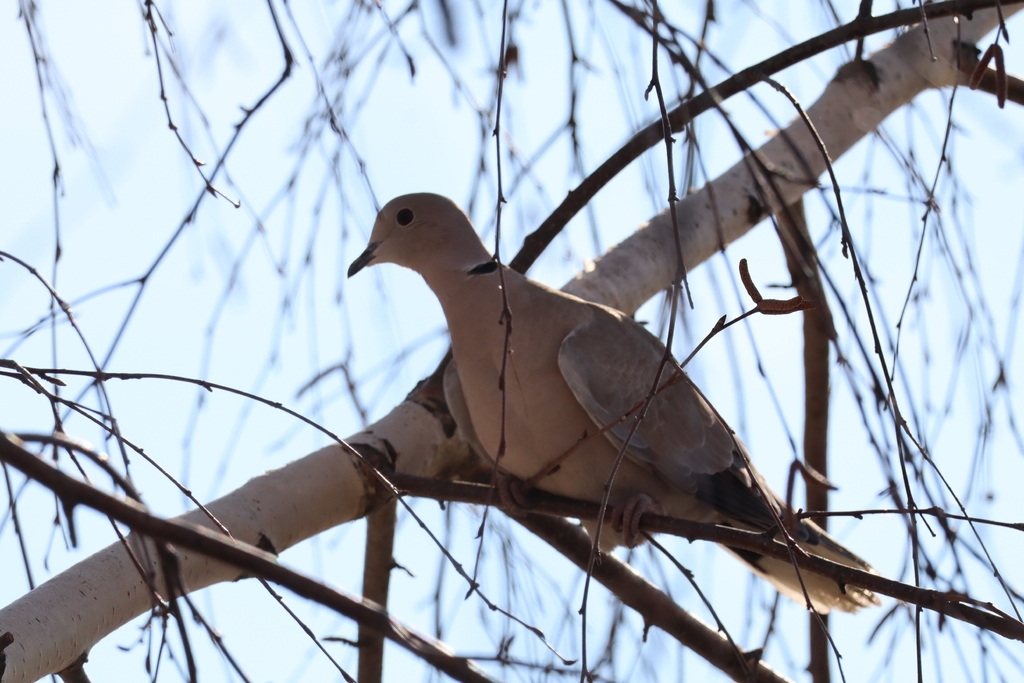
Eurasian Collared Dove
Photo © Radu Teodoreanu
Photo © Radu Teodoreanu — CC BY 4.0 — Source: iNaturalist photo #614430462Identification
The Eurasian collared dove is a medium-sized dove averaging 32 cm in length, with a wingspan of 47–55 cm. Its plumage is grey-buff to pinkish-grey, slightly darker above than below, with a distinctive blue-grey underwing patch. The bird's most identifying feature is the black half-collar edged with white on its nape, from which it derives its name. The tail feathers are grey-buff above and dark grey tipped with white below. Short red legs and a black bill complete the picture, while the iris is red, though the eyes appear black from a distance due to a relatively large pupil.
The two sexes are virtually indistinguishable in the field. Juveniles can be identified by a poorly developed collar and brown iris rather than the adult's red. The bird's distinctive three-syllable call—a goo-GOO-goo with stress on the second syllable—is unmistakable once learned. A harsh, loud screeching call (chrrai-chrrai) is also produced, particularly in flight just before landing. Interestingly, cooing birds in early spring are sometimes mistaken for early-arriving common cuckoos.
Range & Habitat
The Eurasian collared dove is a non-migratory but strongly dispersive species that has become one of the great colonisers of the bird world. Its original range at the end of the 19th century was warm temperate and subtropical Asia, from Turkey eastward to southern China and southward through India to Sri Lanka. The species began expanding in the 20th century, appearing in parts of the Balkans between 1900 and 1920 before spreading rapidly northwest—reaching Germany in 1945, Great Britain by 1953 (breeding first in 1956), Ireland in 1959, and the Faroe Islands in the early 1970s.
By the end of the 20th century, the species had reached northeast to north of the Arctic Circle in Norway, east to the Ural Mountains in Russia, and southwest to the Canary Islands and northern Africa from Morocco to Egypt. It has also spread to most of central and northern China and locally to Japan, likely through introduction. The species has reached Iceland as a vagrant but has not successfully colonised there. It has also been introduced to North America and Caribbean islands, where it is now established across nearly every U.S. state and in Mexico.
Behaviour & Diet
The Eurasian collared dove's non-migratory nature contrasts sharply with its remarkable dispersive abilities, allowing it to colonise far beyond its native range and become a permanent resident in much colder regions than its subtropical Asian origins. This adaptability has made it one of the most successful bird colonisers of the past century, expanding its range dramatically across continents.
The species is vocal and conspicuous, particularly during early spring breeding season when its distinctive three-note call is frequently heard. Their presence is often first detected by their characteristic cooing rather than visual observation, making familiarity with their vocalizations valuable for observers.
Best Time & Places to See It
The Eurasian collared dove has become widespread across much of Europe, Asia, and increasingly in North America. In Europe, it is now found from the Mediterranean northward to Scandinavia and eastward across Russia. The species is non-migratory and permanent residents can be encountered year-round throughout its established range. Early spring is an excellent time to locate birds, as they become particularly vocal during the breeding season.
Given its adaptability and dispersive nature, the dove can be found in a variety of habitats, typically in settled or semi-urban areas where it has established itself. It is now absent only from the most remote regions and truly wild habitats, making it accessible to travellers throughout its range.
Photography Tips
The Eurasian collared dove's grey-buff and pinkish-grey plumage is subtle but photographically rewarding. To capture the bird's diagnostic features, focus on the distinctive black half-collar edged with white on the nape, which is most visible when the bird is perched or turning. The blue-grey underwing patch can be captured during flight, and the red iris and bare skin around the eye provide fine detail for close-up photography.
Early morning and late afternoon light will best reveal the bird's soft coloration and subtle plumage variations. Since the species is non-migratory and habituated to human presence across much of its range, photographers can often approach relatively closely. Listen for the distinctive goo-GOO-goo call to locate birds, and patience near favourite perching and calling sites will reward you with behavioural and portrait opportunities.
Delta de l’Ebre Natural Park
Kanha Tiger Reserve
Tombstone Territorial Park
Abruzzo, Lazio and Molise National Park
Aggtelek National Park
Alaska Maritime National Wildlife Refuge
Alligator River National Wildlife Refuge
Alpilles Regional Nature Park
Alta Murgia National Park
Nothing matches these filters.
No community photos yet. Log in to add the first one.