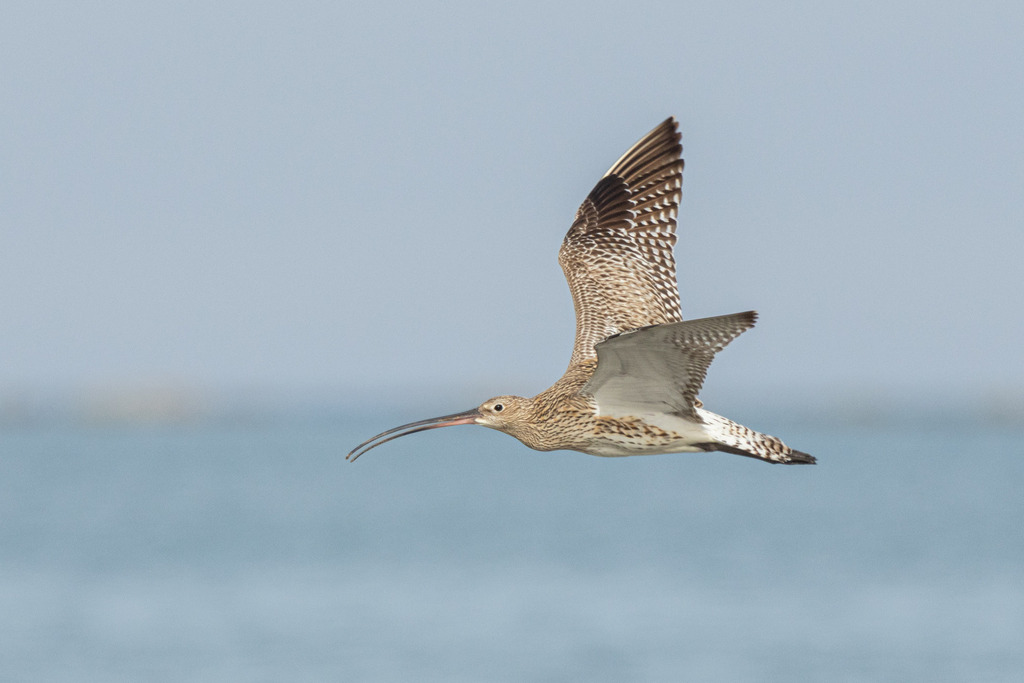
Eurasian Curlew
Photo © Антон Лабачоў
Photo © Антон Лабачоў — CC BY 4.0 — Source: iNaturalist photo #384810974Identification
The Eurasian Curlew is the largest wading bird in its range, measuring 50–60 cm in length with a wingspan of 89–106 cm. Its most distinctive feature is an exceptionally long, smoothly curved bill—longer in females than males—which gives the species its name. The plumage is mainly greyish-brown with a white back and greyish-blue legs. Males and females are visually identical, though determining sex from appearance alone is generally impossible due to considerable individual variation. The bird's familiar loud "curloo-oo" call is instantly recognizable across its range. The only similar species is the smaller Eurasian Whimbrel, which has a shorter bill with a distinctive kink rather than a smooth curve. In flight, curlews may superficially resemble bar-tailed godwits, but curlews are larger with longer feet that extend noticeably beyond the tail, creating a characteristic pointed silhouette.
Range & Habitat
This highly migratory species breeds across temperate Europe and Asia, with three recognized subspecies distributed from western Europe through Siberia to northeastern China. Over most of its range, the Eurasian Curlew is a winter migrant, traveling to Africa, southern Europe, and southern Asia. However, in milder climates such as Ireland and the United Kingdom, birds are present year-round. The species occasionally appears as a vagrant far from its normal range. Curlews favor open habitats including meadows, moorland, and grassland for breeding and feeding. Their populations have been significantly affected by habitat loss; the reclamation and drainage of marshy fields, moorland afforestation, and conversion of natural grasslands have led to local population declines in many areas, though conversely, forest-to-grassland conversion in parts of Scandinavia has benefited some populations.
Behaviour & Diet
The Eurasian Curlew is generally wary and highly gregarious outside the breeding season. Curlews feed primarily by probing soft mud for small invertebrates, though they will opportunistically pick up small crabs and earthworms from the surface. During breeding season, pairs nest in bare scrapes in meadows, typically laying four eggs in April or May. Both parents incubate the eggs for approximately four weeks until hatching begins. Notably, curlews often nest in close proximity to common kestrel nests, gaining protection from predators such as corvids, despite the risk that kestrels may also prey on curlew nests themselves. The species is known for its longevity; the oldest recorded individual was a female ringed in 1992 who was still alive over 33 years later.
Best Time & Places to See It
In the United Kingdom and Ireland, where curlews are present year-round, they can be observed across open grasslands and moorland habitats throughout the seasons, though breeding birds are most active and vocal in spring and early summer. For continental Europe, spring and autumn migration periods offer the best opportunities to encounter this species. Coastal areas, estuaries, and wetlands are reliable locations during migration and winter. However, travelers should note that curlew populations are declining rapidly across much of their range, particularly in the UK and Ireland, making sightings less predictable than historically. Visiting protected wetland reserves and managed grassland habitats increases the likelihood of successful observation.
Photography Tips
The Eurasian Curlew's large size, distinctive silhouette, and long curved bill make it a striking photographic subject. The bird's wariness requires patience and careful approach; use telephoto lenses of at least 400–600 mm to maintain safe distance. Early morning and late afternoon light best reveals the subtle greyish-brown plumage and white back. Photographing feeding birds probing in soft mud captures the characteristic behavior and demonstrates the functional elegance of the extended bill. During breeding season, males and females are easier to observe and photograph as they defend territories and are more vocal. The bird's long legs extending beyond the tail in flight create a distinctive silhouette useful for field identification photography, while on the ground, the contrast between the white back and darker head and underparts provides good compositional elements.
Private Full-Day Birdwatching Tour from Lisbon to the Tagus Estuary
Week-long Birdwatching Programme in Northern & Central Portugal
Nothing matches these filters.
Murchison Falls National Park
Abijata-Shalla Lakes National Park
Addo Elephant National Park
Agulhas National Park
Alpilles Regional Nature Park
Alta Murgia National Park
Arabuko Sokoke Forest Reserve
Avesnois Regional Nature Park
Bako National Park
Nothing matches these filters.
No community photos yet. Log in to add the first one.
No community observations of this species yet.