Eurasian Jay
Garrulus glandarius
Photo © Антон Лабачоў
Photo © Антон Лабачоў — CC BY 4.0 — Source: iNaturalist photo #575538716ABOUT
Subspecies of Eurasian Jay
Caucasian JayLevant JayContinental European JayJapanese JayAnatolian JayCrimean JayEurasian Jay (Siberian)Far Eastern JayBlack-crowned JayTaiwanese JayGreek JayIrish JayCorsican JayWhite-faced JaySicilian JaySardinian JayIberian JayAdriatic JayBritish Eurasian JayCyprus JaySouth-Chinese JayWestern Himalayan JayEastern Himalayan JayNorthwestern Iberian JayNorth Moroccan JayCretan jaySouthwestern Black Sea JayAtlas JayIranian JaySamos Jay
Identification
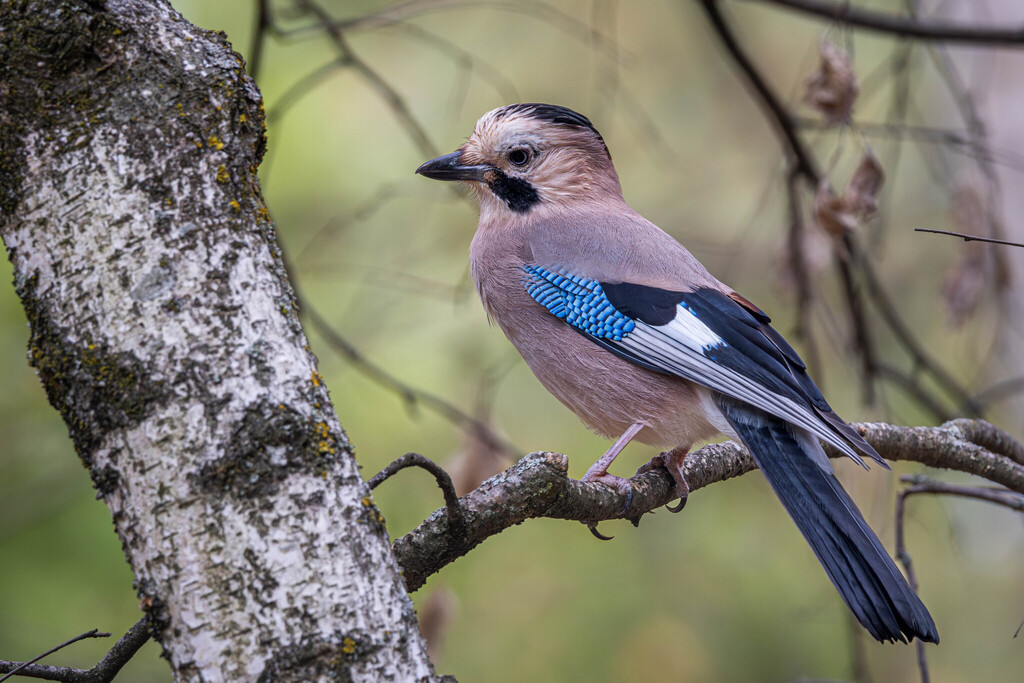
The Eurasian jay is a relatively small corvid, comparable in size to a western jackdaw, measuring 34–35 cm in length with a wingspan of 52–58 cm. The nominate European race displays distinctive pinkish-brown plumage with a whitish throat bordered by a prominent black moustache stripe on each side. Its forehead and crown are whitish with black streaks, while the rump is pure white. The most striking feature is the bright blue patch on the upper wing surface, decorated with fine black bars, contrasting sharply with the mainly black tail.
Range & Habitat
The Eurasian jay occurs across a vast region spanning from western Europe and north-west Africa to the Indian subcontinent, extending to the eastern seaboard of Asia and down into south-east Asia. Across this enormous range, several distinct racial forms have evolved with notably different appearances, particularly when comparing birds from opposite ends of their distribution.
This is fundamentally a woodland bird, showing a strong preference for mixed woodland, particularly areas with oaks. The jay is a habitual acorn hoarder and plays a crucial ecological role as a major propagator of oak species. Historically, before commercial tree planting began, Eurasian jays were the primary source of oak dispersal and propagation across Europe, with individual birds capable of spreading over a thousand acorns annually. Jays have been recorded carrying single acorns as far as 20 km and were instrumental in the rapid northward spread of oaks following the last ice age. In recent years, jays have begun migrating into urban areas, possibly due to continued erosion of their woodland habitat.
Behaviour & Diet
The Eurasian jay is well known for its vocal abilities, particularly its most characteristic call: a harsh, rasping screech used upon sighting predators and as an advertising call. The species is famous for its remarkable mimicry, often imitating other bird species so convincingly that it can be difficult to distinguish from them without seeing the bird directly. Jays frequently imitate the calls of birds of prey, including the mew of the common buzzard and the cackle of the Eurasian goshawk.
Eurasian jays breed when two years of age, though occasionally at one year old. Both sexes build the nest, typically placing it in a tree fork or on a branch close to the main trunk at a height of 2–5 metres. The clutch normally comprises 3–6 pale green to pale olive-brown eggs with fine darker speckles, sometimes bearing brown or black streaks near the broader end. Eggs are incubated by the female and hatch after 16–19 days, with young fledging after 19–23 days and remaining dependent on their parents for a further 6–8 weeks. Only one brood is raised annually. Jays feed both in trees and on the ground.
Best Time & Places to See It
Look for Eurasian jays in mixed woodlands with a good complement of oak trees across their broad Eurasian range. As woodland birds, they remain relatively common in suitable habitat, though they have increasingly adapted to suburban and urban gardens. Patience and careful observation in oak woodlands offer the best chance of encountering this species, particularly when listening for its distinctive rasping calls.
Photography Tips
The Eurasian jay's striking blue wing patch, contrasting rufous plumage, and distinctive facial markings make it an excellent photographic subject. The bird's alertness and tendency to perch openly in trees during breeding season provide good opportunities for photography. Capture the bright blue wing panel in clear light to showcase this distinctive feature, and try to photograph the bird calling to illustrate its vocal behaviour. Early morning light in oak woodlands will best reveal the subtle variation in its plumage colouration.
HIDES
Sort by
50 €/ person
Book now
80 €/ person
Book nowNothing matches these filters.
HOTSPOTS
Country
Type
Sort by
National Park
Abruzzo, Lazio and Molise National Park
Pescasseroli·Italy
+139 birds+18 mammals
National Park
Aggtelek National Park
Szin·Hungary
+119 birds+13 mammals
Natural Park
Alpilles Regional Nature Park
Saint-Rémy-de-Provence·France
+219 birds+37 mammals
National Park
Alta Murgia National Park
Bari·Italy
+168 birds+6 mammals
National Park
Appennino Lucano Val d’Agri Lagonegrese National Park
Spinoso·Italy
+121 birds+3 mammals
National Park
Appennino Tosco-Emiliano National Park
Ventasso·Italy
+86 birds+8 mammals
National Park
Åsnens National Park
Kronoberg County·Sweden
+141 birds+8 mammals
National Park
Aspromonte National Park
Careri·Italy
+89 birds+5 mammals
Natural Park
Avesnois Regional Nature Park
Saint-Hilaire-sur-Helpe·France
+206 birds+40 mammals
Nothing matches these filters.
COMMUNITY
Share your photo of this species
Sort by
No community photos yet. Log in to add the first one.
0
Observed by
0
Hotspots reported
0
Countries
No community observations of this species yet.