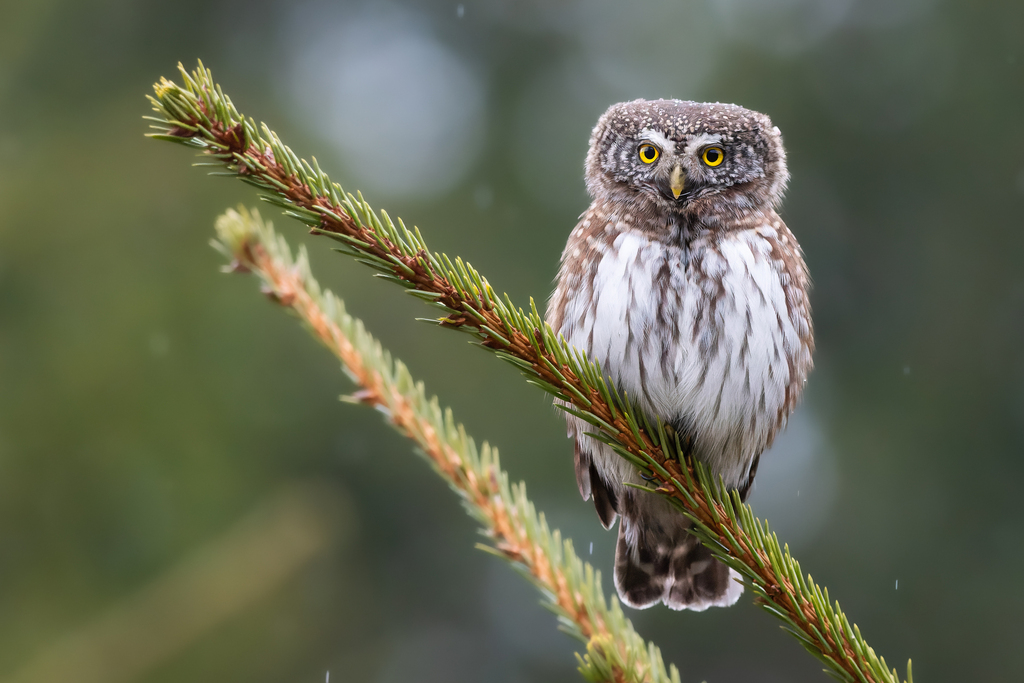
Eurasian Pygmy Owl
Photo © Tomas Broucek
Photo © Tomas Broucek — CC BY 4.0 — Source: iNaturalist photo #266487182Identification
The Eurasian Pygmy Owl is Europe's smallest owl, a compact predator measuring just 15–19 cm in length and weighing a mere 50–77 grams depending on sex. Its plumage ranges from dark reddish to greyish-brown, with spotted sides and a distinctive white half-collar marking the back of the neck. The tail is darker than the body, marked with five narrow whitish bars, while the belly is predominantly white with brown speckles. Look for small, short-headed owls with white to grey eyebrows and striking yellow eyes; notably, this species lacks the ear tufts present on many other owl species. The beak is greyish-yellow and hook-shaped, and despite the bird's diminutive size, the Eurasian Pygmy Owl has evolved disproportionately large feet and black talons to handle larger vertebrate prey.
Range & Habitat
This owl inhabits the boreal forests of Northern and Central Europe extending east to Siberia, with two recognized subspecies occupying different ranges across the continent and Asia. The species favours coniferous forests of the taiga and mountainous regions with mixed and coniferous woodland, typically in cooler areas with higher rainfall than surrounding lowlands. Eurasian Pygmy Owls characteristically live along the edges of clearings that border moist or swampy terrain with nearby water sources. They nest exclusively in tree cavities, frequently adopting abandoned woodpecker holes, particularly those created by Great Spotted Woodpeckers, and readily accept artificial nest boxes designed to mimic natural cavities.
Behaviour & Diet
Crepuscular by nature, this tiny owl is most active during daylight hours near sunrise and sunset. The Eurasian Pygmy Owl primarily hunts small mammals including voles, lemmings, bats, and mice, supplemented by small birds such as thrushes, crossbills, chaffinches, and leaf-warblers, which they can catch in flight. They occasionally take lizards, fish, and insects. A remarkable adaptation to their northern range is extensive food hoarding: owls accumulate large quantities of small mammals and birds in autumn to sustain themselves through winter, a behaviour heavily influenced by weather conditions. Males are highly territorial, maintaining the same nesting territory for up to seven years. These owls form serially monogamous pairs that may bond across multiple breeding seasons, with females laying four to seven eggs typically in April. Fledging occurs at 30–34 days of age.
Best Time & Places to See It
The Eurasian Pygmy Owl is sedentary throughout most of its range, meaning adults remain resident year-round, making it potentially viewable in any season in suitable habitat. Harsh winters may prompt some adult movement southward, while young birds typically disperse in autumn or winter. Search coniferous and mixed forests of the taiga and higher mountain regions in Northern and Central Europe or Siberia, particularly around forest clearings adjacent to moist ground. Early morning and late evening offer the best viewing opportunities when these crepuscular hunters are most active.
Photography Tips
The Eurasian Pygmy Owl's small size and woodland habitat present genuine challenges for photographers. Position yourself near known nest sites or forest edges during dawn and dusk when activity peaks. The bird's preference for perching near clearings can provide better sightlines than deep forest. Look for the distinctive white half-collar and yellow eyes to aid identification. The owl's lack of ear tufts is a useful distinguishing feature to capture. Patience is essential; these diminutive hunters are easily overlooked among forest vegetation. The male's distinctive high-pitched, fluted call—quite unlike typical owl hoots—may help locate individuals, allowing you to position yourself for photography opportunities.
Muddus / Muttos National Park
Norrbottens län, Sweden
+128 birds+7 mammals
Where boreal forest meets wetland across the high plateaus of Swedish Lapland, Muddus National Park unfolds as one of northern Europe's most pristine wilderness sanctuaries. Vast…
VIEW NATIONAL PARKFärnebofjärden National Park
Gävleborgs län, Sweden
+170 birds+20 mammals
Where the Gävle River widens into a sprawling delta before meeting the Gulf of Bothnia, Färnebofjärden National Park unfolds across a landscape of exceptional ecological complexity.…
VIEW NATIONAL PARKHarz National Park
Harz (LK Goslar), Germany
+141 birds+38 mammals
Where granite peaks rise above beech and spruce forests, the Harz unfolds as one of Germany's most biodiverse upland landscapes. Straddling the border between Lower Saxony…
VIEW NATIONAL PARKSaxon Switzerland National Park
Sebnitz, Germany
+118 birds+9 mammals
Sandstone cliffs and narrow gorges define this corner of eastern Saxony, where the Elbe River has carved a dramatic landscape of towering rock formations and densely…
VIEW NATIONAL PARKBavarian Forest National Park
Germany
+127 birds+18 mammals
Where ancient spruce and fir forests rise across the Bohemian plateau, the Bavarian Forest National Park unfolds as one of central Europe's most intact temperate woodland…
VIEW NATIONAL PARKŠumava National Park
Germany
+137 birds+12 mammals
Where the Bohemian Forest rises along the border between Czech and German territories, Šumava National Park unfolds across a landscape of ancient woodlands, glacial valleys, and…
VIEW NATIONAL PARKSipoonkorven National Park
Sipoo, Finland
+94 birds+6 mammals
Where boreal forest meets the Baltic coast, Sipoonkorven National Park sprawls across 70 square kilometres of south-western Finland, a landscape shaped by the slow retreat of…
VIEW NATIONAL PARKPallas-Yllästunturi National Park
Muonio, Finland
+137 birds+19 mammals
Where boreal forest meets fell, across the Finnish Arctic frontier, nearly 3,650 square kilometres of pristine subarctic wilderness unfold in a landscape sculpted by glacial epochs…
VIEW NATIONAL PARKPatvinsuo National Park
Lieksa, Finland
+134 birds+1 mammals
Across eastern Finland's borderlands, where boreal forest meets waterlogged terrain, Patvinsuo National Park sprawls across roughly 185 square kilometers of one of northern Europe's most intact…
VIEW NATIONAL PARKTeijo National Park
Salo, Finland
+121 birds+3 mammals
Across the low, forested plateaus of Southwest Finland, where gentle bedrock ridges emerge through dense coniferous and mixed woodland, lies a landscape sculpted by ice-age glaciation…
VIEW NATIONAL PARKLiesjärven National Park
Tammela, Finland
+83 birds
Across the heart of Finland's lake-studded landscape, where boreal forest meets wetland and granite bedrock surfaces through thin glacial soils, Liesjärven National Park sprawls across roughly…
VIEW NATIONAL PARKIsojärvi National Park
Kuhmoinen, Finland
+81 birds+2 mammals
Across the forested landscape of central Finland, where the Pirkanmaa region rolls gently beneath boreal skies, lies a landscape of water and woodland that defines the…
VIEW NATIONAL PARKKurjenrahka National Park
Nousiainen, Finland
+114 birds+3 mammals
Across the forests and wetlands of southwestern Finland, Kurjenrahka National Park spans 112 square kilometres of the kind of landscape that defines the boreal transition zone—a…
VIEW NATIONAL PARKUrho Kekkonen National Park
Sodankylä, Finland
+122 birds+11 mammals
Across nearly 2,700 square miles of boreal wilderness in Lapland, where the Arctic Circle's influence shapes every ecosystem, lies a landscape dominated by dense spruce and…
VIEW NATIONAL PARKNuuksio National Park
Espoo, Finland
+135 birds+12 mammals
Across the forested plateaus and rocky shorelines of southern Finland, where granite bedrock pierces through boreal woodland just twenty kilometers northwest of Helsinki, lies a landscape…
VIEW NATIONAL PARKMercantour National Park
Isola, France
+146 birds+32 mammals
Where alpine meadows surrender to vertiginous limestone cliffs, the Mercantour's beating heart pulses with Mediterranean and Alpine rhythms. This 4,221-square-kilometre sanctuary straddles France's southeastern border, its…
VIEW NATIONAL PARKÉcrins National Park
La Chapelle-en-Valgaudémar, France
+143 birds+36 mammals
Where granite peaks and Alpine meadows converge across nearly 2,100 square kilometres, Écrins National Park forms one of the wildest mountainous strongholds of the French Alps.…
VIEW NATIONAL PARKVanoise National Park
Val-Cenis, France
+107 birds+29 mammals
Where the French Alps rise in serrated ranks above the Maurienne valley, Vanoise National Park sprawls across more than 1,700 square kilometres of high-altitude wilderness—a realm…
VIEW NATIONAL PARKForêts National Park
Lucey, France
+140 birds+50 mammals
Across the rolling plateaux of central Burgundy, where limestone uplands give way to deep valleys carved by time and water, lies a landscape of profound ecological…
VIEW NATIONAL PARKAggtelek National Park
Szin, Hungary
+119 birds+13 mammals
Where limestone karst terrain rises and plunges across North Hungary's borderlands, Aggtelek National Park unfolds across 543 square kilometres of one of Europe's most geologically dramatic…
VIEW NATIONAL PARKDuna-Ipoly National Park
Dömös, Hungary
+208 birds+19 mammals
Where the Danube curves through central Hungary, the limestone hills and forested valleys of Duna-Ipoly National Park create a landscape that feels caught between seasons and…
VIEW NATIONAL PARKSkuleskogen
Nätra District, Sweden
+158 birds+11 mammals
Where boreal forest meets the raw Höga Kusten coastline, Skuleskogen National Park unfolds across nearly 47 square kilometers of one of northern Sweden's most dramatic landscapes.…
VIEW NATIONAL PARKSarek
Norrbotten County, Sweden
+119 birds+8 mammals
Where granite gorges cut through boreal wilderness and meltwater streams cascade across weathered plateaus, Sarek National Park sprawls across nearly 3,100 square kilometres of Swedish Lapland's…
VIEW NATIONAL PARKNorra Kvill National Park
Kalmar County, Sweden
+67 birds+1 mammals
Granite bedrock and ancient boreal forest converge in this small but ecologically significant pocket of Kalmar County, where the landscape tells the story of Sweden's glacial…
VIEW NATIONAL PARKRegional Park of the Catalan Pyrenees
Olette, France
+244 birds+63 mammals
Where granite peaks thrust skyward above cloud-laden valleys, a wild tapestry of Mediterranean and alpine ecosystems interweaves across the Franco-Spanish frontier. These Pyrenean slopes harbour extraordinary…
VIEW NATURE RESERVESchwarzwald National Park
Baiersbronn, Germany
+120 birds+18 mammals
Where dense spruce forests give way to ancient beech woodlands and windswept moorlands, one of Central Europe's most ecologically vital landscapes unfolds across the Black Forest.…
VIEW NATIONAL PARKPirin National Park
Bansko, Bulgaria
+124 birds+10 mammals
Where jagged limestone peaks pierce the Macedonian sky, ancient glacial valleys cradle some of Bulgaria's most pristine wilderness. This southwestern corner of the Balkans rises to…
VIEW NATIONAL PARKRila National Park
Mala tsarkva, Bulgaria
+138 birds+4 mammals
Where granite peaks pierce the Balkan skyline, pristine conifer forests blanket steep mountain slopes in an ecological tapestry that has remained largely undisturbed for centuries. Bulgaria's…
VIEW NATIONAL PARKVitosha Nature Park
Chuypetlovo, Bulgaria
+137 birds+12 mammals
Where ancient granite peaks rise above the Bulgarian capital, a wild sanctuary unfolds across nearly 27,000 hectares of pristine montane wilderness. Vitosha's character shifts dramatically with…
VIEW NATURAL PARKKarula National Park
Võru County, Estonia
+110 birds+9 mammals
Where glacial lakes pierce a landscape of boreal forest and bogland, Karula National Park sprawls across 222 square kilometers of southeastern Estonia, a sanctuary where the…
VIEW NATIONAL PARKSoomaa National Park
Viljandi County, Estonia
+172 birds+20 mammals
Across the boglands of south-central Estonia, where water dominates more than half the landscape, lies one of northern Europe's most hydrologically dynamic national parks. The terrain…
VIEW NATIONAL PARKLahemaa National Park
Lääne-Viru County, Estonia
+237 birds+25 mammals
Where the Baltic coast meets temperate forest in northwestern Estonia, Lahemaa National Park sprawls across more than 1,300 square kilometers of deeply character-filled terrain. Coastal wetlands…
VIEW NATIONAL PARKLosiny Ostrov National Park
Balashikhinsky District, Russia
+173 birds+20 mammals
Across the forested plateaus of Moscow Oblast, where the Losinka River winds through mixed woodland and marshy clearings, lies a national park that captures the ecological…
VIEW NATIONAL PARKStelvio National Park
Valfurva, Italy
+116 birds+17 mammals
Where granite peaks rise above three thousand metres and alpine meadows give way to rocky scree, Stelvio National Park guards one of Europe's most dramatically vertical…
VIEW NATIONAL PARKGran Paradiso National Park
Cogne, Italy
+120 birds+16 mammals
Where the western Alps rise steeply above the Aosta Valley, granite ridges and alpine meadows converge in a landscape shaped as much by glacial history as…
VIEW NATIONAL PARKDolomiti Bellunesi National Park
Sospirolo, Italy
+76 birds+11 mammals
Where the Dolomites descend into the Veneto foothills near Sospirolo, a landscape of limestone massifs, forested valleys, and rushing waterways creates one of northern Italy's most…
VIEW NATIONAL PARKMagura National Park
Kotań, Poland
+133 birds+14 mammals
Where the Pieniny Mountains rise in soft folds across the Subcarpathian landscape, Magura National Park spans 635 square kilometres of mixed deciduous and coniferous woodland, limestone…
VIEW NATIONAL PARKBieszczady National Park
Bieszczady County, Poland
+131 birds+16 mammals
Where the Carpathian foothills roll across southeastern Poland, a vast upland wilderness of beech and spruce forest unfolds across nearly 1,575 square kilometres, sheltering one of…
VIEW NATIONAL PARKTatra National Park
Zakopane, Poland
+126 birds+17 mammals
Where the High Tatras rise abruptly from the Carpathian foothills, Tatra National Park protects one of Europe's most dramatic mountain landscapes across its 507 square kilometres.…
VIEW NATIONAL PARKPieniny National Park
Sromowce Niżne, Poland
+112 birds+4 mammals
Where limestone cliffs rise steeply from the Dunajec River Gorge, Pieniny National Park unfolds across 48 square kilometres of some of Poland's most dramatic terrain. The…
VIEW NATIONAL PARKGorce National Park
Szczawa, Poland
+90 birds+2 mammals
Where the Beskid Mountains rise above the Vistula River basin, Gorce National Park protects one of Lesser Poland's most distinctive mountain landscapes—a realm of beech and…
VIEW NATIONAL PARKTable Mountains National Park
Karłów, Poland
+86 birds+10 mammals
Granite outcrops and beech forests define this modest yet ecologically rich protected landscape in Lower Silesia, where rolling terrain between 400 and 600 metres elevation creates…
VIEW NATIONAL PARKKampinos National Park
Roztoka, Poland
+183 birds+18 mammals
Sandy pine forests and wetland mosaics spread across the glacial plains northwest of Warsaw, where Kampinos National Park protects one of central Europe's most distinctive lowland…
VIEW NATIONAL PARKBiebrza National Park
Goniądz, Poland
+242 birds+33 mammals
Where the Narew River sprawls across northeastern Poland's flatlands, Biebrza National Park unfolds as one of Europe's largest and most ecologically vital wetland complexes. Encompassing roughly…
VIEW NATIONAL PARKBiałowieża National Park
Bialowieza, Poland
+177 birds+23 mammals
Straddling the border between Poland and Belarus, this primordial forest landscape encompasses one of Europe's last remaining expanses of old-growth woodland, where ancient trees rise through…
VIEW NATIONAL PARKKhoridol Saridag National Park
Khatgal, Mongolia
+164 birds+6 mammals
Where granite peaks thrust skyward across Mongolia's remote southeastern reaches, a landscape of raw geological drama unfolds. Deep river gorges carved through ancient stone create a…
VIEW NATIONAL PARKZyuratkul National Park
Satkinsky District, Russia
+72 birds+7 mammals
Where granite ridges rise above the southern Urals, Zyuratkul National Park unfolds across a landscape shaped by continental climate and ancient geology. The park's defining feature…
VIEW NATIONAL PARKTaganay National Park
Кусинский муниципальный округ, Russia
+82 birds+9 mammals
Where granite ridges thrust through the boreal landscape of the southern Urals, Taganay National Park reveals a wilderness shaped by ancient geology and a subarctic climate…
VIEW NATIONAL PARKNo community photos yet. Log in to add the first one.
No community observations of this species yet.