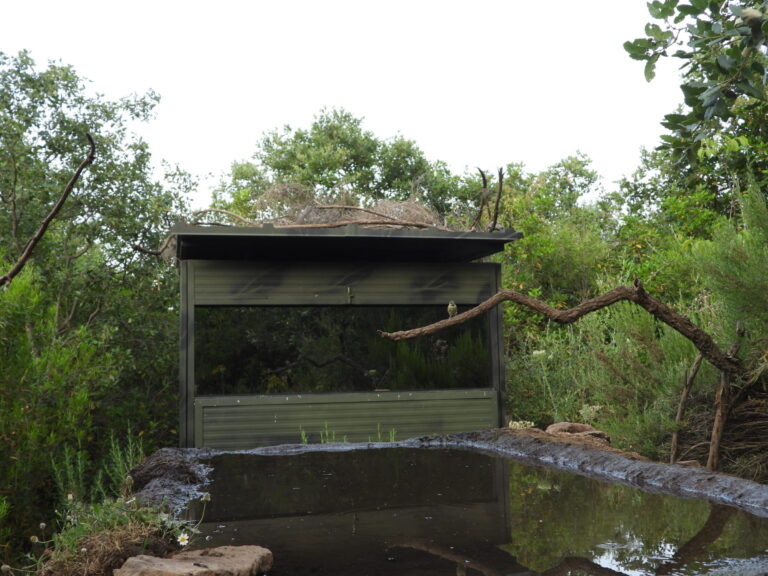
Hide el Venero de los Rabilargos
Great Spotted Woodpecker · Iberian Magpie+33
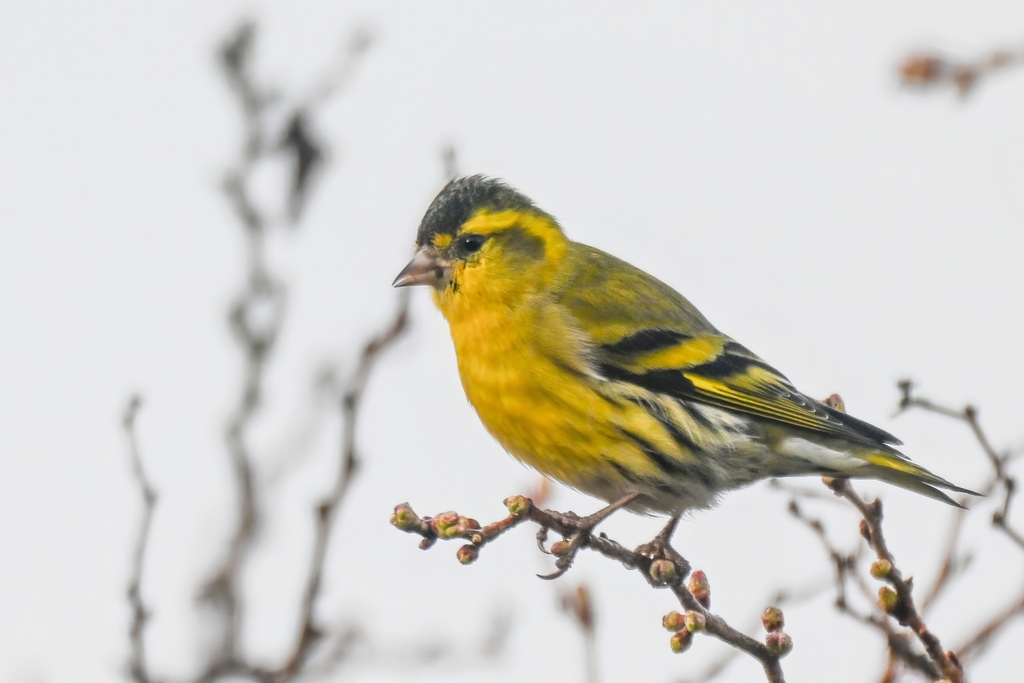
The Eurasian siskin is a small finch, measuring 11–12.5 centimetres in length with a wingspan of 20 to 23 centimetres, weighing just 12 to 18 grams. Despite its diminutive size, it is remarkably distinctive and easy to recognise. Males are strikingly beautiful, displaying bright yellow on the face, breast, and rump, contrasted with a neat black cap and black bib. The wings are black with a striking yellow wing bar, and the tail is black with yellow sides. Females and young birds are more subdued, showing greyish-green heads without the male's cap, and olive-tinged plumage overall. Both sexes have greyish-green upperparts and grey-streaked white underparts. The bird's slender yet strong beak is specially adapted for extracting seeds from between the scales of cones and fruit. Its rapid, bounding flight pattern is typical of finches.
The Eurasian siskin is very common throughout Europe and Eurosiberia, with breeding populations found from northern Scandinavia and Russia to the central and northern parts of Europe, and in Asia from the Khingan Mountains of Inner Mongolia to Jiangsu province in China. The species is found in forested areas, both coniferous and mixed woodland. Birds remain year-round in Central Europe and some southern mountain ranges, while northern populations overwinter in the Mediterranean basin, around the Black Sea, and in southern China including Tibet, Taiwan, and the Yangtse River valleys. Occasional sightings occur in North America.
The Eurasian siskin is a trusting, sociable, and active bird, known for its pleasant song composed of tweets and trills. It is an acrobatic feeder, characteristically hanging upside down like a tit while extracting seeds from alder cones and other plant material. The species exhibits an unusual migration pattern, migrating southwards in large numbers every few years during winter—a behaviour likely related to climatic factors and food availability. This enables overwintering populations to thrive where seeds are abundant. The bird is sufficiently habituated to humans to visit garden bird feeding stations.
The best opportunities to see Eurasian siskins vary by location. In Central Europe and southern mountain ranges, they are present year-round. In northern Scandinavia and Russia, spring and summer offer the best viewing during breeding season. For winter sightings, the Mediterranean basin and areas around the Black Sea are productive, as are regions where large irruptive movements occur every few years. Garden feeding stations with seed offerings attract these birds reliably.
The bright plumage of male Eurasian siskins makes them rewarding subjects, particularly their contrasting black caps and yellow faces. Photograph them in coniferous or mixed woodland habitats where natural perches among alder and spruce provide excellent backdrops. Their acrobatic feeding behaviour, hanging upside down from seed heads and cones, offers dynamic compositional opportunities. Early morning light enhances the yellow and green tones of their plumage. Patient positioning near alder trees or garden feeders where they visit regularly increases chances of close approach.
Nothing matches these filters.
Nothing matches these filters.
No community photos yet. Log in to add the first one.
No community observations of this species yet.
We'd love to hear from you. We'll reply as soon as possible.
Found an error? Have a suggestion? We read every message.
A compact view of how this species lives, moves and responds to its environment.
Select a card to explore the details.
Please confirm the photo rights and credit terms first.
I'm the author of this photo or hold the rights to it, and I keep full ownership. I grant Wild Atlas Guide a free, non-exclusive licence to display it on the site and in Wild Atlas Guide's own channels, including social media, always credited to me by my display name or the Instagram handle I choose to provide. I confirm it does not reveal a sensitive wildlife location or a recognisable person without their permission. I can withdraw future social use for this photo or ask for it to be removed at any time.
Please accept the photo rights and credit terms to continue.
Uploading…
We use cookies to measure traffic and improve Wild Atlas Guide. You decide. Privacy policy