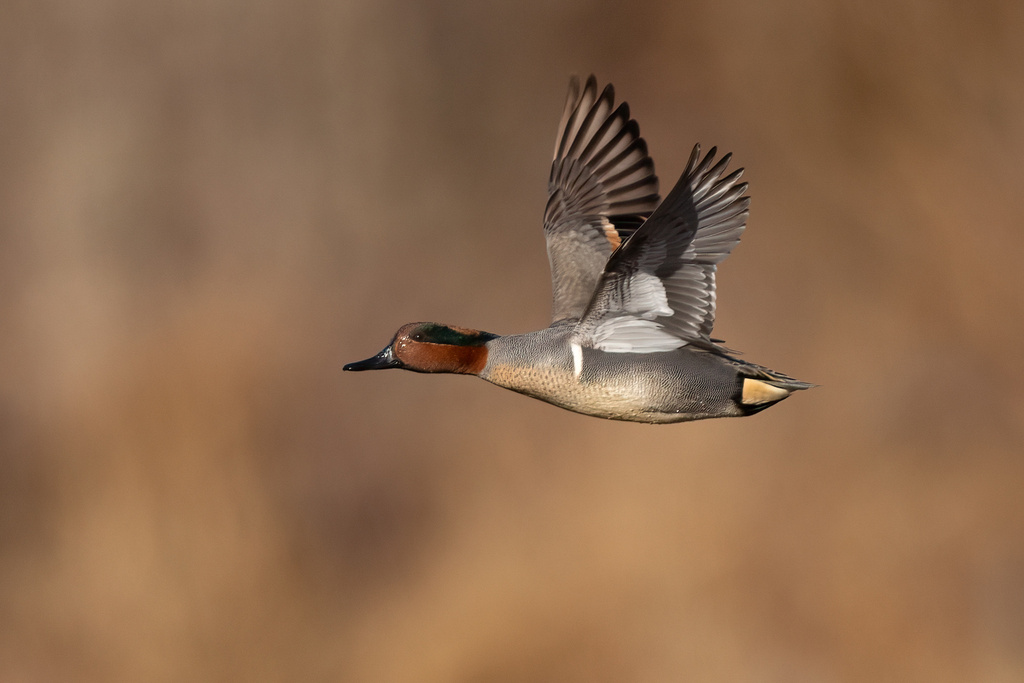
Eurasian Teal
Photo © Matt Felperin
Photo © Matt Felperin — CC BY 4.0 — Source: iNaturalist photo #358124392Identification
The Eurasian teal is one of the smallest dabbling ducks, measuring 34–43 cm in length with a wingspan of 53–59 cm. Males in breeding plumage are unmistakable: they appear grey at distance but display striking details at closer range, including a chestnut head and upper neck with a wide, iridescent dark green patch shaped like a half-moon or teardrop that extends from before the eye to the upper hindneck. This green patch is bordered by thin yellowish-white lines, with a white stripe running along the flanks. The breast is buff with small brown spots, while the belly is predominantly white with fine blackish markings. The speculum (wing patch) is iridescent blackish-green with white tips.
Females and non-breeding males are more subdued in colouration, appearing yellowish-brown with a dark head and subtle facial markings. They resemble a tiny mallard, with dense streaks on the head and neck and scaly spots on the body. Despite their small size, Eurasian teals can be reliably distinguished from their North American counterparts (green-winged teals) through behavioural and morphological differences, though their breeding plumage is remarkably similar.
Range & Habitat
The Eurasian teal breeds throughout temperate Eurosiberia and migrates southward during winter months. The species is highly gregarious outside the breeding season and commonly forms large flocks. It shows a strong preference for sheltered wetlands, where it finds ideal conditions for feeding and resting.
Behaviour & Diet
As a dabbling duck, the Eurasian teal feeds by foraging in shallow water and on wetland margins. Its diet consists primarily of seeds and aquatic invertebrates. The species is notably gregarious, particularly during the non-breeding season when individuals gather in substantial flocks. The male's characteristic call, which gives the species its name—the Swedish "kricka"—has inspired common names across northern Europe, including the Norwegian krikkand, Danish krikand, and German Krickente, all referring to this distinctive vocalization.
Best Time & Places to See It
The Eurasian teal's migratory pattern makes timing crucial for observation. Winter months offer the best opportunities to observe large flocks gathering in southern regions, while breeding season is the time to visit temperate Eurosiberian wetlands. Look for this species in sheltered wetlands where it congregates in groups, making it relatively easy to locate once you find suitable habitat.
Photography Tips
The striking plumage of breeding males offers excellent photographic opportunities, particularly the iridescent green head patch and white flank stripe. Early morning light will enhance the metallic sheen of the male's head markings. When photographing at distance, males appear predominantly grey, so approach carefully to reveal the intricate details of their breeding plumage. Females and eclipse plumage birds present a more challenging subject but reward patient photographers with detailed images of their subtle patterning. Large winter flocks provide opportunities for dynamic composition and behaviour documentation.
Kanha Tiger Reserve
Tombstone Territorial Park
Abijata-Shalla Lakes National Park
Abruzzo, Lazio and Molise National Park
Acadia National Park
Alaska Maritime National Wildlife Refuge
Algonquin Provincial Park
Alligator River National Wildlife Refuge
Alpilles Regional Nature Park
Nothing matches these filters.
No community photos yet. Log in to add the first one.
No community observations of this species yet.