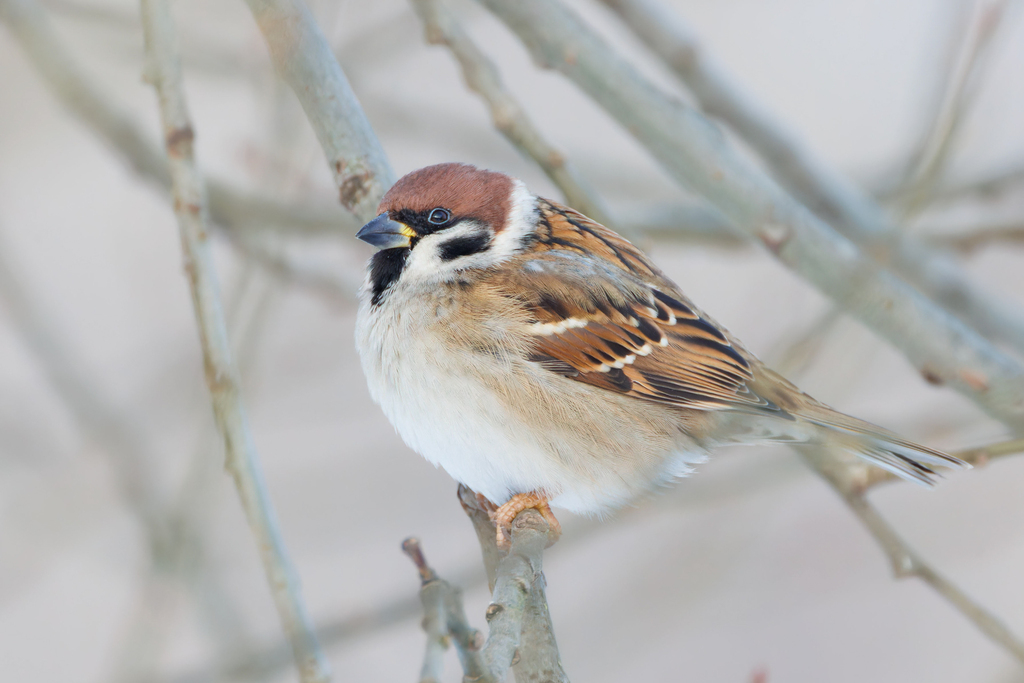
Eurasian Tree Sparrow
Photo © Михаил Голомысов
Photo © Михаил Голомысов — CC BY 4.0 — Source: iNaturalist photo #604593699Identification
The Eurasian tree sparrow is a small passerine, measuring 12.5–14 cm long with a wingspan of about 21 cm and weighing approximately 24 g, making it roughly 10% smaller than the house sparrow. Its most distinctive feature is a striking face pattern: a rich chestnut crown and nape contrasted with pure white cheeks marked by a kidney-shaped black ear patch. The chin, throat, and area between bill and throat are black, while the upperparts are light brown streaked with black. The wings display two narrow white bars, and the legs are pale brown. The bill is lead-blue in summer, becoming almost black in winter. Unlike many sparrow species, the sexes are identical in plumage, with juveniles appearing as duller versions of adults. This contrasting facial pattern makes the tree sparrow easily identifiable across all plumages and distinguishes it clearly from the male house sparrow, which has a grey rather than brown crown.
Range & Habitat
The tree sparrow breeds across much of temperate Eurasia and Southeast Asia, with its range varying slightly among seven recognized subspecies. The nominate European subspecies ranges across most of Europe except southwestern Iberia, southern Greece, and the former Yugoslavia, extending east to the Lena River and south through Turkey, the Caucasus, Kazakhstan, and Mongolia to North Korea. The species has also been introduced to other regions, including the United States, where it is called the Eurasian or German tree sparrow.
In Europe, the tree sparrow inhabits lightly wooded open countryside, contrasting with the house sparrow's preference for more urban areas. The species is widespread in towns and cities of eastern Asia. Population declines have occurred in Western Europe, partly due to changes in farming practices involving increased herbicide use and loss of winter stubble fields. In eastern Asia and western Australia, it is sometimes considered a pest, though it remains celebrated in oriental art.
Behaviour & Diet
The tree sparrow mainly feeds on seeds but also consumes invertebrates, particularly during the breeding season. Its untidy nest is built in a natural cavity, a hole in a building, or the disused nest of a European magpie or white stork. The typical clutch consists of five or six eggs, which hatch in under two weeks. The species does not have a true song; instead, its vocalizations include an excited series of tschip calls made by unpaired or courting males, monosyllabic chirps for social interaction, and a harsh teck flight call.
Both adult and juvenile tree sparrows undergo a slow, complete moult in autumn accompanied by an increase in body mass. This change results from increased blood volume to support active feather growth and higher overall body water content. Like other small birds, tree sparrows face threats from parasites, diseases, and predation by birds of prey, with a typical lifespan of about two years.
Best Time & Places to See It
The tree sparrow's extensive range and large population mean it is not globally endangered, making it relatively accessible to birdwatchers across much of Eurasia. In Europe, look for this species in lightly wooded open countryside and farmland habitats, where it is more common than in heavily urbanized areas. Eastern Asian populations are widespread in towns and cities, offering reliable viewing opportunities in that region. The species' preference for nesting in tree holes and building cavities makes it easier to locate during the breeding season when birds are more active and vocal.
Photography Tips
The tree sparrow's distinctive facial markings—the chestnut crown, white cheeks, and black ear patches—make it an attractive and identifiable photographic subject. The contrasting face pattern is particularly striking and should be the focus of portrait shots. Capture both the profile and front-facing views to showcase the unique black patch on each cheek and the patterning of the crown and nape. The bird's small size and active nature require a fast shutter speed, particularly when photographing unpaired or courting males engaged in their excited vocalizations. The two narrow white bars on the wings are worth capturing in flight shots. Spring and early summer, during the breeding season, offer the best opportunities for active behavior, while the increased body mass and plumage quality following autumn moult produces sharp, well-defined images.
Abruzzo, Lazio and Molise National Park
Aggtelek National Park
Aketajawe Lolobata National Park
Alaska Maritime National Wildlife Refuge
Alpilles Regional Nature Park
Alta Murgia National Park
Altai Tavan Bogd National Park
Appennino Lucano Val d’Agri Lagonegrese National Park
Åsnens National Park
Nothing matches these filters.
No community photos yet. Log in to add the first one.
No community observations of this species yet.