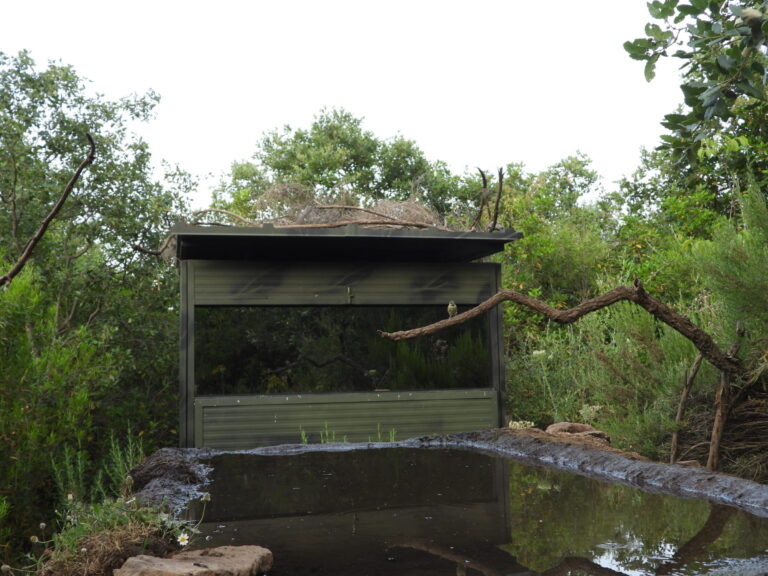
Hide el Venero de los Rabilargos
Great Spotted Woodpecker · Iberian Magpie+33
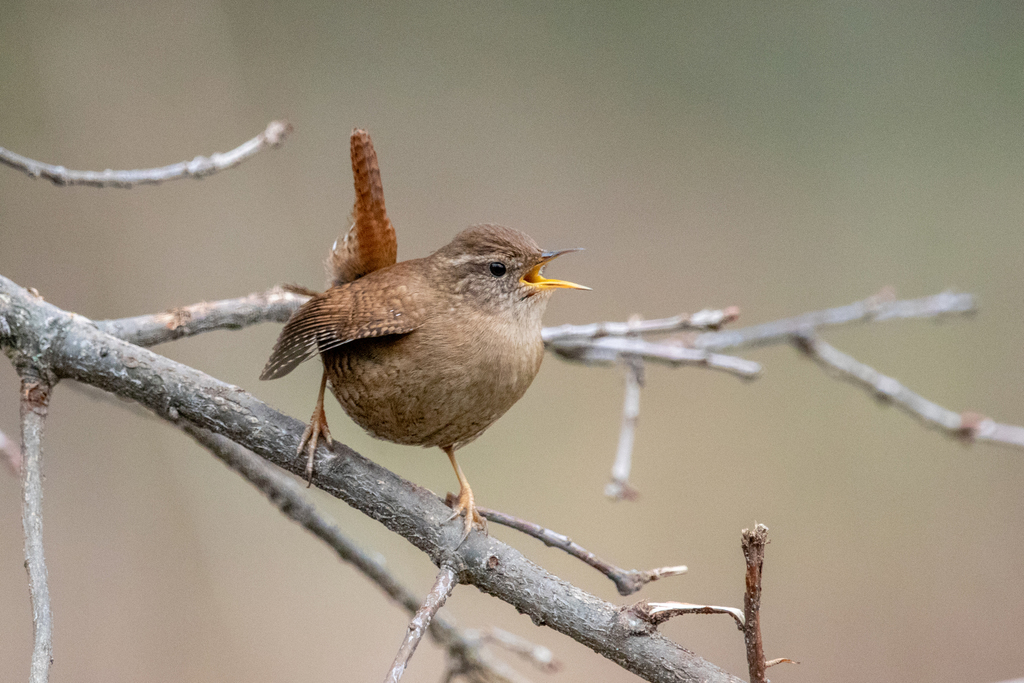
The Eurasian wren is a very small insectivorous bird, instantly recognisable by its distinctive silhouette. Its most striking features are a very short tail, often held erect, combined with a short neck and a relatively long thin bill—proportions that give it a characterful, determined appearance. The plumage is russet brown above with paler buff-brown underparts, finely barred throughout with darker markings. A cream buff supercilium (eyebrow stripe) adds subtle character to its face. The sexes are alike in appearance, making field identification straightforward across its range.
The Eurasian wren is the only member of the wren family found in the Old World, occurring across Europe and the Palearctic region. Its range extends in a broad belt across Asia from northern Iran and Afghanistan eastward to Japan, with populations also found in the Maghreb region of North Africa. The species shows interesting migratory patterns: birds in the northern parts of its range, particularly the northeast, are migratory, while populations in the west and south are sedentary year-round residents.
The scientific name Troglodytes—derived from Greek words meaning "hole-dweller"—perfectly captures this species' most characteristic behaviour. Wrens frequently disappear into cavities, crevices, and other hiding places while hunting for arthropods or when roosting. This secretive habit can make them surprisingly difficult to observe despite their small size and wide distribution. The Eurasian wren exhibits an unusual mating system for passerines: it is highly polygynous, meaning males mate with multiple females, an arrangement uncommon among songbirds.
As a sedentary species across much of western and southern Europe, the Eurasian wren can be found year-round in these regions, making it accessible to travellers and birdwatchers at any season. The species' 28 recognised subspecies are distributed across diverse habitats from the British Isles and continental Europe to Scandinavia, the Mediterranean, the Caucasus, the Himalayas, and across to Japan. Your likelihood of encountering this small bird increases near rocky outcrops, dense scrub, stone walls, and other areas providing the cavities and crevices it favours for hunting and shelter.
Photographing the Eurasian wren presents both challenges and rewards. Patience is essential—position yourself near suitable habitat with cavities and dense cover, and wait quietly for the bird to emerge. The wren's small size and habit of frequently disappearing into holes demands a telephoto lens and fast shutter speed to capture sharp images. Its russet and buff plumage photographs best in soft, overcast light that reveals the subtle barring without creating harsh shadows. Capturing the characteristic erect tail or the bird emerging from a cavity makes for compelling, behaviour-focused images that tell the story of this hole-dwelling specialist.
Nothing matches these filters.
Nothing matches these filters.
No community photos yet. Log in to add the first one.
No community observations of this species yet.
We'd love to hear from you. We'll reply as soon as possible.
Found an error? Have a suggestion? We read every message.
A compact view of how this species lives, moves and responds to its environment.
Select a card to explore the details.
Please confirm the photo rights and credit terms first.
I'm the author of this photo or hold the rights to it, and I keep full ownership. I grant Wild Atlas Guide a free, non-exclusive licence to display it on the site and in Wild Atlas Guide's own channels, including social media, always credited to me by my display name or the Instagram handle I choose to provide. I confirm it does not reveal a sensitive wildlife location or a recognisable person without their permission. I can withdraw future social use for this photo or ask for it to be removed at any time.
Please accept the photo rights and credit terms to continue.
Uploading…
We use cookies to measure traffic and improve Wild Atlas Guide. You decide. Privacy policy