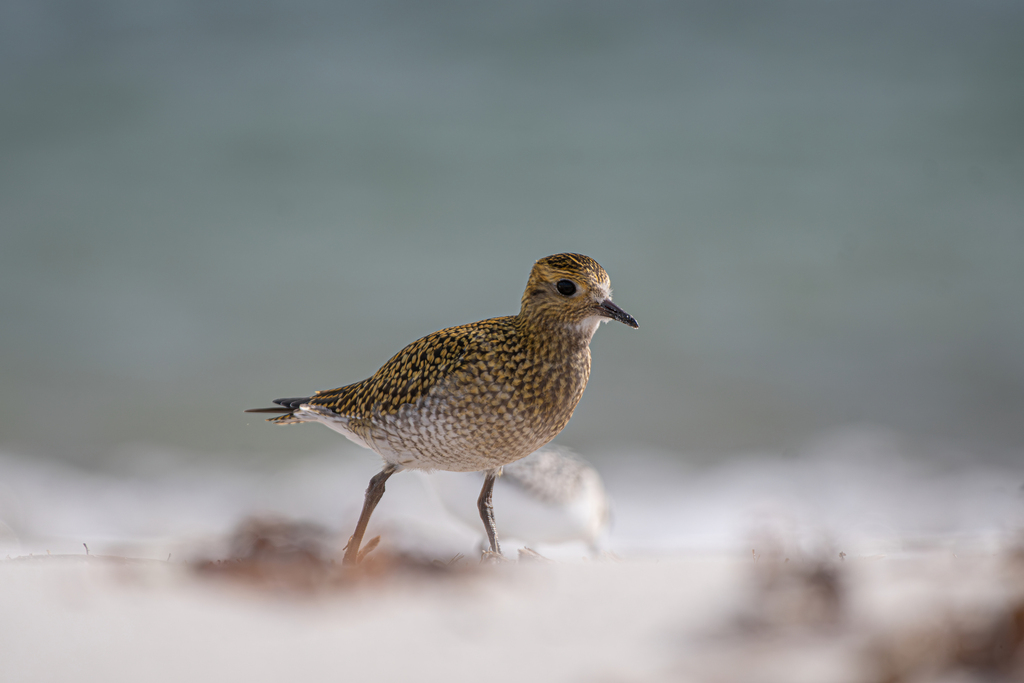
European Golden Plover
Photo © Rafael Würtemberger
Photo © Rafael Würtemberger — CC BY 4.0 — Source: iNaturalist photo #294808050Identification
The European golden plover is a relatively large plover with a distinctive thickset build and wings only slightly longer than its tail. Its most striking feature is a white "S"-shaped band that stretches from the forehead down to the flanks, making it recognisable in both breeding and non-breeding plumage. When distinguishing this species from its close relatives, look for white axillary (armpit) feathers visible in flight and when the bird stretches its wings on the ground—a key difference from the American and Pacific golden plovers, which are both slightly smaller, slimmer, longer-legged, and possess grey rather than white feathers in this area.
Range & Habitat
The European golden plover breeds across a vast range spanning from Iceland in the west to central Siberia in the east, inhabiting Arctic tundra and moorland areas. Breeding populations extend south to Wales and Belarus, though the species has experienced local extinctions, including the loss of a small population on Dartmoor in southwest England around 2010. In winter, these birds migrate southwest to milder regions, ranging from Ireland and Denmark south to the Mediterranean, northwest Africa, and southwest Asia, reaching as far as Algeria, northern Egypt, and the Caspian coast of Iran.
During winter, European golden plovers favour open landscapes including agricultural plains, ploughed fields, and short meadows, typically in flat terrain with moderate vegetation near wetlands. The species has occasionally wandered beyond its normal range, with vagrant records reaching the east coast of Canada, Gambia, Pakistan, and northern India. Iceland holds roughly a third of the global population and remains the species' stronghold.
Behaviour & Diet
The European golden plover is highly gregarious during winter, gathering in large flocks across open areas. Its call is a distinctive monosyllabic, slightly descending, melancholic "tuu" that travellers may hear during migration periods. In flight, the bird displays rapid and powerful movement with regular wingbeats, allowing it to cover vast distances during its long-distance migrations between breeding and wintering grounds.
Diet varies geographically across the breeding range. In the United Kingdom, golden plover chicks depend heavily on craneflies for nutrition, while in Sweden, march flies form a more important dietary component. This flexibility in food sources helps the species adapt to different environments across its extensive range.
Best Time & Places to See It
Iceland is the premier destination for European golden plover enthusiasts, holding approximately one-third of the global population. The species is most abundant during the breeding season in Arctic and subarctic regions. In Icelandic culture, the arrival of the first golden plover signals the onset of spring and receives significant media attention—a tradition that offers travellers a unique opportunity to witness this cultural moment and observe the birds during their return migration.
Winter visitors to lowland agricultural regions across Europe, northwest Africa, and southwest Asia may encounter large flocks gathered in open plains and meadows. Coastal regions from Ireland to Denmark and southward to the Mediterranean also provide reliable winter viewing opportunities, particularly in areas with suitable open habitats near wetlands.
Photography Tips
Photograph European golden plovers in open, flat terrain where they gather in winter flocks, as this environment allows clean compositions without obstruction. The species' white axillary feathers are best captured in flight or when the bird stretches its wings on the ground, so be ready for these moments. The distinctive white "S"-shaped band from forehead to flanks is a key identifying feature worth highlighting in your images. Rapid wingbeats make flight photography challenging but rewarding—use a fast shutter speed to freeze the action and capture the bird's powerful flight style.
Private Full-Day Birdwatching Tour from Lisbon to the Tagus Estuary
Nothing matches these filters.
Alta Murgia National Park
Åsnens National Park
Avesnois Regional Nature Park
Bannau Brycheiniog National Park
Bardenas Reales
Berwyn National Nature Reserve
Biebrza National Park
Búðahraun Nature Reserve
Burren National Park
Nothing matches these filters.
No community photos yet. Log in to add the first one.
No community observations of this species yet.