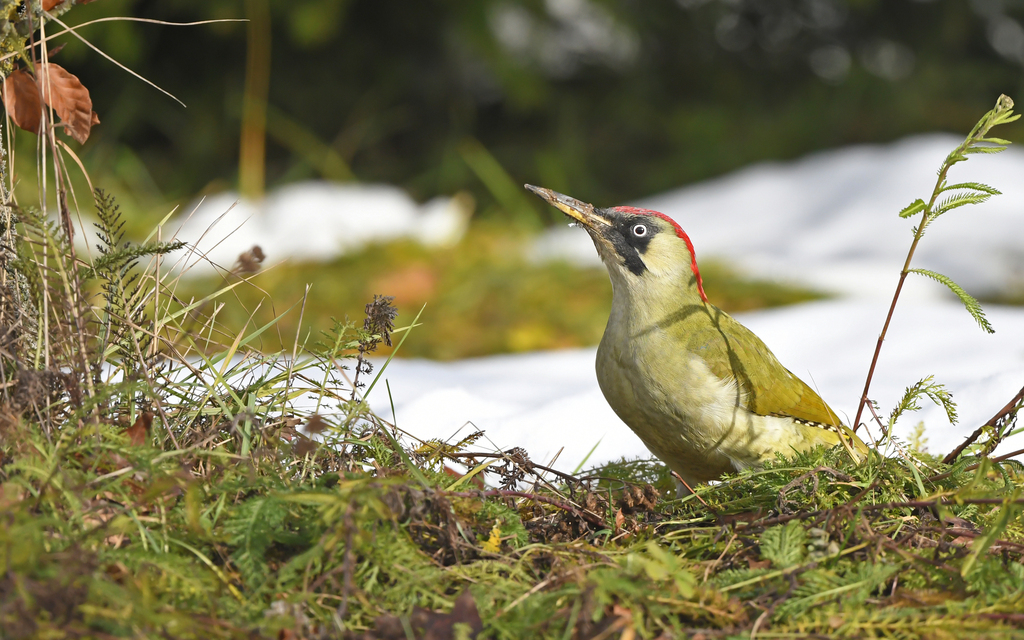
European Green Woodpecker
Photo © Christoph Moning
Photo © Christoph Moning — CC BY 4.0 — Source: iNaturalist photo #340302755Identification
The European green woodpecker is a large woodpecker measuring 30–36 cm in length with a 45–51 cm wingspan. It is unmistakable with its vivid green upperparts, pale yellowish-green underparts, and bright red crown and nape. The most distinctive feature is the black moustache stripe, though males have a striking red centre to this marking while females have solid black. Both sexes display a yellow rump and black lores with a dark mask around white eyes. Juveniles are spotty and streaked all over, with initially dark moustaches, though young males may show red feathers by summer.
In flight, the bird exhibits an undulating pattern with 3–4 wingbeats followed by a short glide. It can be distinguished from the smaller grey-headed woodpecker by its yellowish (not grey) underparts and prominent black facial mask. The similar Iberian green woodpecker replaces it in Spain and Portugal, while Levaillant's woodpecker occurs only in north-west Africa.
Range & Habitat
The European green woodpecker is widely distributed across much of Europe and the western Palearctic, with more than 75% of its range in Europe. It is absent from Ireland, northern and eastern parts of the continent, Greenland, and the Macaronesian Islands. Over half of the European population is concentrated in France and Germany, with substantial populations also in the United Kingdom, Sweden, Russia, Croatia, Romania, and Bulgaria. The species also occurs in western Asia.
This woodpecker requires a combination of old deciduous trees for nesting and nearby feeding grounds rich in ants. It favours semi-open landscapes featuring small woodlands, hedges, scattered old trees, forest edges, and floodplain forests. Suitable foraging habitats include grassland, heaths, plantations, orchards, and lawns. The species is highly sedentary, with individuals rarely moving more than 500 m between breeding seasons.
Behaviour & Diet
Unlike most woodpeckers, the European green woodpecker spends much of its time feeding on ants on the ground and rarely drums on trees. Its vivid plumage belies its shy, wary nature—it is more often heard than seen. The bird draws attention with its loud, distinctive calls: a raucous kyü-kyü-kyück while flying, and a loud series of 10–18 'klü' sounds that accelerates slightly and falls in pitch. Females produce a thinner pü-pü-pü call.
Breeding involves excavating a nesting hole in a tree, with the male performing most of the work over 15–30 days. The entrance hole measures approximately 60 mm × 75 mm, with a cavity interior up to 40 cm deep. Four to six eggs are laid and hatch after 19–20 days. Preferred nest trees include oaks, beeches, willows, and fruit trees in western and central Europe, with aspens favoured in the north. Some tree holes are reused for breeding over more than 10 years.
Best Time & Places to See It
The European green woodpecker's range includes much of continental Europe, making it accessible to travellers in France, Germany, the United Kingdom, and Scandinavia. Look for it in semi-open landscapes with scattered trees and mixed woodland edges where ants are abundant. Parks with mature deciduous trees and open grassland also attract this species.
Since the bird is shy and often difficult to spot despite its vivid colours, listening for its distinctive loud calls is your best chance of locating one. Early morning is typically productive for woodpecker activity. The species is resident throughout its range, so it can be sought year-round, though moult occurs between June and November.
Photography Tips
Photographing this striking woodpecker presents both opportunities and challenges. The combination of bright green, yellow, and red plumage offers excellent colour contrast, but the bird's shyness demands patience and careful approach. Position yourself near suitable habitat—open areas adjacent to woodland with mature trees—and listen for calls to locate individuals.
Since the bird often feeds on the ground, watching open grassland and lawns adjacent to trees may yield closer photographic opportunities than pursuing it in dense woodland. Early morning light will best showcase the vivid red crown and green plumage. Use a telephoto lens and remain still; the bird's tendency to be more often heard than seen means that audio location followed by patient waiting offers the best chance of obtaining images of this charismatic species.
Abruzzo, Lazio and Molise National Park
Aggtelek National Park
Alpilles Regional Nature Park
Alta Murgia National Park
Appennino Lucano Val d’Agri Lagonegrese National Park
Appennino Tosco-Emiliano National Park
Åsnens National Park
Aspromonte National Park
Avesnois Regional Nature Park
Nothing matches these filters.
No community photos yet. Log in to add the first one.
No community observations of this species yet.