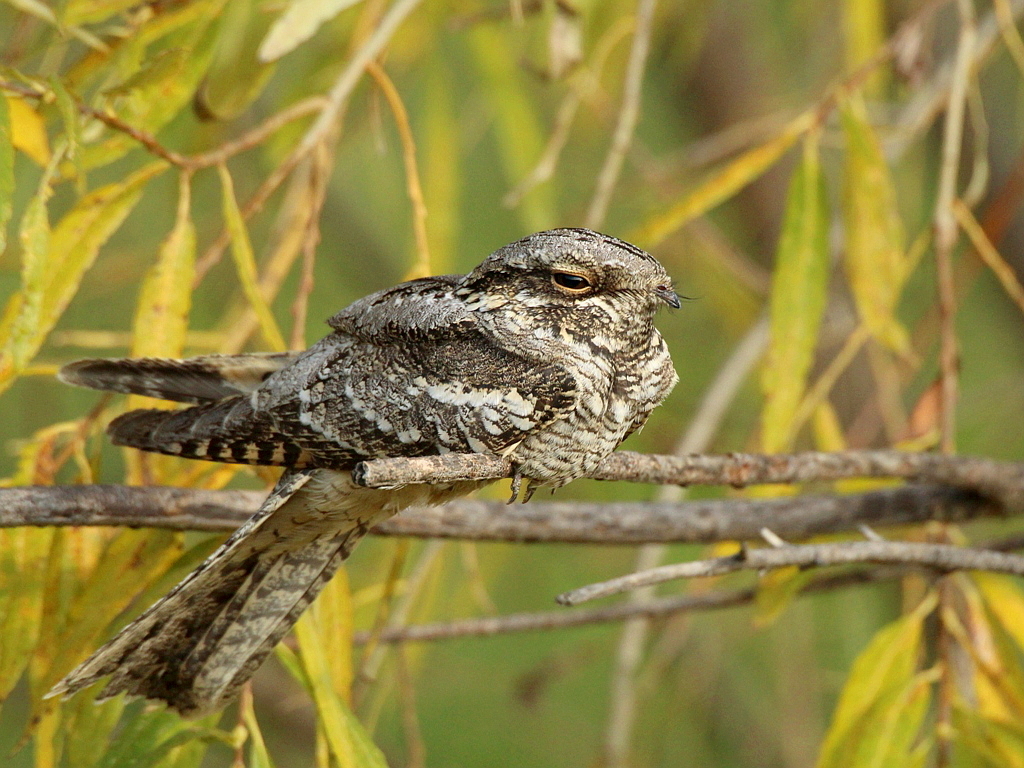
European Nightjar
Photo © Andrew Bazdyrev
Photo © Andrew Bazdyrev — CC BY 4.0 — Source: iNaturalist photo #161683140Identification
The European nightjar is a small, cryptic bird measuring 24.5–28 cm in length with a wingspan of 52–59 cm. Its densely patterned grey and brown plumage provides excellent camouflage, making daytime identification challenging when the bird rests on the ground or perches motionless along a branch. Adults display greyish-brown upperparts with dark streaking, a pale buff hindneck collar, and a distinctive white moustachial line. The closed wing is grey with buff spotting, and underparts are greyish-brown with brown barring and buff spots.
Sexual dimorphism becomes apparent in flight: males display white patches across three primary wing feathers and white tips to the two outer tail feathers, while females lack any white markings in flight. The bird's flight is characteristically noiseless and buoyant, powered by long pointed wings with soft plumage. Dark brown iris, blackish bill, and brown legs and feet complete the description. Among European species, the larger red-necked nightjar, found in the Iberian Peninsula, is greyer with longer wings and a more conspicuous buff collar.
Range & Habitat
The European nightjar breeds across most of Europe and the Palearctic, extending eastward to Mongolia and Northwestern China. Six recognised subspecies show clinal variation, with birds becoming progressively smaller and paler toward the east. Remarkably, all populations are fully migratory, abandoning their breeding grounds entirely to winter in sub-Saharan Africa, making this an intercontinental traveller.
This species favours dry, open country with scattered trees and small bushes. Preferred habitats include heaths, forest clearings, and newly planted woodland. These open landscapes provide ideal hunting grounds for an aerial insectivore while offering suitable nesting and roosting sites.
Behaviour & Diet
The European nightjar is strictly crepuscular and nocturnal, resting during daylight hours. Males establish territories in spring and advertise their presence with a distinctive sustained churring trill delivered from a perch—a sound that has inspired vernacular names like "churn owl." Territorial males patrol with wings held in a characteristic V-shape and tail fanned, chasing intruders while wing-clapping and calling. Courtship involves spiralling display flights accompanied by wing-clapping.
The species feeds exclusively on flying insects captured in flight, often fly-catching from a perch. It hunts primarily by sight, silhouetting prey against the night sky using relatively large eyes, each equipped with a reflective layer that enhances night vision. Notably, the European nightjar does not rely on hearing to locate insects and does not echolocate. Drinking and bathing occur during flight. Breeding involves no nest construction; two grey and brown blotched eggs are laid directly on the ground, hatching after 17–21 days, with fledging occurring 16–17 days later.
Best Time & Places to See It
European nightjars are present at breeding sites during spring and summer months, after their arrival from African wintering grounds. Observers should seek them in heaths, forest clearings, and newly planted woodland areas across their European range. The male's distinctive churring call is the most reliable indicator of presence, often heard from dusk onwards during the breeding season.
Despite suffering habitat loss, disturbance, and insect prey reduction through pesticide use, the species maintains large populations across its extensive range and is classified as of least concern by the International Union for Conservation of Nature.
Photography Tips
Photographing European nightjars presents significant challenges due to their cryptic daytime plumage and nocturnal habits. Daytime photography requires patience and careful searching of preferred habitat; birds are best located by sound before visual confirmation is attempted. The bird's camouflaged appearance means that ground-level and branch-level observations demand meticulous scrutiny.
Night photography offers more rewarding opportunities, capturing the bird's buoyant flight and the striking white wing and tail markings visible only in males during flight. Fast film speeds and sensitive equipment are essential for recording nocturnal activity. Positioning near churring males during dusk or dawn hours increases the likelihood of observing and photographing these elusive birds in their element.
Abruzzo, Lazio and Molise National Park
Aggtelek National Park
Alpilles Regional Nature Park
Alta Murgia National Park
Arabuko Sokoke Forest Reserve
Arusha National Park
Avesnois Regional Nature Park
Bannau Brycheiniog National Park
Bardenas Reales
Nothing matches these filters.
No community photos yet. Log in to add the first one.
No community observations of this species yet.