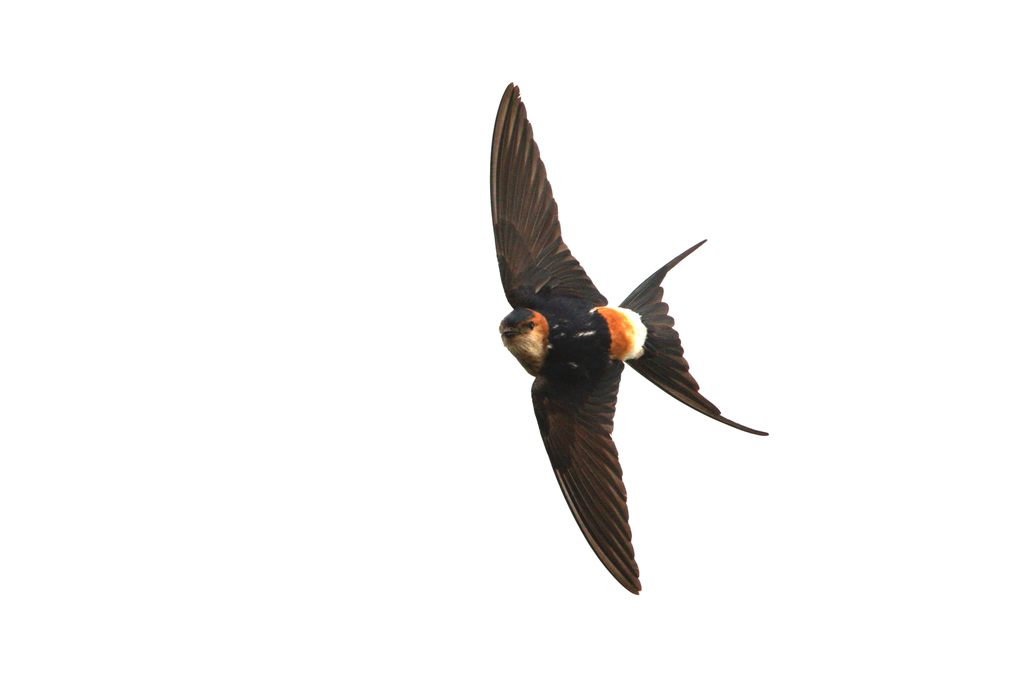
European Red-rumped Swallow
Photo © Christoph Moning
Photo © Christoph Moning — CC BY 4.0 — Source: iNaturalist photo #91767591The European red-rumped swallow (Cecropis rufula) is a small passerine bird in the swallow family Hirundinidae. Historically, it was usually treated in a broad concept of the genus Hirundo, but is now treated in the genus Cecropis. It was formerly considered to be a subspecies of the eastern red-rumped swallow (Cecropis daurica), united, together with the African red-rumped swallow (C. melanocrissus, syn. C. domicella), under the common name of red-rumped swallow. == Description == European red-rumped swallow is somewhat similar in habits and appearance to the other aerial insectivores, such as the related swallows and the unrelated swifts (order Apodiformes). It has blue-glossed black upperparts and pale buffy underparts. Within Europe, it most closely resembles barn swallow, but is easily distinguished by being buffier below, with pale orangey or reddish rump, a pale buffy face and throat, and an orangey-red nape collar. It lacks the breast band of barn swallow, but has a black undertail, giving the appearance of the whole tail as being 'dipped in ink' and lacking the white tail spots of barn swallow. The tail is deeply forked, much more than western house martin but slightly less than barn swallow. It is a fast flier with long…
12 Days Birds & Culture Programme in Southern Portugal
12 Days in Spain Birdwatching Programme
12 Days Portugal & Spain Birdwatching Programme
Private Full-Day Birdwatching Tour from Lisbon to the Tagus Estuary
Short-break Birds & Conservation Programme in Southern Portugal
Short-break Birdwatching Programme in Southern Portugal
Nothing matches these filters.
Butrint National Park
Doñana National Park
L’Albufera Natural Park
Marjal Pego-Oliva Natural Park
Monfragüe National Park
S’Albufera Natural Park
Sierra de Guadarrama National Park
Tablas de Daimiel National Park
Nothing matches these filters.
No community photos yet. Log in to add the first one.
No community observations of this species yet.