European Robin
Erithacus rubecula
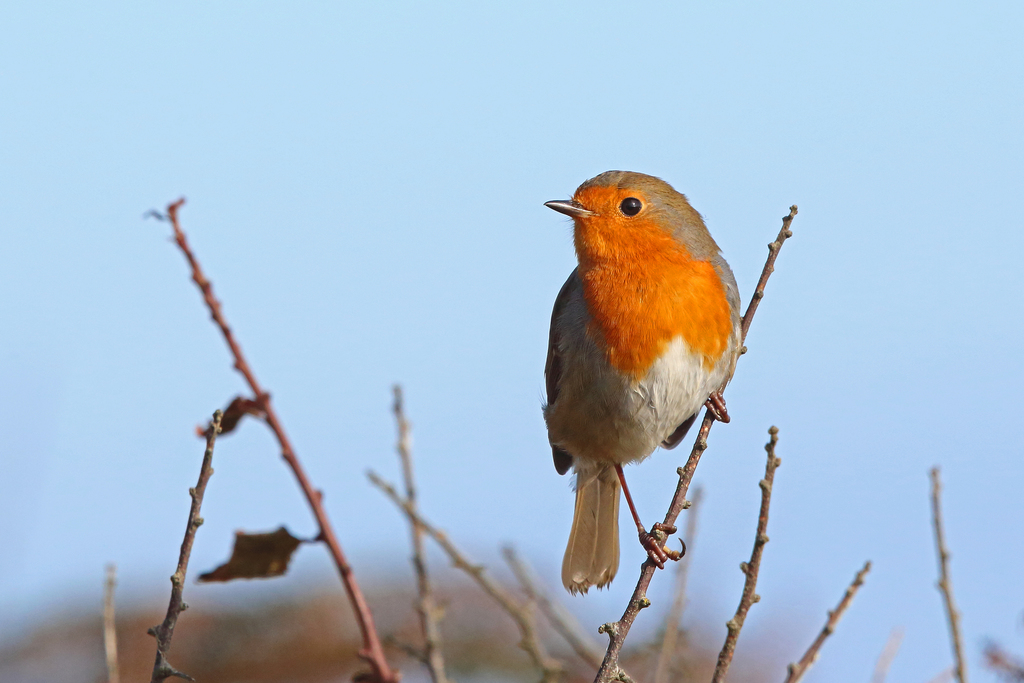
Photo © Nigel Voaden
Photo © Nigel Voaden — CC BY 4.0 — Source: iNaturalist photo #11566966ABOUT
Subspecies of European Robin
Eurasian RobinTenerife RobinBritish RobinGran Canaria RobinWest Siberian RobinNorth African RobinCaucasian RobinCrimean RobinErithacus rubecula hyrcanus
Identification
The European robin is a small passerine, measuring 12.5–14.0 cm in length. Both males and females are identical in plumage, making this species remarkably easy to identify regardless of sex. The bird's most striking feature is its distinctive orange-toned red breast and face, which contrasts sharply with grey edging and brown upper-parts. The belly is whitish, completing a compact and instantly recognizable silhouette that has made the robin a beloved symbol across its range.
Juveniles differ markedly from adults, being freckled brown all over and completely lacking the diagnostic red breast. First-winter immatures resemble adults more closely but retain more obvious yellow-brown tips to the wing covert feathers, which are inconspicuous or absent in fully mature birds. These plumage differences are useful for aging birds in the field.
Range & Habitat
The European robin is found across Europe, extending as far east as Western Siberia and as far south as North Africa. The species exhibits different migration patterns depending on location: birds in the west and south of the range are sedentary year-round, while those in the north and east migrate to escape the harsher winters of their breeding grounds. This behavioural flexibility has allowed the robin to colonize a vast geographic range across multiple climatic zones.
Behaviour & Diet
As its classification within the Old World flycatcher family suggests, the European robin is an insectivorous bird, feeding primarily on insects and other invertebrates. The species is active and characterful, often approaching humans with apparent curiosity—a behaviour that has contributed significantly to its cultural prominence and popularity among birdwatchers and garden visitors throughout its range.
Best Time & Places to See It
Robins are present year-round across much of western and southern Europe, making them accessible to travellers and photographers at any season. In northern and eastern parts of the range, the best time to observe resident populations is during the breeding season, though migratory individuals may be encountered during passage periods. Gardens, parks, and wooded areas throughout Europe offer reliable viewing opportunities.
Photography Tips
The robin's distinctive orange-red breast and relatively confiding nature make it an excellent subject for photography. The contrast between the bright breast and grey facial markings photographs well in soft, even light. Patience is often rewarded, as robins frequently approach photographers and observers, sometimes perching at close range. Photographing juveniles alongside adults provides an opportunity to document the dramatic plumage differences between age classes, adding educational value to your images.
HIDES
Sort by
50 €/ person
Book now
80 €/ person
Book nowNothing matches these filters.
HOTSPOTS
Country
Type
Sort by
National Park
Abruzzo, Lazio and Molise National Park
Pescasseroli·Italy
+139 birds+18 mammals
National Park
Aggtelek National Park
Szin·Hungary
+119 birds+13 mammals
Natural Park
Alpilles Regional Nature Park
Saint-Rémy-de-Provence·France
+219 birds+37 mammals
National Park
Alta Murgia National Park
Bari·Italy
+168 birds+6 mammals
National Park
Appennino Lucano Val d’Agri Lagonegrese National Park
Spinoso·Italy
+121 birds+3 mammals
National Park
Appennino Tosco-Emiliano National Park
Ventasso·Italy
+86 birds+8 mammals
National Park
Asinara National Park
Porto Torres·Italy
+103 birds+5 mammals
National Park
Åsnens National Park
Kronoberg County·Sweden
+141 birds+8 mammals
National Park
Aspromonte National Park
Careri·Italy
+89 birds+5 mammals
Nothing matches these filters.
COMMUNITY
Share your photo of this species
Sort by
No community photos yet. Log in to add the first one.
0
Observed by
0
Hotspots reported
0
Countries
No community observations of this species yet.