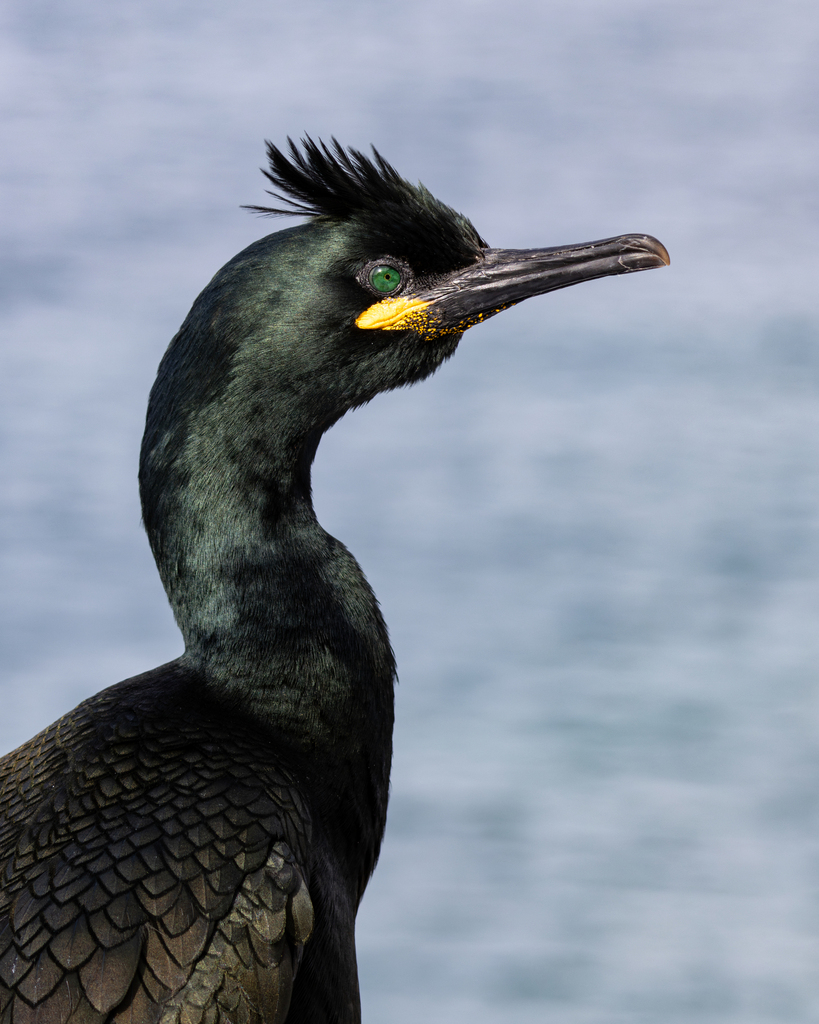
European Shag
Photo © Diego González Dopico
Photo © Diego González Dopico — CC BY 4.0 — Source: iNaturalist photo #498915541Identification
The European shag is a medium-large black seabird measuring 68 to 78 cm long with a wingspan of 95 to 110 centimetres. It has a distinctive longish tail and a yellow throat patch, with a small crest visible during the breeding season. The metallic green-tinged sheen on its feathers has earned it the alternative name "green cormorant." Its thinner bill and lighter build distinguish it from the similar great cormorant, as does its smaller overall size and the darker underparts of juveniles.
Range & Habitat
The European shag breeds around the rocky coasts of western and southern Europe, southwest Asia, and north Africa, with populations mainly wintering in their breeding range—except for the northernmost birds. Three subspecies are recognised, distributed across the Atlantic coasts of northwestern Europe, the Mediterranean and Black Sea, and the northwest African coast. During breeding season, the species can be readily seen at locations including the Farne Islands and Isles of Scilly in England, the Isle of May in Scotland, Runde in Norway, Iceland, the Faroe Islands, and the Cíes Islands in Spain.
Behaviour & Diet
The European shag is one of the deepest divers among cormorants, capable of diving to depths of 61 metres. It feeds predominantly on benthic prey found on the sea bottom, with sand eels being its most common food. In UK waters, typical dive times last 20 to 45 seconds with recovery periods of around 15 seconds between dives. The bird will travel many kilometres from roosting sites to feed and is rarely found inland, preferring coasts well-supplied with fish.
European shags breed on rocky ledges, crevices, and small caves, building untidy nests of rotting seaweed or twigs cemented with guano. The long nesting season begins in late February, with some nests started as late as May. Three eggs are laid, and chicks hatch without down, requiring parental warmth for approximately two months before fledging occurs between early June and late August.
Best Time & Places to See It
The best time to observe European shags is during the breeding season, between late April and mid-July, when birds are concentrated at breeding colonies. Outstanding locations include the Farne Islands and Isles of Scilly in England, the Isle of May in Scotland, Iceland, and the Cíes Islands in Spain, which hosts a large colony of approximately 2,500 pairs. The Saltee Islands in Ireland and various sites in Scandinavia and the Mediterranean also offer reliable viewing opportunities.
Photography Tips
Photograph shags during their diving sequences to capture the characteristic upward jump they perform before submerging—a behaviour that provides extra impetus for deep dives. The metallic green sheen on breeding plumage is best rendered with careful exposure management in natural light. During breeding season, the small crest and yellow throat patch are striking features worth isolating. Early morning and late afternoon light will enhance the iridescent qualities of the feathers and the contrast between the bird and rocky coastal habitats.
Asinara National Park
Brijuni National Park
Búðahraun Nature Reserve
Burren National Park
Butrint National Park
Cabo de Gata-Níjar Natural Park
Cabo Peñas
Cairngorms National Park
Calanques National Park
Nothing matches these filters.
No community photos yet. Log in to add the first one.
No community observations of this species yet.