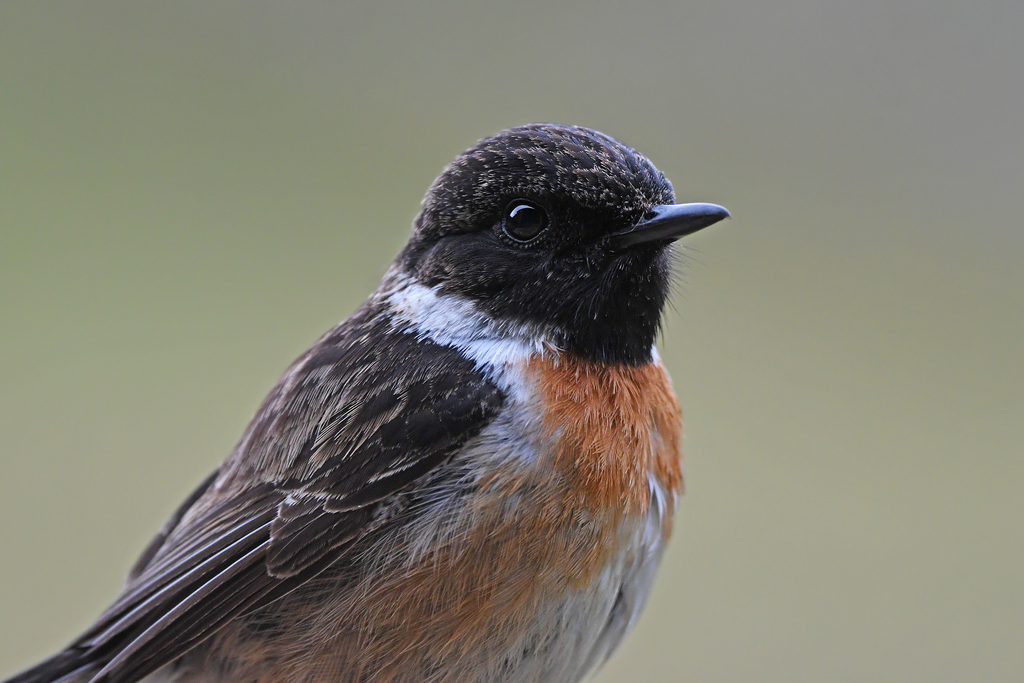
European Stonechat
Photo © Christoph Moning
Photo © Christoph Moning — CC BY 4.0 — Source: iNaturalist photo #480159059Identification
The European stonechat is a small passerine bird measuring 11.5–13 cm long and weighing 13–17 g, making it slightly smaller than a European robin. Both sexes are distinctive but notably different in plumage. Summer males are striking: black upperparts and head with a contrasting orange throat and breast, white belly and vent, and a distinctive white half-collar on the sides of the neck. They also display a small white scapular patch on the wings and a very small white rump patch, often streaked with black. Females are considerably duller, with brown upperparts and head, dark brown streaking on paler brown underparts, and lack the white neck patches and rump of males. The only white on females is the scapular wing patch, which is often buffy-white. Both sexes have distinctively short wings, shorter than related species such as the whinchat and Siberian stonechat.
The two subspecies differ in colour intensity: the continental S. r. rubicola is paler with larger white patches, while the Atlantic coastal S. r. hibernans is darker brown with less white. The species takes its English name from its distinctive call, which sounds like two stones knocked together, while the scientific name Saxicola means "rock-dweller" in Latin. Males sing a high, twittering song similar to a dunnock's.
Range & Habitat
The European stonechat is found across Europe from the Atlantic coastal areas in northwestern Norway, Great Britain, Ireland, and northwestern France, extending southward through Denmark, France, Spain, and Morocco, and eastward to Poland, Ukraine, and Turkey. The species is divided into two weakly defined subspecies: S. r. hibernans occupies northwestern Europe in Atlantic coastal regions, while S. r. rubicola covers the south and east of the range from the Mediterranean through to the South Caucasus. The two subspecies intergrade broadly where their ranges meet.
European stonechats breed in heathland, coastal dunes, and rough grassland with scattered small shrubs, bramble, open gorse, tussocks, or heather. They are short-distance migrants or non-migratory, though birds from the colder northeastern parts of the range typically move south to winter in southern Europe and North Africa, while others remain resident year-round.
Behaviour & Diet
European stonechats are monogamous during the breeding season but do not pair for life, with birds first breeding at one year old. The female builds the nest entirely, constructing a loose unwoven cup of dried grass lined with hair and feathers, which she places in dense vegetation close to the ground. Clutches typically contain 4–6 pale blue to greenish-blue eggs with red-brown freckles concentrated at the larger end. The female incubates eggs for 13–14 days beginning after the final egg is laid, with both parents subsequently caring for and feeding chicks. Nestlings fledge 12–16 days after hatching and continue to receive parental care for a further 4–5 days, after which the female may begin building a new nest for another brood while the male continues feeding the fledglings.
Best Time & Places to See It
European stonechats are year-round residents across much of their range, though populations shift seasonally. In northwestern Europe, the resident subspecies hibernans can be encountered throughout the year, particularly in coastal areas of the United Kingdom, Ireland, and northwestern France. The continental subspecies rubicola is best observed during the breeding season in heathland and grassland habitats across southern and central Europe. Winter visitors from the north arrive in southern Europe and North Africa during colder months, making Mediterranean regions and North African wintering grounds productive in winter.
Photography Tips
Male European stonechats in breeding plumage are highly photogenic subjects with striking contrast between black, orange, and white. Males perch openly on low shrubs and prominent perches, making them accessible to photographers. Early morning light emphasizes the brilliance of their orange breast and the white collar patches. The species' characteristic habit of frequently changing perches on low vegetation makes it possible to anticipate and frame shots. Females and non-breeding birds are more subdued and require patience, but their subtle plumage provides rewarding opportunities for detailed portraiture. The species' small size and preference for open habitats with scattered vegetation mean that obtaining clear, unobstructed images is often achievable with moderate telephoto lenses.
Abruzzo, Lazio and Molise National Park
Aggtelek National Park
Al Hoceima National Park
Alpilles Regional Nature Park
Alta Murgia National Park
Appennino Lucano Val d’Agri Lagonegrese National Park
Asinara National Park
Aspromonte National Park
Avesnois Regional Nature Park
Nothing matches these filters.
No community observations of this species yet.