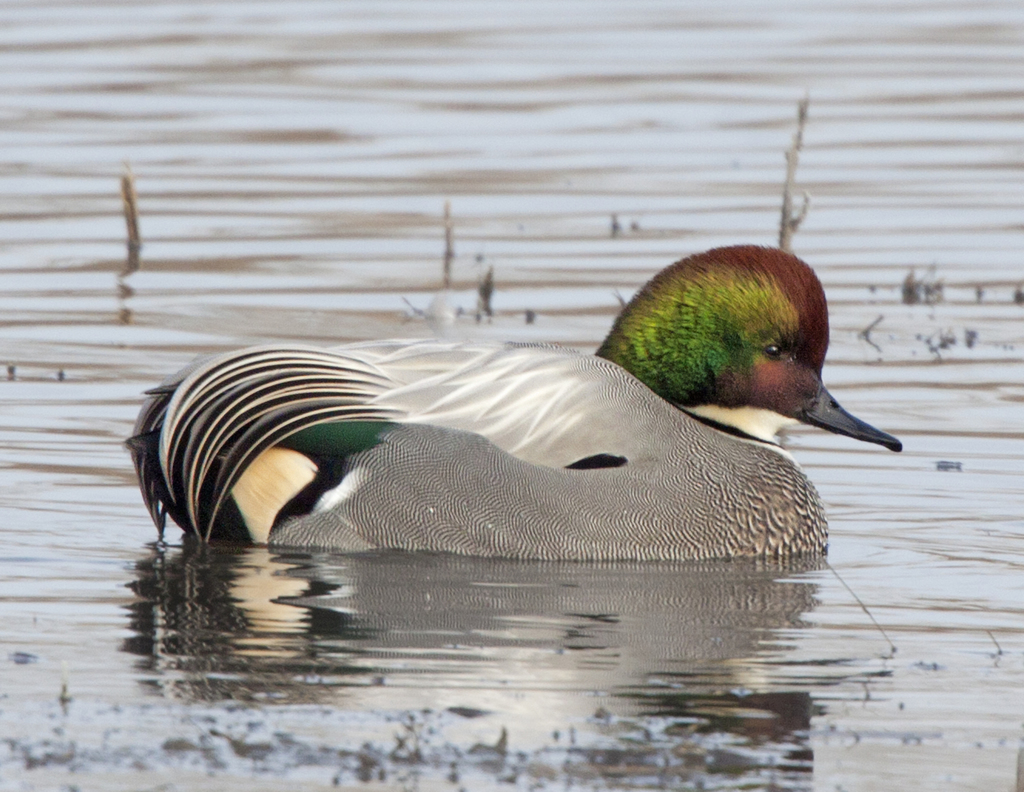
Falcated Duck
Photo © nmoorhatch
Photo © nmoorhatch — CC BY 4.0 — Source: iNaturalist #60444777Identification
The falcated duck is a medium-sized dabbling duck, comparable in size to a gadwall, measuring 46 to 53 centimetres in length with a wingspan of 79 to 91 centimetres. Males are noticeably heavier than females, weighing up to 770 grams compared to females at around 422 grams. The breeding male is unmistakable and remarkably handsome: its body is covered in finely vermiculated grey plumage, while the head is dark green with a distinctive white throat and bronzed crown. Most striking are the long, sickle-shaped tertial feathers that hang elegantly off the back, giving the species its evocative name. The vent region displays a striking pattern of yellow, black, and white.
Females and eclipse males are considerably duller, appearing dark brown with plumage superficially similar to female wigeons. However, the female's characteristically long grey bill is a useful identification feature. In flight, both sexes reveal a pale grey underwing and a blackish speculum bordered with white on its inner edge. Young birds are buffer than females and possess shorter tertials. Outside the breeding season, males are usually quiet, though they do produce a shrill whistle and quieter calls, while females issue hoarse quacks and high-pitched decrescendo calls.
Range & Habitat
The falcated duck breeds across eastern Asia, from eastern Siberia and Mongolia through northeastern China and northern Japan, with populations in Russia's Far East including Khabarovsk, Primorskiy, and Sakhalin. It is a strongly migratory species, wintering across much of Southeast Asia from northern Bangladesh and Myanmar through Laos and Vietnam, southward into central and southern China, and as far west as northeastern India in states including Assam and Uttar Pradesh. The global population is estimated at approximately 89,000 individuals, with about 27 percent occurring within China's National Nature Reserves.
This species favours lowland wetland habitats such as water meadows and lakes. Outside the breeding season, falcated ducks are highly gregarious, forming large flocks during migration and winter. Occasional sightings have been recorded in western North America and Poland, though these are attributed to vagrant individuals or ducks escaped from captivity, as the species' popularity in the ornamental waterfowl trade clouds the origins of such extralimital records.
Behaviour & Diet
As a dabbling duck, the falcated duck feeds by dabbling for plant food or by grazing on vegetation in shallow wetlands. The species is strongly migratory, undertaking long journeys between breeding grounds in the north and wintering areas across Southeast Asia and India. Outside the breeding season, these ducks are notably gregarious, gathering in substantial flocks that make them conspicuous during migration periods, though survey data from central China suggests their numbers in key wintering areas can fluctuate considerably.
Best Time & Places to See It
The falcated duck's large range spans from 1,000,000 to 10,000,000 square kilometres. Birdwatchers seeking this species should focus on the breeding season in eastern Siberia, Mongolia, northeastern China, and northern Japan, where males in full breeding plumage are most visible and vocal on breeding territories. During winter, the species can be found across Southeast Asia, particularly in northern Myanmar, Laos, and Vietnam, as well as in central and southern China. However, sightings can be unpredictable; survey work in central China, a key wintering area, has recorded as few as four individuals in 2004 and ten in 2005, suggesting the best opportunities may be found in protected areas such as China's National Nature Reserves, which support approximately 30 percent of the species' near-threatened global populations.
Photography Tips
Breeding males offer the most photogenic opportunities, with their distinctive grey vermiculated plumage, emerald-green head, white throat, and especially the elegant sickle-shaped tertials creating striking compositions. Photograph males on breeding territories where they are more vocal and active. In flight, capture the contrast between the pale grey underwing and darker speculum with its white border. During winter months when birds gather in larger flocks, position yourself at lowland wetlands at dawn and dusk when duck activity peaks. The pale grey underwing is best captured during take-off or banking flight. Remember that outside the breeding season, females and eclipse males are considerably duller; focus on well-lit conditions to render their subtle brown plumage and importantly, the long grey bill that aids field identification.
St. Paul Island
Saint Paul, United States
+255 birds+8 mammals
Windswept tundra rolls across this remote Pribilof island, where volcanic basalt cliffs plunge into the Bering Sea and fog rolls in thick enough to erase the…
VIEW PROTECTED LANDSCAPEBaikal National Park
Ольхонский район, Russia
+184 birds+11 mammals
Where the world's deepest freshwater lake meets ancient Siberian taiga, Baikal National Park sprawls across 66,203 square kilometers of one of Earth's most singular ecosystems. The…
VIEW NATIONAL PARKTransbaikal National Park
Barguzinsky Rayon, Russia
+83 birds+7 mammals
Where the eastern shore of Lake Baikal meets the Barguzinsky Range, a vast wilderness of boreal forest, alpine tundra, and rocky shoreline unfolds across more than…
VIEW NATIONAL PARKKaziranga National Park
Kohora, India
+422 birds+26 mammals
Dawn breaks over the floodplains of the Brahmaputra, where tall grasslands stretch endlessly beneath monsoon-heavy skies. This sprawling wilderness of northeastern Assam is a mosaic of…
VIEW NATIONAL PARKKeoladeo National Park
Shreenagar Rural, India
+326 birds+14 mammals
Where shallow wetlands shimmer beneath vast Rajasthani skies, one of Asia's finest bird sanctuaries pulses with extraordinary life. This former maharaja's hunting reserve, now spanning 29…
VIEW NATIONAL PARKAltai Tavan Bogd National Park
Tsengel, Mongolia
+146 birds+3 mammals
Where the Altai Mountains rise in jagged defiance along Mongolia's western frontier, the terrain transforms into a realm of alpine tundra, rocky plateaus, and glacier-carved valleys…
VIEW NATIONAL PARKLand of the Leopard National Park
Khasansky District, Russia
+83 birds+11 mammals
Where coniferous and mixed forests sweep across the rolling terrain of Russia's Far East, Land of the Leopard National Park embraces a landscape shaped by the…
VIEW NATIONAL PARKNortheast China Tiger and Leopard National Park
Mu Dan Jiang Shi, China
+202 birds+19 mammals
Across the temperate forests of northeastern China, where winters grip the landscape in subzero silence and summers remain cool and brief, the Mudanjiang region supports a…
VIEW NATIONAL PARKYancheng National Nature Reserve
Yancheng, China
+208 birds+4 mammals
Where the East China Sea's tidal rhythms sculpt the Jiangsu coast, Yancheng National Nature Reserve sprawls across one of Asia's most dynamic wetland complexes. This vast…
VIEW NATURE RESERVEPoyang Lake National Nature Reserve
Shangrao, China
+270 birds+7 mammals
Where the Yangtze River's massive floodplain spreads across central China, Poyang Lake National Nature Reserve encompasses one of the continent's most dynamic and water-rich wetland systems.…
VIEW NATURE RESERVECaohai National Nature Reserve
Bijie, China
+93 birds
At roughly 1,900 metres elevation on Guizhou's high plateau, Caohai sprawls across a temperate landscape shaped by pronounced seasonal extremes. Winters here are dry and cool,…
VIEW NATURE RESERVEQinghai Lake National Nature Reserve
Hainan Tibetan Autonomous Prefecture, China
+243 birds+11 mammals
At 3,200 metres above sea level on the Tibetan plateau, where winter temperatures plunge far below freezing and snow blankets the landscape for half the year,…
VIEW NATURE RESERVEAlaska Maritime National Wildlife Refuge
Alaska, United States
+391 birds+58 mammals
Where the North Pacific collides with Alaska's rugged coastline, a sprawling archipelago of islands, rocky outcrops, and coastal headlands forms one of North America's most remote…
VIEW WILDLIFE SANCTUARYNo community photos yet. Log in to add the first one.
No community observations of this species yet.