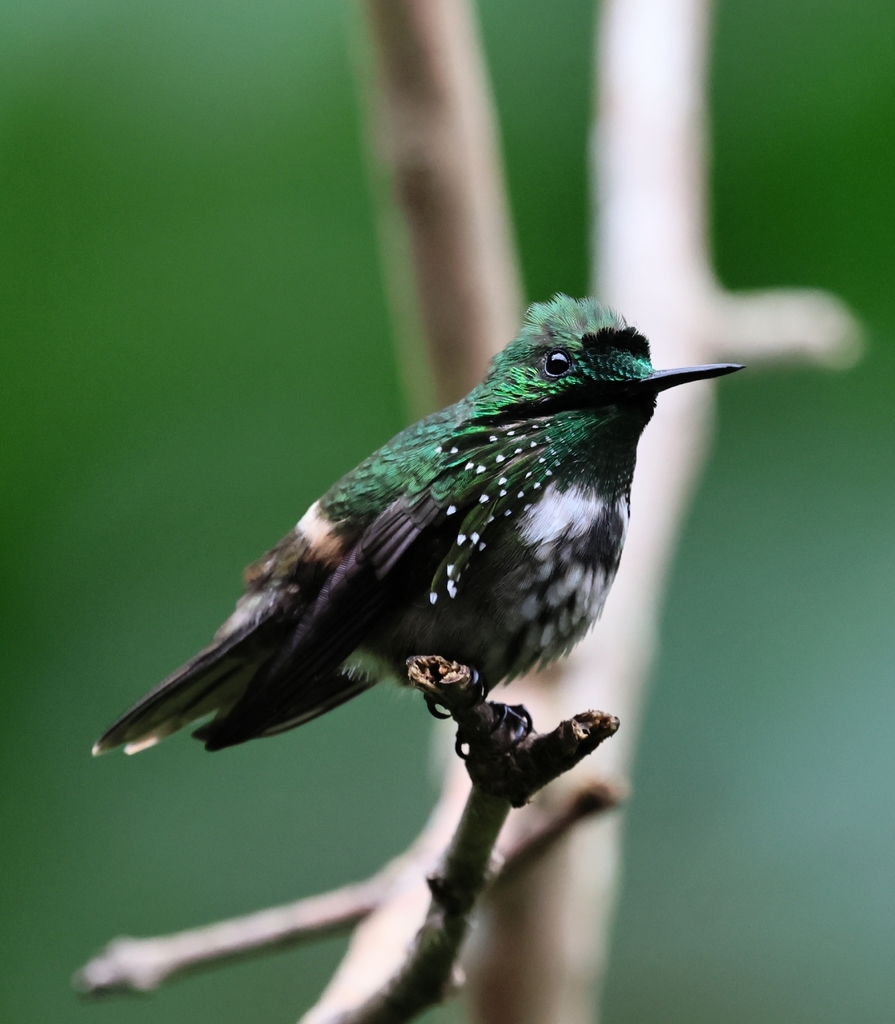
Festive Coquette
Photo © Miguel
Photo © Miguel — CC BY-SA 4.0 — Source: iNaturalist #366346740Identification
The festive coquette is a tiny hummingbird measuring just 7.5 to 9.1 cm in length and weighing approximately 3 grams. Both sexes display bronzy-green upperparts with a distinctive pale band across the rump, purplish-bronze lower rump and undertail coverts, and a purplish-copper tail with pale-tipped outer feathers. All birds have a short, straight black bill.
Males are particularly ornate, featuring an iridescent green forehead bordered by a band of stiff black feathers, white-tipped green cheek tufts, and a glittering green-and-white ruff around the bill and chin. The male's breast is whitish with black streaking, and the belly is grayish-brown with a blackish central stripe. Females lack the male's elaborate head decorations but possess a striking white "moustache" marking, a pale buff chin with a dark center spot, and brownish underparts with whitish scaling. Juveniles resemble adult females.
Range & Habitat
Endemic to southeastern Brazil, the festive coquette occurs from Espírito Santo southward through Santa Catarina, inhabiting humid primary and secondary forests as well as cerrado habitat. The species ranges from sea level to 1,000 meters elevation. Unconfirmed records from northeastern Argentina suggest occasional dispersal, though the species is considered sedentary throughout most of its range.
Behaviour & Diet
The festive coquette feeds primarily on nectar and small insects, hovering before flowers to extract nectar or occasionally piercing flower bases to rob nectar directly. The bird exhibits trap-lining behavior within limited areas and will glean insects from foliage or catch them in flight. Unlike many hummingbirds, it does not defend exclusive feeding territories, though it competes aggressively with other festive coquettes at flowering plants.
During breeding season—reported variously as August to November or October to February—males display before females by hovering while flaring their iridescent forehead and cheek patch feathers. Females construct delicate cup nests from soft plant down, suspended 2 to 5 meters above ground on thin branches. Clutches of two eggs are incubated for 13 to 14 days, with fledging occurring approximately 22 days post-hatch. The species is mostly silent, producing only short "tsip" or "chip" calls while feeding, though wings generate a distinctive low bee-like hum during hover.
Best Time & Places to See It
The festive coquette remains within its southeastern Brazilian range year-round, making it accessible to travelers throughout the year, though breeding season activity peaks between August and February depending on local populations. Visitors should focus on humid forest areas and cerrado habitat within protected zones, where the bird's sedentary nature makes it more predictable to locate.
Photography Tips
Photographing this diminutive hummingbird presents challenges inherent to small, fast-moving subjects. High shutter speeds (at least 1/2000 second) are essential to freeze wing motion. Focus on areas with flowering plants where the bird trap-lines regularly; patient observation of feeding routes yields the best opportunities. Males are more conspicuous than females due to their brilliant iridescent plumage; position yourself with backlighting to capture the glittering green chin and forehead feathers. Early morning light often produces the most vivid iridescent color rendition. The bird's small size demands close working distances and telephoto lenses; a macro or tele-macro setup yields superior detail of the distinctive head markings that distinguish males from females.
Carlos Botelho State Park
Ilha do Cardoso State Park
Intervales State Park
Saint-Hilaire/Lange National Park
Serra da Bocaina National Park
Serra do Mar State Park
Nothing matches these filters.
No community photos yet. Log in to add the first one.
No community observations of this species yet.