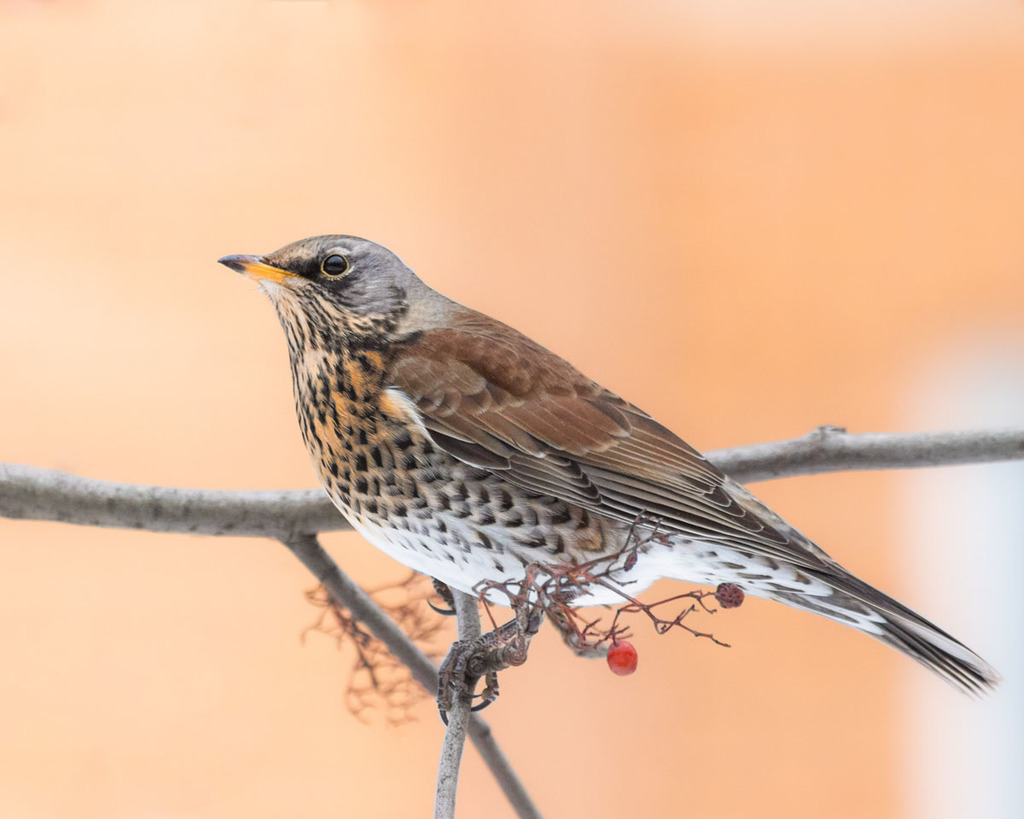
Fieldfare
Photo © Михаил Голомысов
Photo © Михаил Голомысов — CC BY 4.0 — Source: iNaturalist photo #171598616Identification
The fieldfare is a striking and easily recognisable thrush, measuring 25 cm in length with a distinctive combination of slate-grey head, nape and rump contrasting sharply with a dark brown back and blackish tail. The breast is boldly speckled with brownish-black markings on a creamy-buff ground, while the underparts are predominantly white. In flight, the white under wing-coverts are conspicuous and diagnostic. The beak is strong with a slight curve, orange-yellow in winter, while the legs and feet are brown.
Males display a bluish-grey crown and nape, with the forehead and crown feathers bearing central brownish-black bands. Females are very similar but somewhat more brownish on the upper parts, with narrower black stripes on the crown and paler, less heavily marked throats and breasts. Juveniles are duller with pale streaks on feathers that appear as dark streaks in adults, acquiring adult plumage after their first autumn moult. The harsh flight call "tsak tsak tsuk" is also distinctive and often heard before the bird is seen.
Range & Habitat
The fieldfare breeds in woodland and scrub across northern Europe and the Palearctic, demonstrating strong migratory behaviour with northern populations moving south during winter. It is a very rare breeder in the British Isles but winters there in large numbers, alongside substantial populations in Southern Europe, North Africa and the Middle East.
The species shows a preference for wooded habitats and scrubland during the breeding season, where it often nests in small colonies, possibly for protection from predators. During winter, migrating and wintering birds form large flocks, frequently associating with redwings.
Behaviour & Diet
The fieldfare is omnivorous with distinctly seasonal feeding habits. During summer months it feeds on a wide range of molluscs, insects and earthworms, while in winter it switches to berries, grain and seeds. This dietary flexibility supports its migratory lifestyle across diverse seasonal habitats.
Fieldfares are highly social birds, particularly outside the breeding season when they congregate in large flocks. When nesting, they typically nest in small colonies in trees, where both parents feed the chicks. Clutches of five or six eggs are laid, with chicks fledging after approximately two weeks. Southern populations may produce two broods annually, while northern birds typically raise only one. The male produces a rather feeble song during breeding season, a mixture of blackbird-like phrases interspersed with whistles, guttural squeaks and call notes, sung both in flight and from perches.
Best Time & Places to See It
For birders and nature travellers, the fieldfare is best observed during winter months in the United Kingdom, Southern Europe, North Africa and the Middle East, where it arrives in large, conspicuous flocks. Winter is the prime season for sightings as the species is a very rare breeder in the British Isles but winters there in considerable numbers.
Look for fieldfares in open country, farmland and areas with berry-bearing trees and shrubs. Large flocks often associate with redwings, making mixed thrush flocks a productive focus for observation. Early morning visits to feeding areas will yield the best sightings.
Photography Tips
The fieldfare's striking plumage and conspicuous white under wing-coverts make it an attractive photographic subject. The contrast between the slate-grey crown and rump and the dark back provides excellent tonal separation, particularly in side-on poses or banking flight shots that showcase the diagnostic white underwings.
Winter flocking behaviour offers opportunities for flock photography, while perched birds allow detailed study of the boldly speckled breast pattern and facial markings. The bird's characteristic harsh flight call provides an audio cue to anticipate photographic moments. Early light conditions that enhance the bluish-grey tones of the head and rump will produce the most striking images.
Abruzzo, Lazio and Molise National Park
Aggtelek National Park
Alaska Maritime National Wildlife Refuge
Alpilles Regional Nature Park
Alta Murgia National Park
Altai Tavan Bogd National Park
Appennino Lucano Val d’Agri Lagonegrese National Park
Appennino Tosco-Emiliano National Park
Åsnens National Park
Nothing matches these filters.
No community photos yet. Log in to add the first one.
No community observations of this species yet.