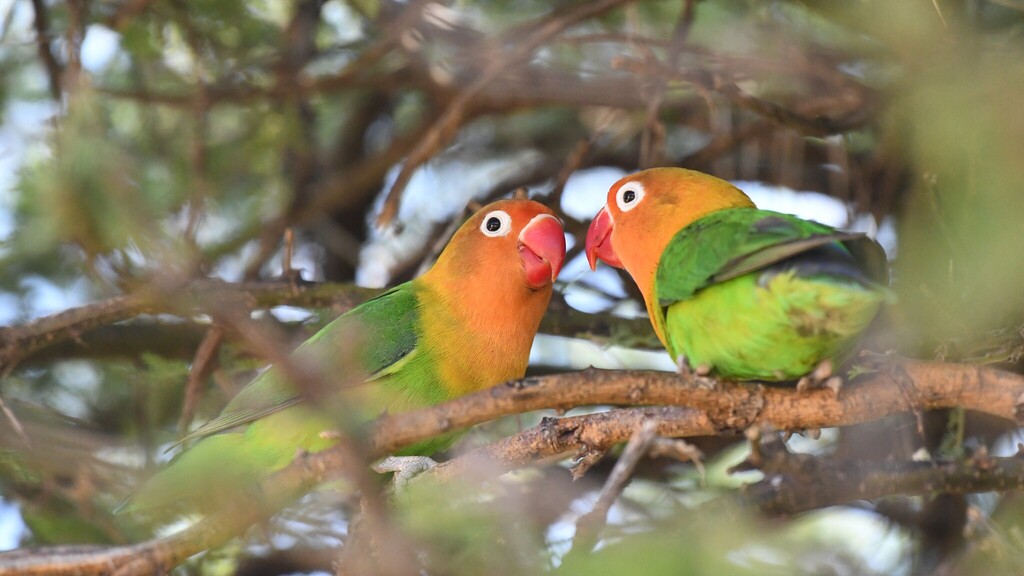
Fischer’s Lovebird
Photo © Tristan Jobin
Photo © Tristan Jobin — CC BY 4.0 — Source: iNaturalist photo #502125774Identification
Fischer's lovebird is a small parrot, measuring just 14 cm (5.5 in) in length and weighing 43-58g, making it one of the smaller lovebird species. The plumage is predominantly green on the back, chest, and wings, with a distinctive golden-yellow neck that transitions to darker orange toward the head. The top of the head is olive green, and the bird sports a bright red beak and a striking white bare eye-ring. The upper tail feathers display purple or blue coloring. Young birds resemble adults but are duller, with brown markings on the base of the lower mandible.
While wild Fischer's lovebirds are characteristically green, several color mutations have been selectively bred in captivity. The most prominent is the blue variation, which features a bright blue back, tail, and chest with a white neck and pale grey head. Other mutations include yellow lutino (pale yellow with orange face), pied, cinnamon, and albino varieties. Notably, Fischer's lovebirds exhibit no sexual dimorphism—males and females are visually identical, distinguishable only through DNA testing or by observing perching posture, as females typically sit with their legs farther apart due to their wider pelvis.
Range & Habitat
Fischer's lovebirds are native to a small region of east-central Africa in northern Tanzania, occurring south and southeast of Lake Victoria. They inhabit elevations between 1,100 and 2,200 meters (3,600–7,200 ft), living in small flocks among isolated clumps of trees interspersed with grassland plains. During drought years, some populations shift westward into Rwanda and Burundi in search of moister conditions.
The current wild population is estimated between 290,000 and 1,000,000 individuals, though numbers outside protected areas remain low due to historical capture for the pet trade. To prevent further decline, export licenses were suspended in 1992. While these lovebirds have occasionally been observed in Puerto Rico, Florida, and the U.S. Virgin Islands, these sightings are attributed to escaped pets with no established wild populations. Around 100 mating pairs have also been recorded in Portugal's Algarve region.
Behaviour & Diet
Fischer's lovebirds are highly vocal, producing high-pitched chirps and creating audible wing noise during their characteristically fast flight. They are social birds that live in small flocks and are renowned for their powerful pair bonds—the name "lovebird" derives from their lifelong monogamous partnerships and the strong physical contact they maintain with their mates. Separated mates suffer physical health decline, underscoring the depth of their attachment.
These parrots are opportunistic feeders, consuming a wide variety of seeds and fruits. They sometimes become agricultural pests, raiding crops such as maize and millet. Breeding occurs from January through April and June through July, with females laying three to eight white eggs (typically four or five) in tree cavities 2–15 meters above ground. Females incubate for 23 days, and chicks fledge approximately 38–42 days after hatching.
Best Time & Places to See It
The breeding season from January through April and June through July offers the best opportunities to observe Fischer's lovebirds in their most active and vocal state, as noise levels increase substantially during pre-mating rituals. Their native range in northern Tanzania, particularly south and southeast of Lake Victoria at elevations of 1,100–2,200 meters, provides the most reliable locations for sightings in the wild. During drought years, populations may shift westward into Rwanda and Burundi, expanding potential observation areas.
These birds favor isolated woodland clumps surrounded by grassland plains, so scanning such habitats during early morning hours when flocks are most active will maximize viewing opportunities. Their conspicuous green plumage and highly vocal nature make them relatively detectable once in suitable habitat, though low population densities outside protected areas may limit encounters.
Photography Tips
The Fischer's lovebird's small size and energetic nature present both challenges and opportunities for photographers. Their fast, direct flight and distinctive audible wing noise provide cues for anticipating photo opportunities, though tracking these quick-moving birds requires fast shutter speeds and continuous autofocus. The bright red beak and white eye-ring create striking focal points, while the green plumage demands careful exposure metering to avoid blown highlights on pale sky backgrounds.
Pair bonds offer compelling compositional possibilities—photograph birds in physical contact, grooming one another, or perched side by side to capture the intimate behavior that earned them their evocative common name. Early morning light during breeding season, when birds are most vocal and active, will yield the most dynamic images. A telephoto lens of at least 400–600mm is essential given their small stature and preference for elevated perches in scattered trees, and patience will be rewarded as their predictable vocalizations help locate flocks in grassland-woodland mosaics.
Serengeti National Park
Tanzania
+558 birds+57 mammals
Across Tanzania's northern plateau, where volcanic soils meet acacia woodland and open grassland, unfolds one of Earth's most dynamic ecosystems. The Serengeti National Park sprawls across…
VIEW NATIONAL PARKArusha National Park
Tanzania
+555 birds+16 mammals
Where the slopes of Mount Mawenzi rise above the Arusha region, a compact yet ecologically rich national park unfolds across montane forest, moorland, and alpine zones.…
VIEW NATIONAL PARKAmboseli National Park
Etonet/Lenkism ward, Kenya
+501 birds+43 mammals
Where the Amboseli basin opens toward the Tanzanian frontier, a shallow alkaline lake mirrors vast skies across one of East Africa's most iconic savanna landscapes. The…
VIEW NATIONAL PARKTarangire National Park
Tanzania
+527 birds+50 mammals
Acacia woodland and grassland sweep across the Manyara Region where the Tarangire River carves through low hills and volcanic soils, creating one of East Africa's most…
VIEW NATIONAL PARKNgorongoro Conservation Area
Tanzania
+626 birds+55 mammals
Volcanic calderas and open grassland dominate this high plateau in northern Tanzania, where the landscape rises above 2,000 metres and ancient geological forces have shaped both…
VIEW WILDLIFE MANAGEMENT AREAEstrecho Natural Park
Pedro Valiente, Spain
+281 birds+20 mammals
Where Mediterranean pine forests meet wind-sculpted coastal cliffs, one of Europe's most dynamic ecological crossroads unfolds across the Strait of Gibraltar. Spanning 686 square kilometers of…
VIEW NATURAL PARKDon Edwards San Francisco Bay National Wildlife Refuge
Fremont, United States
+286 birds+20 mammals
Where the San Francisco Bay's shallow margins dissolve into tidal salt marshes and mudflats, this wildlife sanctuary preserves one of California's most ecologically vital estuarine systems.…
VIEW WILDLIFE SANCTUARYNairobi National Park
Nairobi, Kenya
+515 birds+35 mammals
Just minutes from Kenya's capital, where the Nairobi River winds through acacia woodland and open grassland, lies one of Africa's most paradoxical wildlife sanctuaries. The park's…
VIEW NATIONAL PARKLake Nakuru National Park
Nakuru West, Kenya
+494 birds+32 mammals
Alkaline waters ringed by acacia woodland and grassland create one of East Africa's most distinctive wetland ecosystems, where the interplay of geology and climate sustains a…
VIEW NATIONAL PARKSamburu National Reserve
Samburu, Kenya
+430 birds+42 mammals
Across the arid plains of northern Kenya, where scattered acacia woodland gives way to rocky outcrops and dry riverbeds, Samburu National Park unfolds as one of…
VIEW NATURE RESERVEHell’s Gate National Park
Olkaria ward, Kenya
+388 birds+18 mammals
Volcanic scarps and geothermal vents dominate the floor of Hell's Gate, where the East African Rift has carved a dramatic gorge through crystalline rock formations. The…
VIEW NATIONAL PARKNo community photos yet. Log in to add the first one.
No community observations of this species yet.