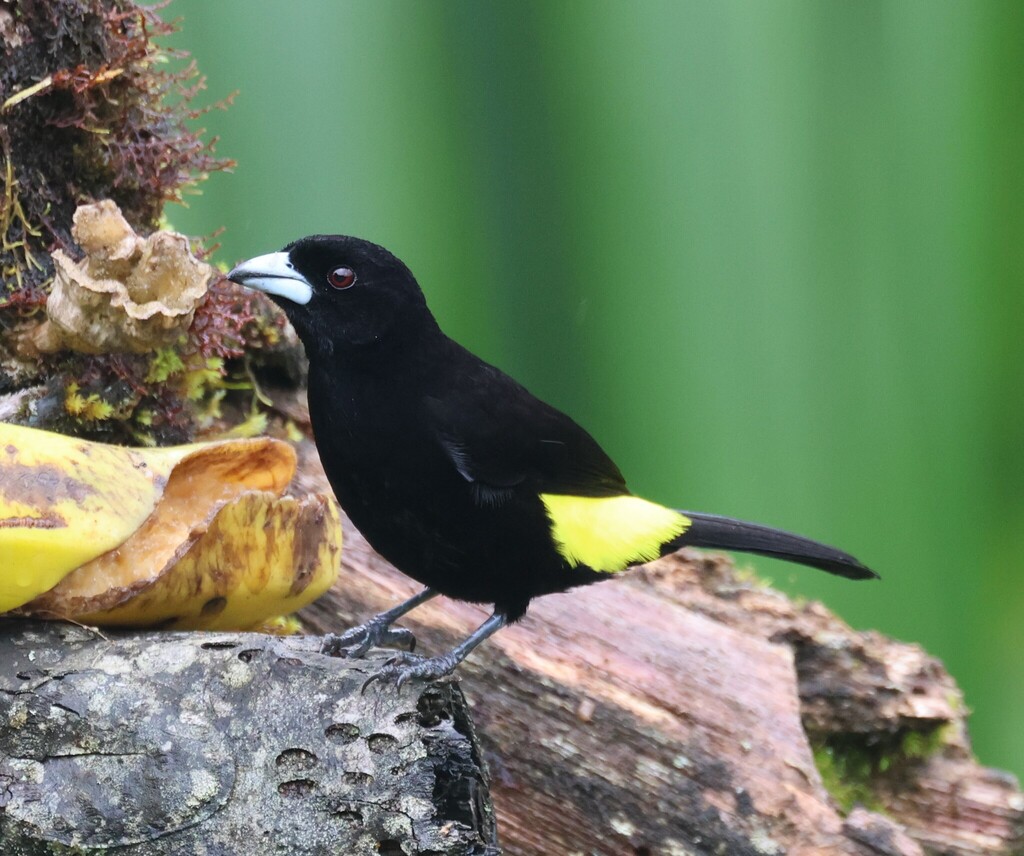
Flame-rumped Tanager
Photo © scaup
Photo © scaup — CC BY 4.0 — Source: iNaturalist photo #600585683Identification
The flame-rumped tanager is a striking small tanager measuring approximately 19 cm in length, instantly recognizable by its vivid plumage and pronounced sexual dimorphism. Males display velvety black upperparts with a scarlet-red spot on the back, while the chest and rump are orange to red and the belly is bright yellow. Their distinctive cobalt-blue to silver bill with a black tip is a useful field mark. Females are considerably duller, with olive-brown backs marked with dark spots, a reddish-orange rump, and light yellow chest and belly. The two subspecies differ notably in rump coloration: males of the nominate flammigerus show a red rump, while icteronotus males display a bright yellow rump—a difference so striking that the latter is sometimes called the lemon-rumped tanager.
Range & Habitat
This tanager is distributed from Panama south through Colombia and Ecuador to western Ecuador. It is considered quite common throughout its range, primarily inhabiting semi-open forest environments including shrubby clearings, forest edges, and gardens, with a strong preference for elevations between 800 and 2000 meters above sea level. The widespread icteronotus subspecies occurs across the Tumbes-Chocó-Magdalena region, while the nominate flammigerus is confined to the Cauca Valley in Colombia, where the two subspecies are known to hybridize.
Behaviour & Diet
While detailed behavioral studies are limited, flame-rumped tanagers are typically observed in small groups frequenting the edges and clearings of their forest habitat. Like other tanagers, they feed primarily on fruit and insects, moving actively through vegetation as they forage. Their preference for semi-open habitats and gardens makes them more conspicuous than many forest tanagers, allowing observers good opportunities for viewing and photography.
Best Time & Places to See It
The flame-rumped tanager can be found year-round throughout its range, making it accessible to travelers at any season. The most reliable locations include Colombia's Cauca Valley for the red-rumped nominate subspecies, and the lowlands and foothills of Panama, western Colombia, and Ecuador for the yellow-rumped icteronotus. Forest edge habitats, particularly in areas with fruiting trees and flowering shrubs, offer the best viewing opportunities. Its preference for semi-open habitats and gardens means it is often more accessible than strictly forest-interior species.
Photography Tips
The brilliant red or yellow rump and black plumage of males make flame-rumped tanagers rewarding photographic subjects, though their active foraging behavior requires a responsive shutter speed. Early morning light will best reveal the velvety texture of male plumage and the iridescence of their blue bills. Position yourself near forest edges and gardens where they forage; patient waiting near fruiting trees often yields excellent photo opportunities. Female birds, though duller, can be challenging but rewarding subjects; use overcast conditions to avoid harsh shadows that obscure plumage details. A telephoto lens of at least 300-400mm is recommended for comfortable framing at typical viewing distances.
Guided Birding Tour
Cerros de Amotape National Park
District of San Jacinto, Ecuador
+246 birds+1 mammals
Arid mountains rise abruptly from Peru's northwestern frontier, their slopes clothed in xerophytic scrubland and seasonal deciduous forest that transforms these Andean foothills into one of…
VIEW NATIONAL PARKNatural Utría National Park
Alto Baudó (Pie de Pató), Colombia
+372 birds+11 mammals
Where the Chocó's coastal mountains plunge toward the Pacific, Utría National Park preserves one of Colombia's most biodiverse and least-visited wilderness expanses. Sprawling across 1,287 square…
VIEW NATIONAL PARKNatural Munchique National Park
El Tambo, Colombia
+194 birds
Where the Western Cordillera rises steeply from the Pacific plains of southwestern Colombia, Natural Munchique National Park sprawls across 1,078 square kilometers of montane forest that…
VIEW NATIONAL PARKNatural Serranía de los Yariguíes National Park
El Carmen de Chucurí, Colombia
+320 birds+3 mammals
Where the northern cordilleras of Colombia rise toward cloud forest, the Serranía de los Yariguíes unfolds across nearly 1,820 square kilometers of some of the most…
VIEW NATIONAL PARKNatural Farallones de Cali National Park
Buenaventura, Colombia
+733 birds+27 mammals
Where the Pacific coastal plain meets the western slopes of the Andes, Farallones de Cali National Park sprawls across nearly 3,500 square kilometers of dramatic topography…
VIEW NATIONAL PARKPuracé National Natural Park
Puracé, Colombia
+327 birds+2 mammals
Where the Andes thrust upward across southwestern Colombia, Puracé National Natural Park spans nearly 2,631 square kilometers of some of South America's most dramatic montane terrain.…
VIEW NATIONAL PARKNatural Nevado del Huila National Park
Planadas, Colombia
+117 birds
Where the Colombian Andes rise above 5,000 metres, tropical cloud forest yields to páramo and glaciated peaks, and the Planadas region of Tolima contains one of…
VIEW NATIONAL PARKGeneral de División Omar Torrijos Herrera National Park
La Pintada, Panama
+401 birds+2 mammals
Across the highlands of central Panama, where the continental divide funnels moisture-laden trade winds into steep river valleys, the terrain rises and falls in a landscape…
VIEW NATIONAL PARKSoberanía National Park
Cristóbal, Panama
+495 birds+34 mammals
Rainforest and riverine woodland blanket the rolling terrain of this 714-square-kilometre national park in Colón Province, where the Caribbean watershed feeds a maze of streams and…
VIEW NATIONAL PARKDarién National Park
Tucutí, Panama
+534 birds+13 mammals
Where the spine of Central America crumbles into wetland and rainforest, Darién National Park sprawls across more than 20,000 square kilometres of some of the tropics'…
VIEW NATIONAL PARKNo community photos yet. Log in to add the first one.
No community observations of this species yet.