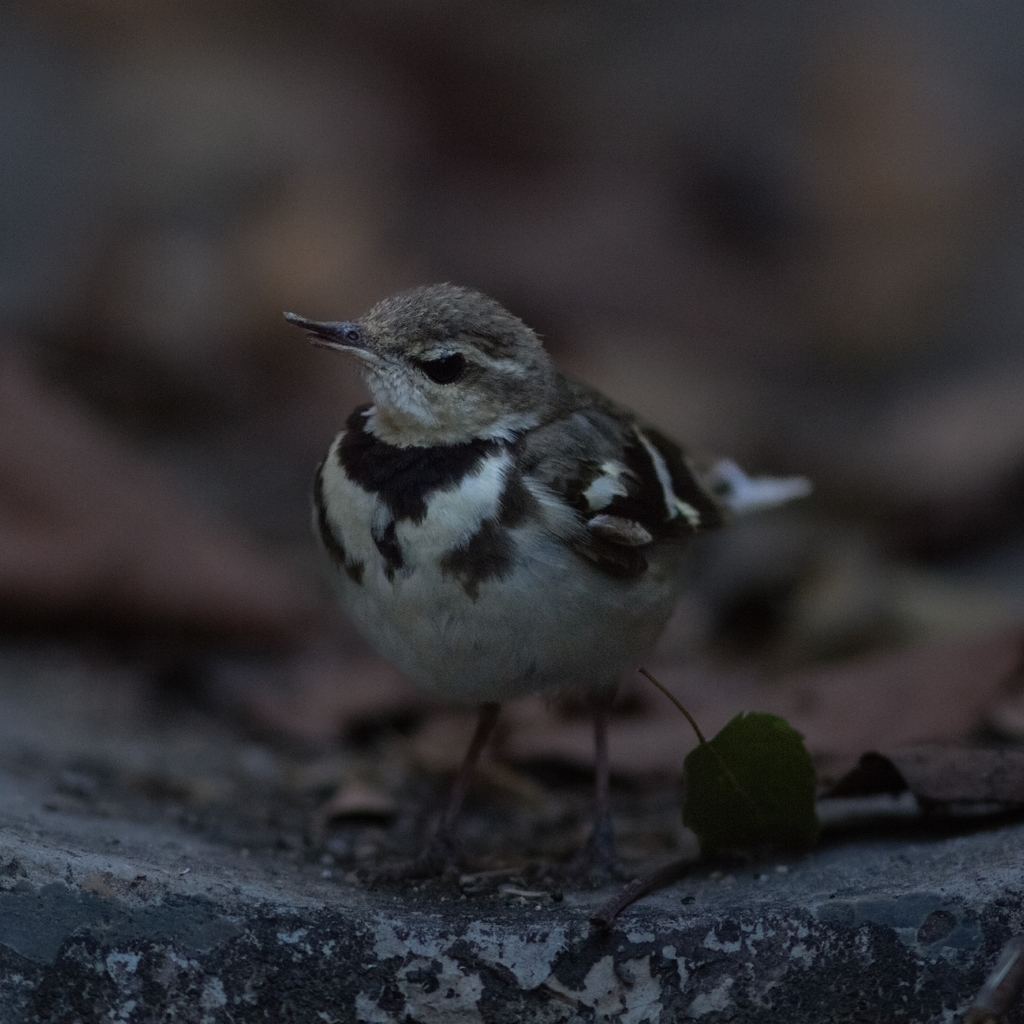
Forest Wagtail
Photo © Jacob She
Photo © Jacob She — CC BY 4.0 — Source: iNaturalist #335065689Identification
The Forest Wagtail is a distinctive 18 cm slender bird with a long tail, easily recognised by its olive-brown back and crown contrasting with black wings bearing two yellow wing bars and white-edged tertials. A white supercilium (eyebrow stripe) sits above a dark eye-stripe, while the underparts are predominantly white with a characteristic black double breast band—the upper forming a bib-like patch and the lower often broken. The sexes are similar, though young birds display more yellowish colouration on the underside. Most notably, this wagtail produces a distinctive single-note 'pink pink' call and possesses a soft, lilting song.
One of the most peculiar features distinguishing the Forest Wagtail from all its relatives is its unique tail-wagging behaviour: rather than the typical up-and-down wagging of other wagtails, it swings its tail sideways from side to side, a characteristic reflected in its Japanese name meaning 'sideways-swinging wagtail'.
Range & Habitat
True to its name, the Forest Wagtail is the only wagtail species associated with forested environments. It breeds in the temperate regions of eastern Asia, including parts of Korea, China (Gansu, Anhui, Hunan) and Siberia. During winter, it migrates southward across tropical Asia, wintering throughout southern India, Sri Lanka, and extending to Indonesia, with records suggesting birds reach these regions via the Andaman Islands. It prefers open woodland areas such as clearings rather than dense forest, and in winter favours well-shaded forest habitats, forest paths, and clearings in coffee plantations.
Behaviour & Diet
Forest Wagtails are found singly or in small groups, displaying remarkable arboreal adaptability. They forage actively in trees, capturing insects along branches with surprising agility, and can climb steep branches and run rapidly along horizontal limbs with ease. When disturbed, they flush into the trees with their characteristic sharp 'pink' call. Like pipits, they also forage on the ground, and at night they roost communally among reeds in the company of other wagtails. As strictly insectivorous birds, they are adept hunters of small invertebrates in their forest environment.
Best Time & Places to See It
Forest Wagtails arrive at their breeding grounds in late March from Sri Lanka and mid-March from the Malay Peninsula, with breeding activity peaking from May to July. During this period, males sing actively and sway with each syllable. Winter visitors to India and Sri Lanka offer excellent opportunities to locate this species from October onwards in suitable forest habitats. Look for them in open areas within forests, along woodland paths, and in coffee plantation clearings where they actively forage both in trees and on the ground.
Photography Tips
The Forest Wagtail's striking plumage and arboreal habits offer rewarding photographic opportunities. Position yourself in open woodland clearings during early morning hours when birds are most active and light conditions favour capturing the distinctive yellow wing bars and white tertial edges. The bird's habit of foraging along branches provides excellent perching opportunities; use a fast shutter speed to freeze the characteristic sideways tail-wagging motion that sets this species apart from all other wagtails.
Focus on capturing the diagnostic field marks: the white supercilium, dark eye-stripe, and particularly the double breast band. Since these birds often perch in trees and are relatively approachable when feeding, a telephoto lens (300-500mm) will allow you to fill the frame while maintaining safe distance and avoiding disturbance during the critical breeding season.
Lunugamvehera National Park
Sri Lanka
+204 birds+14 mammals
Dry scrubland and shallow wetlands converge in Sri Lanka's southeastern lowlands, where Lunugamvehera National Park anchors one of the island's most ecologically vital landscapes. The park's…
VIEW NATIONAL PARKMinneriya National Park
Sri Lanka
+158 birds+9 mammals
Across the dry zone of Sri Lanka's North Central Province spreads a landscape of shallow tanks, grassland margins, and scattered dry forest—a mosaic of water and…
VIEW NATIONAL PARKWasgamuwa National Park
Sri Lanka
+156 birds+8 mammals
Dry deciduous forest and open grassland sweep across the North Central lowlands where Wasgamuwa National Park protects one of Sri Lanka's largest remaining tracts of this…
VIEW NATIONAL PARKOrang National Park
Rangagarapathar, India
+298 birds+1 mammals
Where the Brahmaputra's floodplains meet the foothills of Assam, Orang National Park unfolds across a mosaic of riverine grasslands, forests and wetlands that pulse with the…
VIEW NATIONAL PARKEravikulam National Park
Devikulam, India
+192 birds+7 mammals
High in the Western Ghats of Kerala, where monsoon mists cling to slopes that rise above 2,000 metres, Eravikulam National Park preserves one of South India's…
VIEW NATIONAL PARKHat Noppharat Thara-Mu Ko Phi Phi National Park
Ao Nang, Thailand
+253 birds+9 mammals
Where limestone karsts rise dramatically from turquoise waters, Hat Noppharat Thara-Mu Ko Phi Phi National Park unfolds across a mosaic of beach, mangrove forest, and island…
VIEW NATIONAL PARKKhao Yai National Park
Prachantakham District, Thailand
+377 birds+46 mammals
Evergreen dipterocarp forest blankets the rolling terrain of this national park in eastern Thailand, where limestone hills rise abruptly from the forest floor and seasonal streams…
VIEW NATIONAL PARKKhao Laem Ya-Mu Ko Samet National Park
Mueang Rayong District, Thailand
+159 birds+3 mammals
Where limestone hills meet the Gulf of Thailand, Khao Laem Ya–Mu Ko Samet National Park stitches together a mosaic of terrestrial and marine worlds that few…
VIEW NATIONAL PARKKhao Laem National Park
Sangkhla Buri District, Thailand
+197 birds
Where the Vajiralongkorn Reservoir sprawls across the forested valleys of Kanchanaburi's northern borderlands, Khao Laem National Park protects a landscape where limestone ridges rise dramatically from…
VIEW NATIONAL PARKGiant Panda National Park
Mianyang, China
+447 birds+47 mammals
Where the eastern slopes of China's Sichuan plateau descend into cloud-wrapped valleys, one of Asia's most biodiverse landscapes unfolds across more than 350,000 square kilometres. This…
VIEW NATIONAL PARKKanha Tiger Reserve
Kanha Kisli F.V., India
+321 birds+23 mammals
Where sal forests give way to emerald meadows and crystalline streams carve through ancient valleys, one of India's finest wilderness reserves unfolds across the Maikal Range.…
VIEW NATIONAL PARKKaziranga National Park
Kohora, India
+422 birds+26 mammals
Dawn breaks over the floodplains of the Brahmaputra, where tall grasslands stretch endlessly beneath monsoon-heavy skies. This sprawling wilderness of northeastern Assam is a mosaic of…
VIEW NATIONAL PARKPeriyar National Park
Mlappara, India
+232 birds+4 mammals
Dawn breaks over mist-shrouded ridges where the Western Ghats tumble toward Kerala's spice-scented lowlands. Here, ancient tropical forests envelope a glittering artificial lake, creating a mosaic…
VIEW NATIONAL PARKPampadum Shola National Park
Vattavada, India
+258 birds+14 mammals
Where misty shola forests cling to the high plateaus of the Nilgiri Mountains, ancient evergreen remnants create a world apart. This 2,316-hectare reserve protects one of…
VIEW NATIONAL PARKBandipur National Park
Hirehalli, India
+302 birds+19 mammals
Where the Western Ghats descend into the Deccan plateau, ancient deciduous forests blanket a landscape carved by the Nugu River. Bandipur unfolds across 880 square kilometres…
VIEW NATIONAL PARKNagarahole Tiger Reserve
Nalkeri Forest, India
+323 birds+23 mammals
Where granite escarpments rise above dense deciduous forests and the Kabini River carves through pristine wilderness, one of India's most biodiverse landscapes unfolds across the Western…
VIEW NATIONAL PARKTaman Negara National Park
Kampong Samas, Malaysia
+393 birds+48 mammals
Where ancient rainforest meets limestone peaks, one of Southeast Asia's oldest protected wilderness preserves sprawls across 4,343 square kilometers of primordial landscape. Dipterocarp giants tower overhead,…
VIEW NATIONAL PARKPenang National Park
Balik Pulau, Malaysia
+107 birds+2 mammals
Granite peaks rise abruptly from the Andaman Sea where tropical rainforest clings to steep slopes in one of Malaysia's oldest protected landscapes. Mangrove forests fringe the…
VIEW NATIONAL PARKWest Bali National Park
Gerokgak, Indonesia
+240 birds+8 mammals
Across West Bali's northwestern reaches, where the Indian Ocean meets volcanic slopes and limestone cliffs plunge toward turquoise shallows, sprawls a protected realm of roughly 325…
VIEW NATIONAL PARKWay Kambas National Park
Lampung Timur, Indonesia
+237 birds+20 mammals
Across the low swamplands of eastern Lampung, where freshwater wetlands merge into tidal mangrove forests along the Sunda Strait, sprawls one of Sumatra's most vital sanctuaries.…
VIEW NATIONAL PARKGobi Gurvan Saikhan National Park
Tsagaan Subarga Hural, Mongolia
+183 birds+23 mammals
Where rust-coloured badlands rise from the southern Gobi steppe, the terrain transforms into a landscape of geological drama that few visitors expect to find in Mongolia's…
VIEW NATIONAL PARKGir National Park
Asundrali, India
+258 birds+13 mammals
Dry deciduous forests cloak the rolling hills of western Gujarat where the Gir landscape rises as a final sanctuary for one of the world's rarest felids:…
VIEW NATIONAL PARKWolong National Nature Reserve
Wenchuan County, China
+333 birds+17 mammals
Where the Qingyi River cuts through the eastern flanks of the Minshan Range, a temperate montane forest cloaks steep valleys in dense canopy that thins dramatically…
VIEW NATURE RESERVENo community photos yet. Log in to add the first one.
No community observations of this species yet.