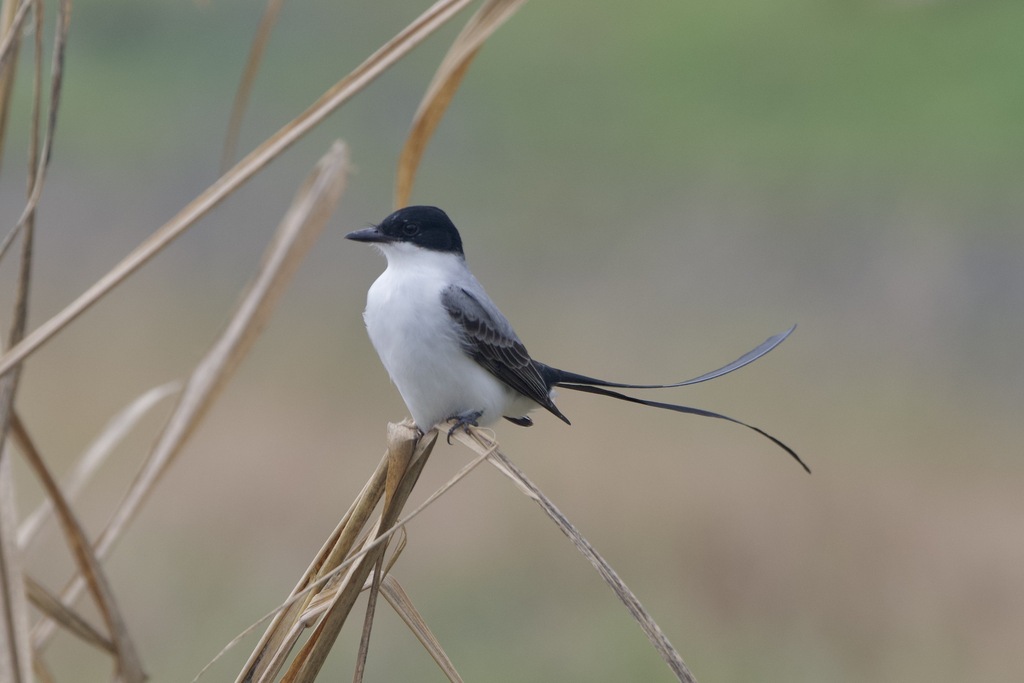
Fork-tailed Flycatcher
Photo © Dario Taraborelli
Photo © Dario Taraborelli — CC0 1.0 — Source: iNaturalist photo #240954312The fork-tailed flycatcher (Tyrannus savana) is a passerine bird of the tyrant flycatcher family and is a member of a genus typically referred to as kingbirds. Named for the long, forked tail, particularly in males, fork-tailed flycatchers are seen in shrubland, savanna, lightly forested and grassland areas, from southern Mexico to Argentina. They are frequently observed on conspicuous perches whence they sally after insect prey. Northern populations near southern Mexico tend to be permanent residents, while fork-tailed flycatchers that live further south are migrants with a reputation for wandering as far north as New Brunswick, Canada. == Taxonomy == The fork-tailed flycatcher was described in 1760 by Mathurin Jacques Brisson under the French name "le tyran à queue fourchue" (lit. 'the fork-tailed tyrant') and then again in 1780 by Georges-Louis Buffon under the name "le savana" (because it lived in savannahs), but it was not until 1802 that François Marie Daudin coined the binomial name Tyrannus savana. The type locality is Suriname. Four subspecies are recognised: Tyrannus savana monachus Hartlaub, 1844 – southern Mexico to Colombia, the Guianas, and northern Brazil Tyrannus savana sanctaemartae (Zimmer, JT, 1937) – northern Colombia and northwest Venezuela Tyrannus savana circumdatus (Zimmer, JT, 1937) – east-central…
Amacayacu National Park
Amazônia National Park
Anavilhanas National Park
Antisana National Park
Araucárias National Park
Barra del Colorado National Wildlife Refuge
Baru Volcano National Park
Brasília National Park
Calilegua National Park
Nothing matches these filters.
No community photos yet. Log in to add the first one.
No community observations of this species yet.