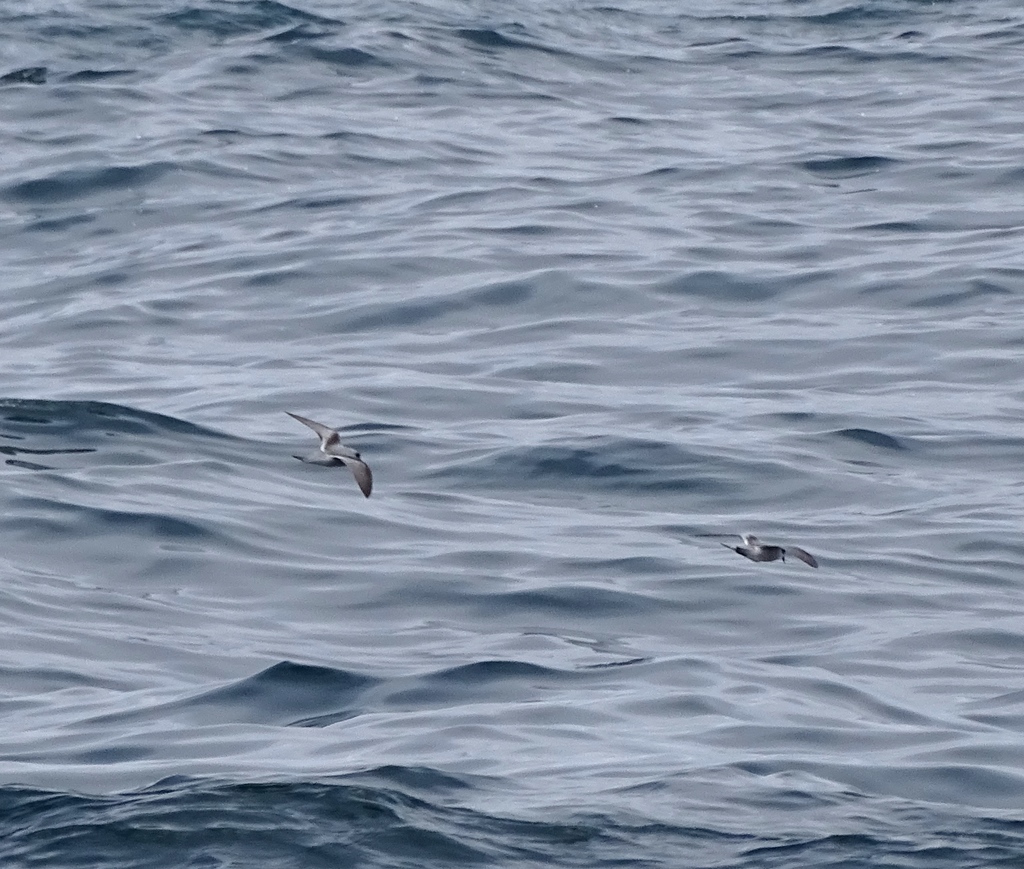
Fork-tailed Storm Petrel
Photo © Sandra Keller
Photo © Sandra Keller — CC BY 4.0 — Source: iNaturalist #85287624Identification
The fork-tailed storm petrel is a small seabird measuring 20 cm in length with a wingspan of 46 cm. Its most distinctive feature is its overall bluish-grey plumage, making it the only bird in its family with this colouration. The species typically has a paler underside that contrasts with the darker colours under its wings, a dark grey forehead, a black ear patch, and a small black bill. Despite its name, the forked tail is not always visible in flight. Other storm petrels are significantly darker; the similar-looking ashy storm petrel, for instance, is considerably more sombre. Southern populations appear somewhat darker than their northern counterparts. Males and females are virtually indistinguishable in colour and size, while juveniles resemble adults except for a less noticeable notch in their tails.
Range & Habitat
The fork-tailed storm petrel is the second-most abundant and widespread storm petrel globally, with an estimated range covering 22,400,000 km² and over 6,000,000 individuals occurring worldwide. During breeding season, they form dense colonies on islands throughout northern California, Oregon, Washington, British Columbia, Alaska, and northeast Asia off the Kamchatka Peninsula, with most of the population concentrated in Alaska, notably in the Bering Sea near the Aleutian Islands. Their southernmost colony is on Little River Rock in Humboldt County. Outside the breeding season, these pelagic birds spend up to eight months over the northern Pacific Ocean, with frequent sightings off the Californian coast during winter and sparse sightings indicating foraging as far south as Hawaii.
Behaviour & Diet
Fork-tailed storm petrels are generally silent birds, calling only when entering their breeding colony at night. Their most common call is a 3- to 5-note, raspy "ana-ana-ana", heard from both sexes and intensifying during courtship, accompanied by elaborate aerial displays. Males also emit a higher-pitched single note call to locate females and maintain pair bonds. The species mainly feeds on planktonic crustaceans, small fish, and squid, foraging by picking food off the water surface while in flight with characteristic short, stiff wingbeats close to the water. They are extremely opportunistic feeders with a well-developed olfactory system, often being the first birds to arrive at food sources and even scavenging on fatty tissue from dead marine mammals and trailing behind fishing boats.
Best Time & Places to See It
For breeding season encounters, visit islands and coastal regions of Alaska, British Columbia, or northern California from late spring through summer, when birds return to their colonies. The Bering Sea near the Aleutian Islands holds the densest populations. If visiting during winter months, the Californian coast offers the best chances of sightings, as fork-tailed storm petrels are the most northerly distributed storm petrel during this season. Birds only return to land to breed in single colonies, nesting in rock crevices or small burrows where a single egg is laid.
Photography Tips
Photographing fork-tailed storm petrels presents considerable challenges due to their pelagic nature and small size. Access to breeding colonies during the breeding season offers the best opportunities, though nesting birds are typically active at night when they call and engage in aerial displays. The distinctive bluish-grey plumage and contrasting paler underside are key identifying features to capture. At sea, their characteristic low, fluttering flight with short wingbeats close to the water surface is diagnostic. Patience and boat-based seabird trips off California or Alaska during appropriate seasons are essential for any serious attempt at photographing this species.
Gulf Islands National Park Reserve
Southern Gulf Islands Electoral Area, Canada
+268 birds+26 mammals
Scattered across the Salish Sea in British Columbia's southwestern corner, this national park reserve stitches together a fragmented archipelago of forested islands and rocky outcrops where…
VIEW NATIONAL PARKKenai Fjords National Park
Kenai Peninsula Borough, United States
+164 birds+19 mammals
Granite peaks and tidewater glaciers dominate Alaska's Kenai Peninsula, where nearly 7,900 square kilometers of pristine coastal wilderness descend from the Harding Icefield toward the Gulf…
VIEW NATIONAL PARKKatmai National Park
Lake and Peninsula Borough, United States
+160 birds+19 mammals
Across southwestern Alaska's Lake and Peninsula Borough, nearly 27,000 square kilometers of subarctic wilderness sprawl between volcanic peaks and coastal wetlands, anchored by the confluence of…
VIEW NATIONAL PARKGlacier Bay National Park
Unorganized Borough, United States
+221 birds+15 mammals
Tidewater glaciers calving into fjords of impossible blue, where temperate rainforest rises steeply from the water's edge and alpine peaks pierce the clouds—this is the ecological…
VIEW NATIONAL PARKRedwood National Park
Humboldt County, United States
+343 birds+43 mammals
Where the Pacific fog rolls deep into northern California's coastal valleys, some of the tallest trees on Earth rise from a landscape shaped by tectonic forces…
VIEW NATIONAL PARKOlympic National Park
Jefferson County, United States
+263 birds+35 mammals
Where temperate rainforest meets alpine wilderness, Olympic National Park sprawls across nearly 11,000 square kilometers of the Pacific Northwest's most pristine landscape. The park's three distinct…
VIEW NATIONAL PARKWrangell-Saint Elias National Park
Unorganized Borough, United States
+155 birds+13 mammals
Where granite peaks thrust above 5,400 metres and vast fields of glacial ice dominate the landscape, Wrangell-Saint Elias encompasses one of North America's most extreme wilderness…
VIEW NATIONAL PARKGwaii Haanas National Park Reserve and Haida Heritage Site
Area E (Moresby Island), Canada
+98 birds+8 mammals
Where temperate rainforest meets the Pacific's edge, the islands of southern Haida Gwaii rise as one of North America's most pristine coastal wilderness areas. Spanning approximately…
VIEW NATIONAL PARKSt. Paul Island
Saint Paul, United States
+255 birds+8 mammals
Windswept tundra rolls across this remote Pribilof island, where volcanic basalt cliffs plunge into the Bering Sea and fog rolls in thick enough to erase the…
VIEW PROTECTED LANDSCAPELake Clark National Park
United States
+158 birds+11 mammals
Where subarctic tundra meets volcanic terrain and pristine waterways, Lake Clark National Park unfolds across southwestern Alaska as a landscape carved by ice age glaciers and…
VIEW NATIONAL PARKKodiak National Wildlife Refuge
United States
+221 birds+22 mammals
Where temperate rainforest meets subarctic coast, Kodiak National Wildlife Refuge sprawls across Alaska's largest island, a sanctuary defined by steep valleys carved by tidewater glaciers and…
VIEW WILDLIFE SANCTUARYKenai National Wildlife Refuge
United States
+152 birds+16 mammals
Across Alaska's Kenai Peninsula, where glacial valleys descend toward the Cook Inlet and the Gulf of Alaska, lies one of North America's most expansive subarctic wildlife…
VIEW WILDLIFE SANCTUARYIzembek National Wildlife Refuge
Cold Bay, United States
+138 birds+9 mammals
Where the Aleutian archipelago reaches westward into the Bering Sea, subarctic tundra and shallow coastal waters converge to create one of Alaska's most ecologically vital wildlife…
VIEW WILDLIFE SANCTUARYFarallon National Wildlife Refuge
San Francisco, United States
+384 birds+16 mammals
Windswept granite peaks rising abruptly from the Pacific, the Farallon Islands form a wildlife sanctuary of extraordinary seabird abundance and ecological significance just twenty-seven miles west…
VIEW WILDLIFE SANCTUARYNo community photos yet. Log in to add the first one.
No community observations of this species yet.