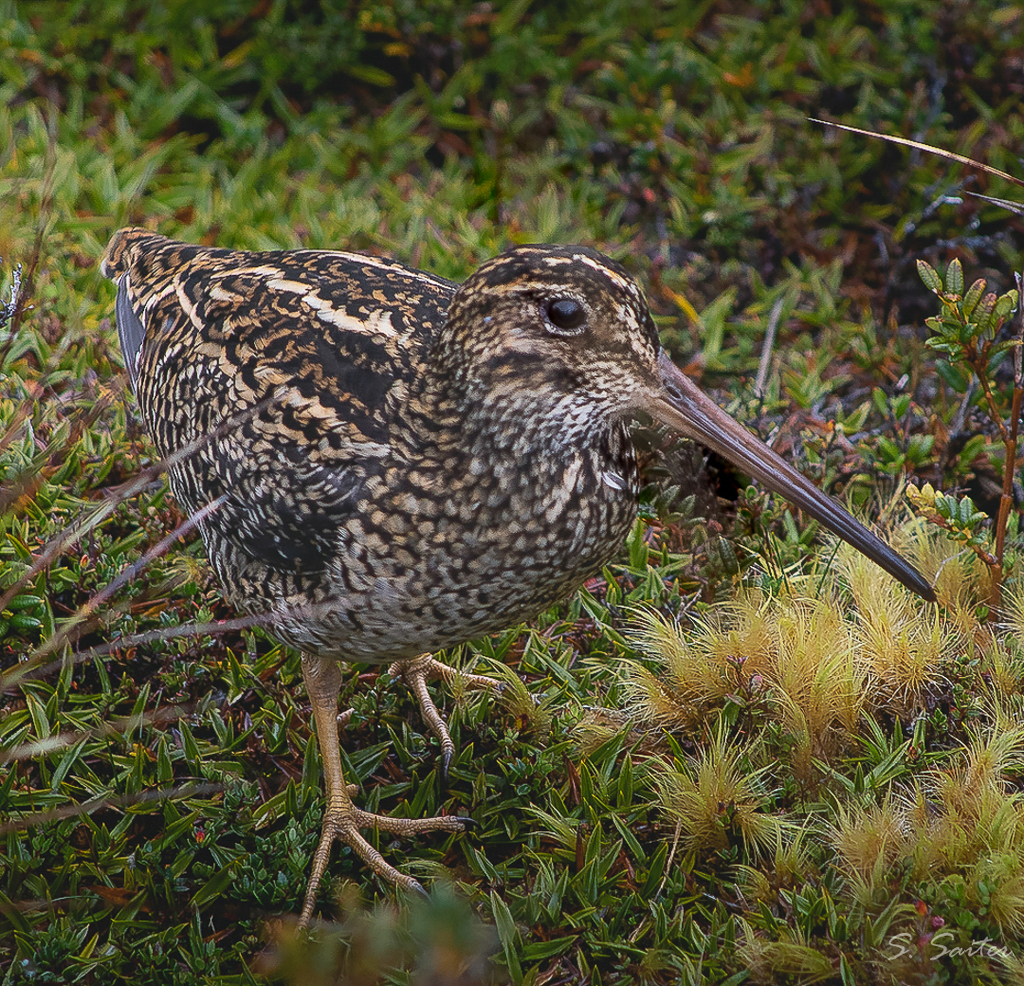
Fuegian Snipe
Photo © Sebastián Saiter V.
Photo © Sebastián Saiter V. — CC BY 4.0 — Source: iNaturalist photo #256094193Identification
The Fuegian snipe is a small, stocky wader measuring 30–32 cm long with relatively short legs for its family. Its upperparts, head, and neck display streaked and patterned dark brown and buff plumage, with golden edges to the feathers forming lines down the back—less sharply defined than in most snipe species. The belly is buff with brown barring on the flanks. The bird has a long, straight, horn-coloured bill of fairly robust build, and yellowish-green legs and feet. The sexes are similar in appearance, while immature birds show pale fringes on the wing coverts.
When comparing with the Magellan snipe, the only other snipe with overlapping range, the Fuegian snipe is noticeably larger and heavier, with a woodcock-like flight on broad wings lacking a white trailing edge. On the ground, it lacks the clear pale stripes visible on its smaller relative. The species produces a distinctive chip-chip-chip call and a sharp, far-carrying char-woo during its display flight.
Range & Habitat
The Fuegian snipe breeds in south-central Chile and Argentina, extending south to Tierra del Fuego. It is mainly sedentary, though the Tierra del Fuego population winters on mainland Chile. The species is sporadically recorded in the Falkland Islands, where breeding has been claimed historically, though documentation remains questionable; recent records are extremely rare, leaving unclear whether these occurrences result from a tiny breeding population or mainland vagrancy.
This snipe inhabits grassy and forested boggy areas with low scrub or rushes, ranging from altitudes of 4,200 m in the northern part of its range down to nearly sea level in Tierra del Fuego, where it also occupies unforested open grass and scrubby areas. The species is common in Tierra del Fuego and decreasingly so farther north.
Behaviour & Diet
Little is documented about the Fuegian snipe's breeding biology, but it performs a striking nocturnal aerial display involving high circling flights followed by powerful stoops. During these stoops, modified outer tail feathers vibrate to produce a distinctive drumming sound, which alternates with the char-woo call. The bird's cryptic plumage provides excellent camouflage when standing motionless among marsh vegetation.
The Fuegian snipe forages by probing its long bill deep into mud and soft ground in search of insects and worms, a typical feeding behaviour for snipes.
Best Time & Places to See It
Tierra del Fuego is the most reliable location for encountering this species, where it is common. The bird can be found throughout its range in suitable boggy and marshy habitats, particularly in grassy areas with low scrub or rushes. The Falkland Islands offer only extremely rare sightings. Given its nocturnal display behaviour, observers may have the best chance of detecting the species by listening for its distinctive calls and drumming sounds during breeding season, particularly in the early morning or evening hours.
Photography Tips
The Fuegian snipe's cryptic plumage makes it challenging to photograph when stationary among marsh vegetation. Patient observers should focus on boggy areas and watch for movement rather than scanning for the bird's outline. The best photographic opportunities may come during the bird's conspicuous nocturnal aerial display, when it is most active and visible against the sky, though capturing these aerial sequences requires preparation and quick reflexes.
When the bird is on the ground, approach slowly and carefully to avoid flushing it. The relatively short-legged, stocky posture and the long, straight bill are key features to capture. Early morning and dusk offer the best lighting conditions and coincide with peak activity periods in its boggy habitats.
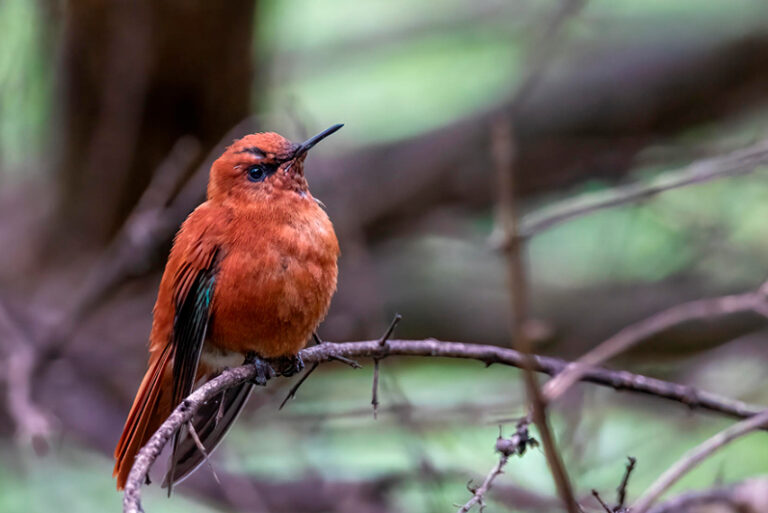
Chile: Fuegian Snipe & Juan Fernandez
Cabo de Hornos National Park
Cape Horn, Chile
+88 birds+9 mammals
Where the Andes plunge into the Southern Ocean and the Drake Passage churns between two continents, Cabo de Hornos National Park sprawls across one of Earth's…
VIEW NATIONAL PARKReserva Nacional Magallanes
Punta Arenas, Chile
+78 birds+2 mammals
Where windswept steppe meets sub-Antarctic forest near the southern tip of continental South America, Reserva Nacional Magallanes unfolds across roughly 352 square kilometres of profound ecological…
VIEW NATIONAL PARKNo community photos yet. Log in to add the first one.
No community observations of this species yet.