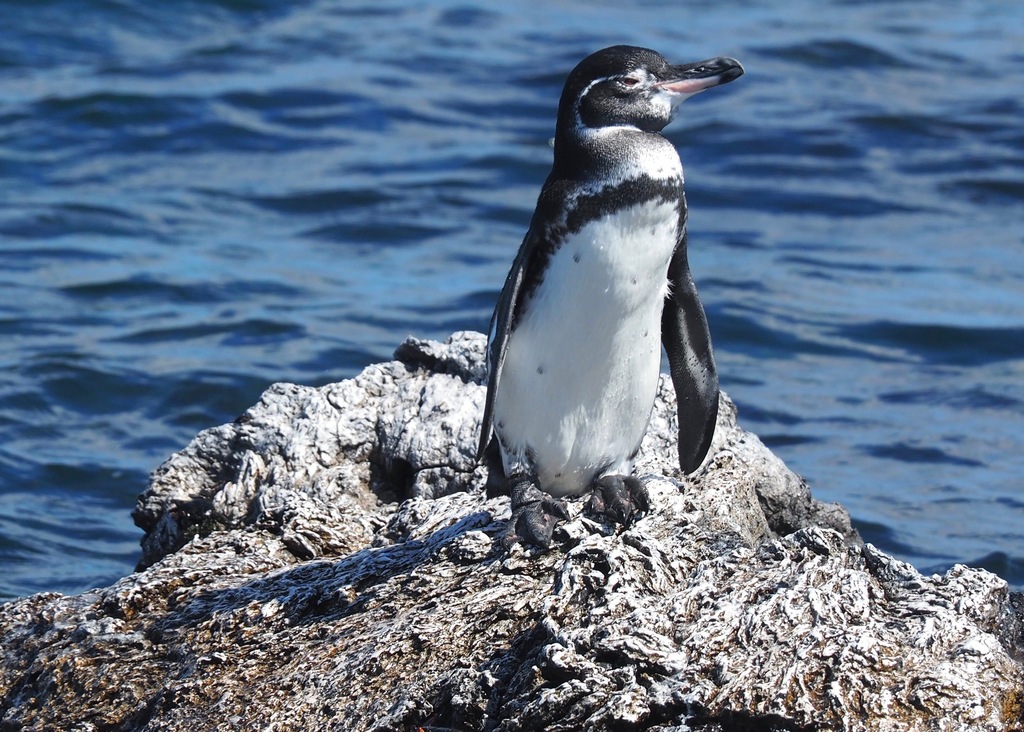
Galapagos Penguin
Photo © John G. Phillips
Photo © John G. Phillips — CC BY 4.0 — Source: iNaturalist photo #50207140Identification
The Galápagos penguin is the second-smallest penguin species, standing 48–50 centimetres tall and weighing 2–4 kilograms, with females generally smaller than males. Adults are unmistakable: a black head with a distinctive white border running from behind the eye, around the ear coverts and chin, to the throat. Two black bands cross the breast and connect to the back, with the lower band extending down the flanks to the thigh. The beak is black on top, fading to pink below. Juveniles are darker overall, with a wholly dark head and greyish sides and chin, lacking the distinctive breast bands of adults.
Range & Habitat
Endemic to the Galápagos Islands of Ecuador, the Galápagos penguin is the only penguin species found north of the equator. Approximately 90% of the population inhabits Fernandina Island and the west coast of Isabela Island, with smaller populations on Santiago, Bartolomé, northern Santa Cruz, and Floreana. The cool waters of the Humboldt and Cromwell Currents enable these tropical penguins to survive despite their equatorial latitude, providing the nutrient-rich conditions essential for their food supply.
Behaviour & Diet
Galápagos penguins forage during the day in cool currents and return to land at night, typically ranging only a few kilometres from breeding sites. They feed on small schooling fish—mainly mullet, sardines, pilchards, and anchovies—and occasionally crustaceans, playing an important role in regulating marine populations. Living in a tropical environment where air temperatures range from 15–28°C, they have evolved remarkable thermoregulation strategies: stretching their flippers and hunching to shield their feet from the sun, and panting to cool their throat and airways. Breeding patterns are closely tied to climate; during El Niño events, when food becomes scarce, birds typically defer breeding. The species is monogamous, with pairs mating for life and nesting in deep volcanic caves and crevices that provide protection from intense sun and predators.
Best Time & Places to See It
The best viewing opportunities are on Fernandina Island and the west coast of Isabela Island, where 90% of the population occurs. Breeding season peaks between May and July, when climate conditions and food availability are typically optimal, making this the most productive time for observation. The volcanic landscape and coastal areas near the cool currents offer the best chances of encountering these penguins as they return from daytime foraging.
Photography Tips
The striking contrast between black upperparts and white underparts, combined with the distinctive facial markings, makes these penguins photogenic subjects. Photograph them entering or leaving the water during early morning or late afternoon light to capture their sleek form and the beautiful interplay of their white and black plumage. In caves and crevices where they nest, use available natural light carefully to avoid harsh shadows while respecting their breeding sites. Their small size and coastal habitat mean wide-angle shots showing them in their dramatic volcanic environment can be particularly effective.
No community photos yet. Log in to add the first one.
No community observations of this species yet.