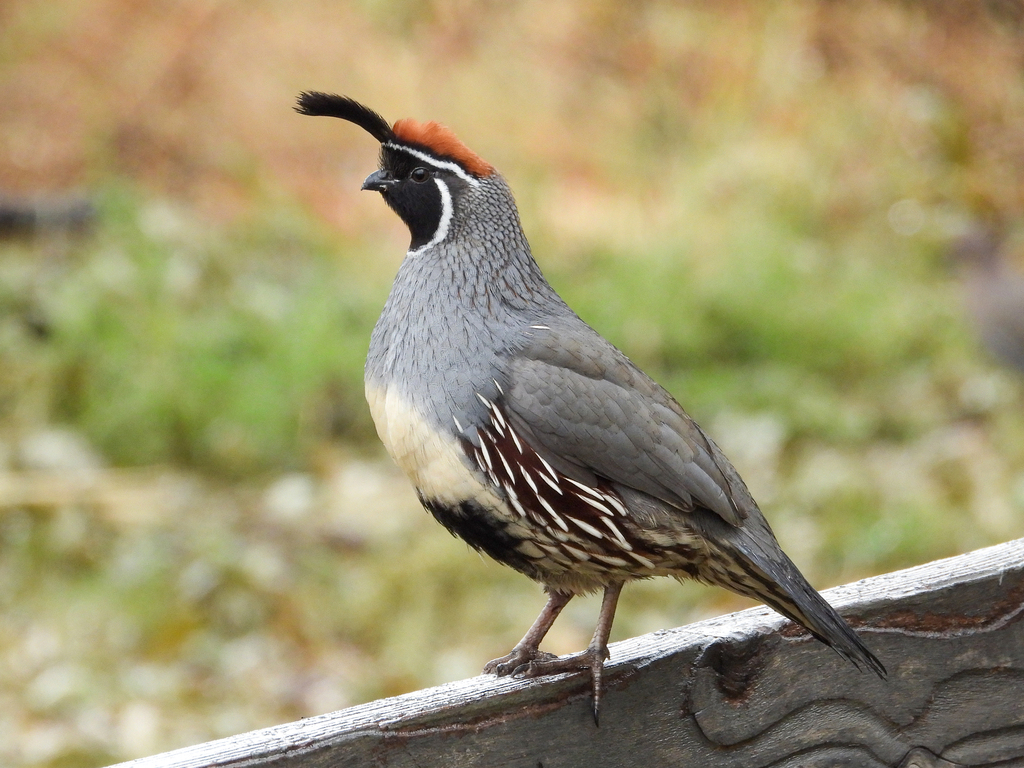
Gambel’s Quail
Photo © James M. Maley
Photo © James M. Maley — CC BY 4.0 — Source: iNaturalist photo #246498800Identification
Gambel's quail is a compact ground-dwelling bird easily recognized by its distinctive top knot and scaly underside plumage. Males are particularly striking, featuring bluish-gray bodies with copper feathers crowning the head, bold black faces, and crisp white eye stripes. Females are more subdued in coloration. These small quail average 11 inches (28 cm) in length with a wingspan of 14–16 inches (36–41 cm), equipped with relatively short, rounded wings and characteristically long, featherless legs built for swift ground movement.
Gambel's quail can be easily confused with the closely related California quail, with which it shares a common ancestor from 1 to 2 million years ago. The most reliable distinguishing feature is range, but when the two species' territories overlap, look for the black patch on the lower breast of male Gambel's quail—a marking absent in California quail. California quail also display a more scaly overall appearance.
Range & Habitat
This species is endemic to arid desert regions of the southwestern United States and northwestern Mexico. Its range encompasses Arizona, California, Colorado, New Mexico, Nevada, Utah, Texas, and Sonora, extending into New Mexico-border Chihuahua and the Colorado River region of Baja California. The species has been introduced beyond its native range, most notably on San Clemente Island, where a population established in 1912 remains today.
Behaviour & Diet
Gambel's quail are predominantly terrestrial birds that prefer walking to flying, moving with surprising speed through brush and undergrowth despite their short, rounded wings. Flight is rare and characteristically explosive—a burst of rapid wingbeats followed by a gliding descent to the ground. As a non-migratory species, populations remain year-round in their territories.
These quail are highly social outside the breeding season, congregating into coveys during late summer, fall, and winter. Come spring, they pair off for breeding and become aggressively territorial. Females typically lay 10–12 eggs in simple scrapes concealed in vegetation, with incubation lasting 21–23 days. Chicks are precocial, leaving the nest within hours of hatching. Interestingly, chicks consume more insects than adults, gradually shifting to a primarily seed and plant-based diet as they mature.
Best Time & Places to See It
Gambel's quail are most conspicuous during early morning hours in desert scrublands throughout their range. The best viewing opportunities occur in spring and early summer when birds are more active and vocal during breeding season. Winter and fall coveys can number many birds, increasing your chances of sightings, particularly in brushy desert habitat typical of Arizona, southern California, and Nevada.
Photography Tips
Photograph Gambel's quail during dawn hours when lighting is optimal and birds are most active. Focus on capturing the distinctive male plumage—the striking black face, white eye stripe, and copper crown are key identifying features. Since these birds are ground-dwellers that rarely take flight, position yourself low to anticipate their movement through brush. The explosive, short flights they occasionally make offer dynamic shooting opportunities for patient photographers.
Big Bend National Park
Brewster County, United States
+345 birds+34 mammals
Where the Chisos Mountains rise abruptly from the Sonoran Desert floor, Big Bend National Park spans over 7,300 square kilometers of one of North America's most…
VIEW NATIONAL PARKCanyonlands National Park
Wayne County, United States
+186 birds+15 mammals
Where the Colorado River has carved an intricate labyrinth through the high desert plateau of southeastern Utah, Canyonlands National Park sprawls across nearly 3,030 square kilometres…
VIEW NATIONAL PARKSaguaro National Park
Rincon Valley, United States
+354 birds+40 mammals
Where the Sonoran Desert meets sky-island mountains, two geographically separated districts of Saguaro National Park sprawl across nearly two thousand square kilometers of Arizona's most iconic…
VIEW NATIONAL PARKJoshua Tree National Park
Riverside County, United States
+221 birds+23 mammals
Across 5,610 square kilometers of Riverside County's high desert, a landscape of geological drama unfolds where granite monoliths pierce through bajadas of creosote scrub and Joshua…
VIEW NATIONAL PARKZion National Park
Washington County, United States
+244 birds+30 mammals
Towering sandstone cliffs in shades of crimson, rust, and cream rise abruptly from the Virgin River's winding canyon floor, their sculpted faces bearing witness to millions…
VIEW NATIONAL PARKMesa Verde National Park
Montezuma County, United States
+166 birds+10 mammals
Across the high desert plateau of southwestern Colorado, where sandstone mesas rise abruptly from piñon-juniper scrubland, Mesa Verde National Park preserves one of North America's most…
VIEW NATIONAL PARKCapitol Reef National Park
Garfield County, United States
+196 birds+22 mammals
Wrinkled ridges of crimson and gold sandstone rise from the floor of south-central Utah, their weathered faces carved by the Fremont River into one of the…
VIEW NATIONAL PARKHawaiʻi Volcanoes National Park
Hawaiʻi County, United States
+84 birds+2 mammals
Where volcanic slopes descend toward the Pacific across more than five thousand square kilometers, Hawaiʻi Volcanoes National Park presents one of Earth's most dynamic laboratories of…
VIEW NATIONAL PARKBlack Canyon of the Gunnison National Park
Montrose County, United States
+169 birds+13 mammals
Where the Gunnison River has carved one of North America's steepest and most dramatic canyons, ancient metamorphic rock walls plunge nearly 2,000 feet in places, creating…
VIEW NATIONAL PARKDeath Valley National Park
Inyo County, United States
+339 birds+25 mammals
Across nearly 3.5 million acres of southeastern California's Inyo County, vast salt flats meet sculpted badlands and alluvial fans in a landscape so extreme it defines…
VIEW NATIONAL PARKGrand Canyon National Park
United States
+277 birds+35 mammals
A mile-deep chasm of rust-red rock and purple shadow cuts through the high desert plateau of northern Arizona, revealing nearly two billion years of geological history…
VIEW NATIONAL PARKGuadalupe Mountains National Park
Culberson County, United States
+262 birds+14 mammals
Where fossil-laden limestone ridges thrust skyward above the Chihuahuan Desert floor, Guadalupe Mountains National Park reveals a landscape sculpted by ancient seas and relentless aridity. These…
VIEW NATIONAL PARKPetrified Forest National Park
Apache County, United States
+206 birds+23 mammals
Across the high desert plateau of northeastern Arizona, where the climate swings between scorching summer days and frost-laden winters, badlands of raw earth and timber-turned-to-stone dominate…
VIEW NATIONAL PARKWhite Sands National Park
Otero County, United States
+178 birds+6 mammals
Across the Tularosa Basin in south-central New Mexico sprawls an otherworldly landscape of gypsum dunes—the largest gypsum field on Earth and a stark desert playground shaped…
VIEW NATIONAL PARKBosque del Apache National Wildlife Refuge
Socorro County, United States
+345 birds+17 mammals
Where the Rio Grande emerges from its desert canyon in central New Mexico, a narrow ribbon of riparian woodland defies the arid landscape that surrounds it.…
VIEW WILDLIFE SANCTUARYCabeza Prieta National Wildlife Refuge
United States
+155 birds+6 mammals
Across southwestern Arizona's harshest terrain, where the Colorado River marks the border with Mexico, lies a sanctuary shaped entirely by heat and aridity. Cabeza Prieta National…
VIEW WILDLIFE SANCTUARYKofa National Wildlife Refuge
Yuma County, United States
+142 birds+10 mammals
Desert mountains rise in sculptured ridges across northwestern Arizona, where the Colorado River's distant influence fades into some of the most austere terrain in the American…
VIEW WILDLIFE SANCTUARYHavasu National Wildlife Refuge
Lake Havasu City, United States
+291 birds+8 mammals
Where the Colorado River widens into a vast reservoir in the Sonoran Desert, Havasu National Wildlife Sanctuary protects one of the most critical wetland ecosystems in…
VIEW WILDLIFE SANCTUARYImperial National Wildlife Refuge
La Paz County, United States
+222 birds+4 mammals
Where the Colorado River carves through the Sonoran Desert in southwestern Arizona, Imperial National Wildlife Sanctuary unfolds across a landscape shaped by water and aridity. The…
VIEW WILDLIFE SANCTUARYSalton Sea National Wildlife Refuge
Imperial County, United States
+289 birds+4 mammals
Across the floor of California's inland desert, where summer temperatures soar and rainfall is measured in tenths of inches, lies an improbable oasis of shallow water…
VIEW WILDLIFE SANCTUARYNo community photos yet. Log in to add the first one.
No community observations of this species yet.